

The 10-year hit 5.12%, WTI rose 2.33%, and September pipeline restart odds fell to 52%.
Wednesday took back the relief trade.
The Nasdaq fell 1.13%, a day after a record close. The S&P 500 lost 0.75%. The Dow dropped 352 points, or 0.68%. The VIX rose 6.83% to 15.18.
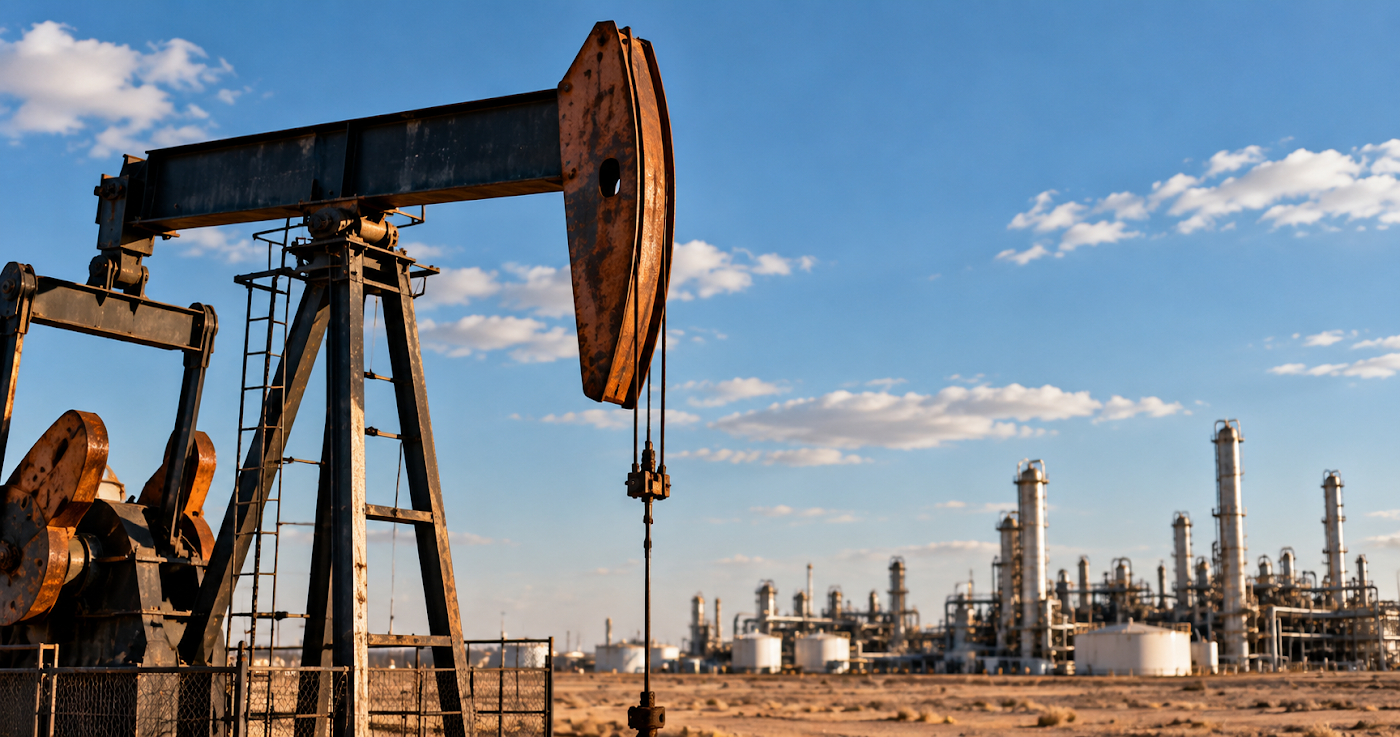
Oil rose 2.33% to $92.63. The 10-year jumped more than 14.6 basis points to 5.12%. Gold fell 1.2%, and the dollar jumped on rate hike expectations.
The morning letter asked whether lower oil would finally reach rates. By the close, the answer was no. Yields jumped after hot business data and a hawkish Fed governor. Crude bounced as Libya lost its largest oil field and Iran's president turned defiant.
The screen lost its relief. The path got harder.
There's a Strategy Behind the Iran War.
I know because I've seen the evidence firsthand.
On March 2nd — three days after the first missiles hit — I sat across from two U.S. Congressmen in back-to-back private meetings.
Those meetings pointed me toward something I spent weeks verifying.
The real purpose behind the strikes. The real objective. And the single company at the dead center of all of it.
This isn't random. It's a calculated Two-Front Economic War.
And there's one company positioned right at the heart of it.
See the strategy behind the Iran war — and the company at the center of it
The sooner you understand what's really happening — the better positioned you'll be before
— Dylan Jovine, Founder, Behind the Markets
The bond market stopped accepting the oil story. For two sessions, lower crude was a reason to buy risk. Wednesday broke that link.
The 10-year touched about 5.12%, its highest since July 2007. It followed a flash survey showing the fastest business growth in five years and the steepest cost rise in four. Minutes later, Fed Governor Michael Barr said more policy moves are likely needed.
Equities can absorb lower oil with a higher multiple, but not lower oil plus a higher discount rate. A 10-year above 5% presses on mortgages, credit, banks and long-duration tech.
Fed funds futures lifted October hike odds to about 70%, from about 55% a day earlier. Polymarket's October contract still sat at 54% by early afternoon.
The longer books lean hawkish. Two Fed hikes in 2026 sit at 64%, three at 21.7% and one at 14%. The 10-year touching 5.2% before 2027 sits at 78%, with 5.5% at 20% and 5.7% at 8%.
The Discount-Rate Turn
Lower crude used to be enough to lift the tape. Hot growth data now outranks oil relief in the rate market. Every oil dip has to fight a higher discount rate, so equity bounces need the bond market's permission.
Oil bounced as diplomacy stopped looking clean.
On Tuesday, a senior Iranian official said Tehran could reopen Hormuz within seven days. The U.S. would need to ease military pressure and lift its naval blockade. Crude slid after that offer.
On Wednesday, Iranian President Masoud Pezeshkian told the U.N. his country would "never bow." The U.S. delegation walked out, and he repeated the same Hormuz terms.
An armed group shut the pipeline from El Sharara, Libya's largest oil field. Libya's state oil company warned it may declare force majeure.
Polymarket prices WTI hitting $95 in September at 71%, $100 at 27% and $105 at 10%. The downside is live too, with a dip to $90 at 79% and below $85 at 26%.
The Two-Sided Barrel
Talks pull crude down while outages push it back up. Both forces hit on the same day, which keeps both tails of the WTI book alive. The market is pricing a range, not a straight line, and relief stays reversible until one force clears.
Free Stock Pick: The Company First in Line
for America’s New Super Fuel
The U.S. Army and Department of Energy are about to flip the switch on a revolutionary new fuel — and one obscure defense contractor has a five-year head start on every competitor.
This joint, high-priority initiative — ordered by President Trump — is called Project Janus.
And the first powerplant to run this new fuel is expected to go live before December 18, 2026…
When it does, this company’s name will be everywhere.
Full details — including the name and ticker symbol — are being revealed for free.
Click HERE to get the stock name, ticker, and the full Project Janus story for free.
The route books weakened while the gas books stayed firm.
Saudi Arabia has restarted the East-West pipeline in phases, with full capacity about six weeks away. The contracts still price short of certainty because they resolve on a Saudi government statement, not on reporting, and partial operation only counts if Riyadh says so in the present tense. September 30 fell to 52%, October 31 slipped to 79%, and a thin October 15 market sits at 66%.
Kalshi prices Hormuz traffic returning to normal by October 31 at 8%, November 30 at 13%. It prices U.S. gas above $4.46 this week at 70%, above $4.48 at 48% and above $4.50 at 11%.
Energy Secretary Chris Wright said a diesel export ban "definitely doesn't work." He pointed to voluntary limits a day after President Trump backed the idea. A ban by September 30 sits at 15%, and by October 31 at 35%.
The Household Lag
Crude sets the headline, but routes and pump prices decide whether relief reaches households. The pipeline is moving again and its contracts still price delay, partly because they settle on an announcement rather than a flow. That slower chain keeps inflation risk alive even when the barrel eases.
All seven Senate Banking Democrats asked Chairman Tim Scott for a public hearing on prediction markets.
Their letter came the day Republican members met privately with Kalshi CEO Tarek Mansour. It stressed investor protection and products tied to company metrics.
CFTC Chairman Michael Selig promised "zero tolerance" for wash trading. He called mention contracts "concerning" and said margin would go only to tightly screened traders.
Kalshi is defending its ether perpetual market. One analysis found $5,500 trades made up over a third of its volume. One researcher's data put daily volume near 174 times open interest. Kalshi credits its liquidity program. It says the CFTC has not contacted it, after a Wall Street Journal report of an agency review.
Bloomberg reports Susquehanna's prediction-markets team has grown to about 80 people. It also launched a student contest with simulated midterm contracts.
The Rulebook Premium
Prediction markets are adding the tools of mature derivatives venues. Margin, perpetuals and company-metric contracts draw heavier oversight than election odds. Growth and scrutiny now arrive on the same schedule.
FREE Gold Ticker to Buy ASAP: (NYSE:___)
Jim Rickards – the world’s #1 gold expert – has just revealed one of his favorite gold plays… 100% FREE

As Jim sees it, we’re witnessing the biggest gold boom of the last 100 years – and those who keep their money on the sidelines are missing their chance at a fortune thanks to gold’s epic run.
But smart investors who get in now, could make 10X their money in the coming months.
Three books priced the same Wednesday and two of them agreed.
Fed funds futures moved October from 55% to 70% within hours of the flash survey. The 10-year moved 14 basis points to a 2007 high. Both read the growth data as a rate problem.
Polymarket's October contract didn't move. It sat at 54% while futures repriced around it.
That's a 16-point gap on one question, on a day with a clean catalyst and a published number. Either the contract is slow, or its traders read the same survey and saw less in it.
The Uneven Repricing
Markets did not reprice Wednesday's news at one speed. A futures curve reprices when the math changes, while an event contract reprices when someone decides to trade it. That difference is not noise, it is a gap with a settlement date attached. The first market to close it will show which read was stale.
Wednesday answered the morning with a reversal.
Oil did not keep falling. The 10-year did not stay calm. The Nasdaq fell from a record, the Dow fell, and the VIX rose.
What is priced: 5.2% on the 10-year at 78%, $95 WTI in September at 71%, September 30 restart at 52%, and gas above $4.46 at 70%.
What is not priced: whether the 10-year holds above 5.1%, how long Libya's outage lasts, or whether oversight slows new products.
The relief trade lost its link. The bond market took control.
Capital moves early. Coverage catches up. The gap between the two is worth watching.
3 STOCKS OUR SIGNAL ENGINE SAYS TO WATCH CAREFULLY
Three stocks. Three signals. Two weeks later, the story changed.
On September 2, we published three market questions around KLAC, HPE and PG&E.
Two weeks later, every one of them produced new evidence.
One company delivered record revenue and raised its outlook.
Another saw weakness spread across its entire peer group.
And in the third, a market risk that had only been showing up beneath the surface suddenly became explicit.
Yet none of these stories is finished.
That’s why we built Market Tell.
To track the signals that keep moving after the headline is gone — and show you what investors should be watching next.
We’ve put the latest analysis into a new FREE Special Report:
3 Stocks at a Major Turning Point
See what changed… what still hasn’t been resolved… and the signals we’re watching now.