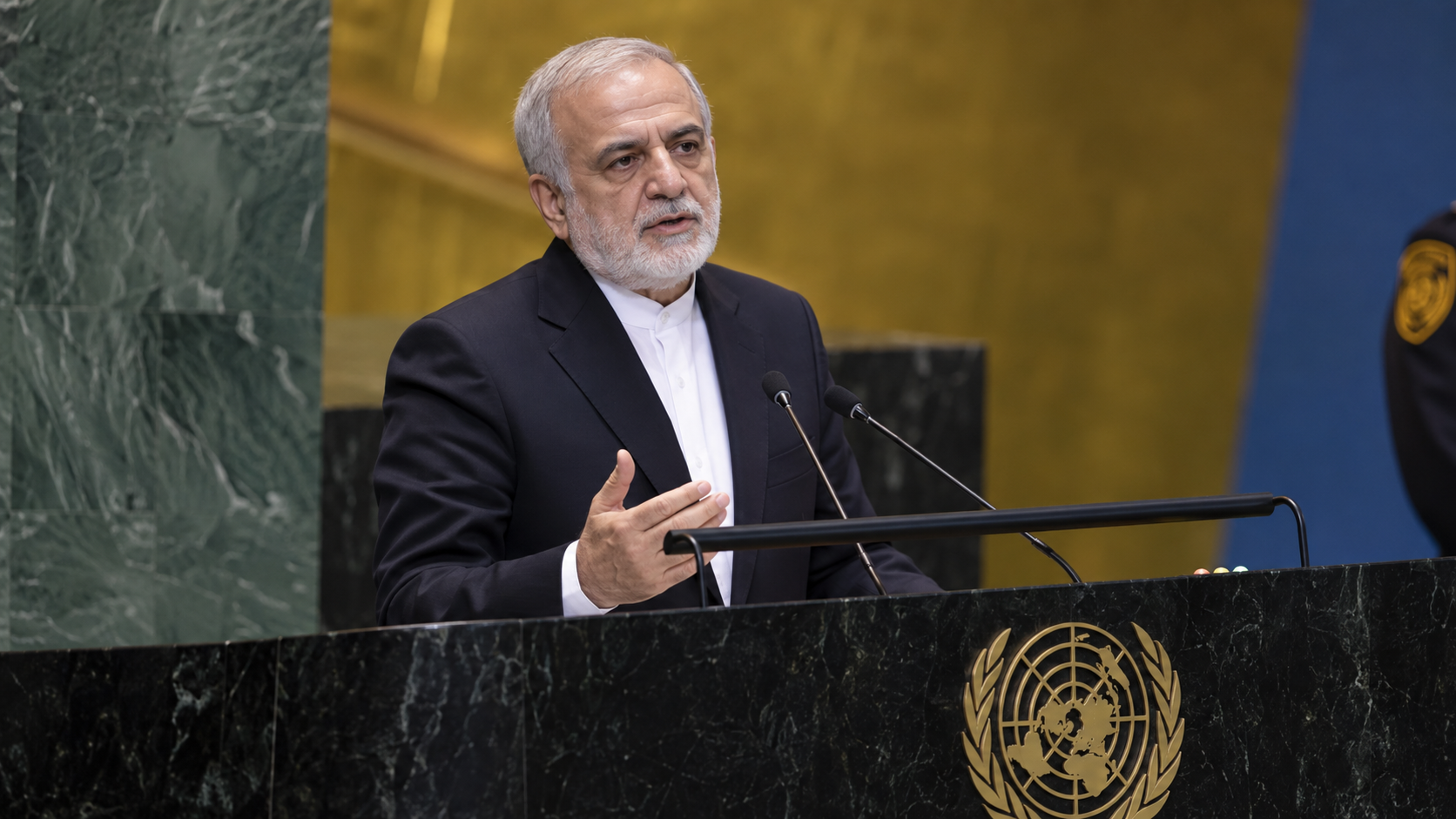
The U.S. delegation walked out as Masoud Pezeshkian began speaking. His condition for reopening the Strait of Hormuz matched what Tehran had already put on the table in private.
On Tuesday, President Trump described a three-hour meeting between his envoys and Iran's foreign minister as "a very good meeting." On Wednesday, Iran's president stood in front of the United Nations General Assembly and struck a very different tone.
"We will never bow our head or bend at the knee," Iranian President Masoud Pezeshkian told the assembly's 81st session. The U.S. delegation walked out as he began to speak.
Pezeshkian argued that sanctions and military pressure would harden rather than weaken Iranian resistance. He said Iran "has never ever been an aggressor, has never started a war," and displayed images he described as civilians killed in the conflict, along with an image of the country's former supreme leader. "We proved that we're not afraid of fighting," he said.
Inside the defiance sat a familiar offer. Pezeshkian said Iran could reopen the Strait of Hormuz if the United States eased its military pressure and lifted its naval blockade. That tracks the conditions Tehran has already laid out for reopening the waterway: an end to the blockade along Iran's southern coast, the release of Iranian assets frozen abroad, and an end to hostilities on all fronts.
The contrast with the private channel is sharp. Special Envoy Steve Witkoff and senior adviser Jared Kushner met Foreign Minister Abbas Araghchi on Tuesday on the sidelines of the General Assembly, with Qatar mediating. Witkoff wrote afterward that the two sides were in talks through mediators whose discussions "we hope will prove constructive and promising." In the same set of remarks in which he praised the meeting, Trump said he faced a "big decision" between a deal with Tehran and moving to "annihilate" the country.
That leaves two ways to read the week. In one, the private meeting is the working negotiation, and a defiant address to a global audience does not change its terms. Pezeshkian's speech is consistent with that reading, since it paired defiance with a stated path to reopening Hormuz. In the other, the public register matters, and a walkout and casualty imagery a day after the talks point to more distance between the two sides than Tuesday's language implied.
Oil traders have been living inside that gap all week. Brent crude slipped below $100 overnight on Tuesday after the talks and was trading back above $101 by Wednesday afternoon, on a day that also brought a new supply disruption in Libya.
The next data points are close. Trump has said another meeting is expected "in the very near future." Chinese President Xi Jinping meets Trump in Washington on Thursday, with Iran on the agenda alongside trade, rare earths, artificial intelligence and Taiwan. Whether a second U.S.-Iran session is scheduled, and whether either side moves on the blockade, will show which of this week's two registers is the one being negotiated in.