

At 1:47 p.m. on Sunday, Polymarket priced Flávio Bolsonaro's chances of becoming Brazil's president at 81.4 cents. About six hours later, Brazil's electoral court declared Lula da Silva the winner by 4.4 million votes. By this morning, the biggest U.S.-listed Brazil fund was indicated about 25% lower, more than twice the 11.5% it had gained after the first round. The election produced the surprise. The selloff is telling you how crowded the trade had become.
But before we get to that, let's take a quick look at the markets and what matters today…
3 Movers in 3 Minutes
1. Musk says SpaceX got its $40 billion, and the neoclouds can't. Elon Musk said Sunday that SpaceX (SPCX) had closed $40 billion of debt financing for AI chips. People familiar with the talks told Bloomberg that pricing was still being negotiated. In the same post he wrote that "debt markets have almost entirely shut off access to money" for companies without substantial revenue outside AI data centers, and that more than 200 neoclouds face "guppy-level death and consolidation." No lenders or terms were disclosed. CoreWeave (CRWV) was indicated about 3% lower premarket, below its 52-week low, and Nebius (NBIS) about 1%. This is a rival's opinion, not a filing. But it lands in a month when protection on CoreWeave's debt has traded above 1,000 basis points a year. AI capital is splitting into borrowers with another business to lean on and borrowers without one.
2. Verizon answered the SpaceX question with subscribers. Verizon (VZ) added 406,000 postpaid phone lines in the third quarter, its strongest third quarter in five years and nearly double the roughly 209,000 analysts expected, per Reuters. It raised its full-year target to 1.1 million to 1.2 million additions and lifted its earnings outlook, though revenue of $34.3 billion missed. The stock jumped as much as 3% in early premarket trading, then gave nearly all of it back. On Friday, AT&T (T) and T-Mobile (TMUS) lost about $25 billion of market value on a report that SpaceX wants 80,000 cell sites. The first carrier to report since Friday's cell-site story says customers are still arriving. The 8:30 a.m. call will show whether management takes the fourth-carrier question head on.
3. A hospital system may buy control of Surgery Partners for less than Bain once offered. The Financial Times reported that Bon Secours Mercy Health, a nonprofit health system, is in late-stage talks to buy a majority stake in Surgery Partners (SGRY) at about $20 a share, valuing it near $6 billion including debt, with Bain Capital keeping its roughly 40% stake. Nothing is confirmed. The shares were indicated about 24% higher premarket. The number underneath: Bain itself offered $25.75 a share in January 2025, and an independent committee ended talks that June. Twenty dollars is about 22% below that. With buyout financing getting pricier by the week, the sponsor is not cashing out. It is staying in and letting a strategic buyer write the check.
3 Signals for Today
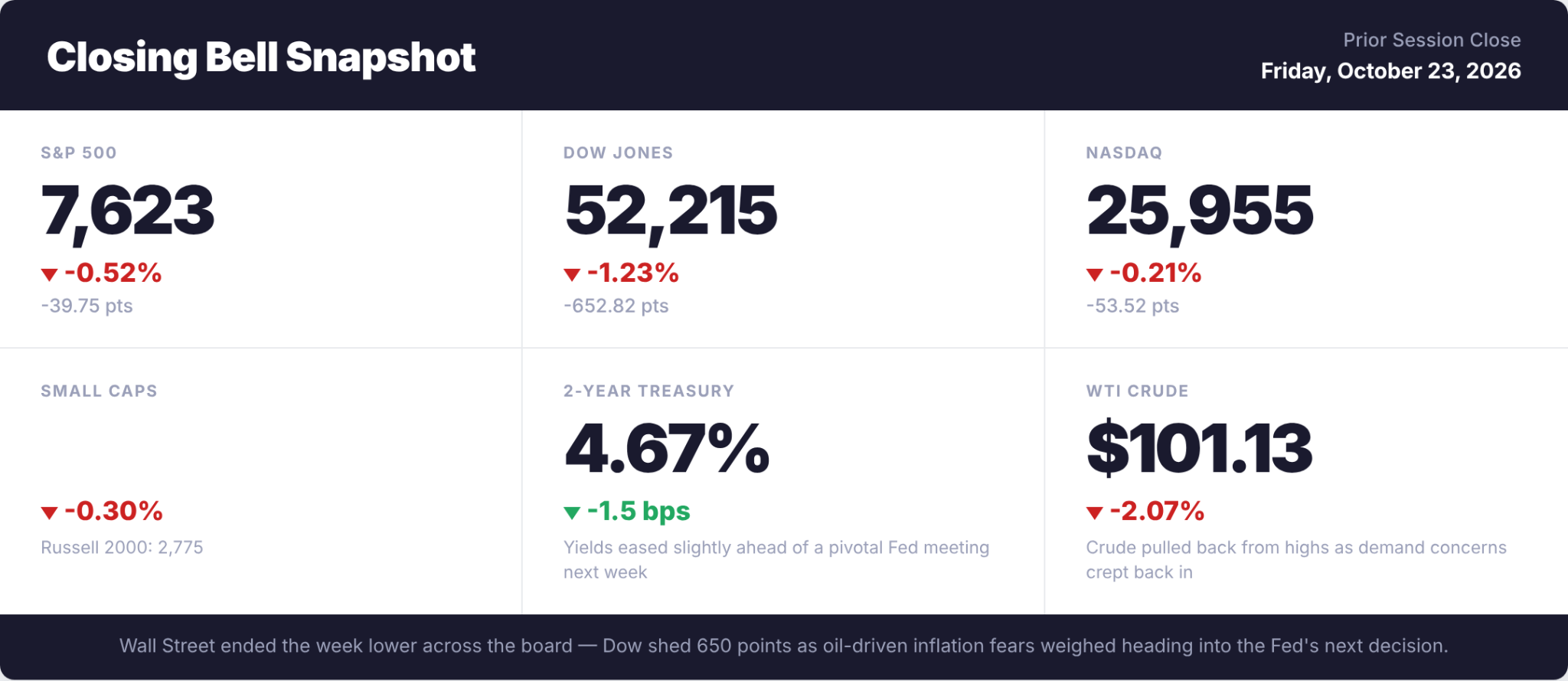
Tehran's table, and $115 oil. Delegations from Saudi Arabia, Pakistan and Turkey are in Tehran today for talks aimed at averting renewed fighting. Brent traded near $115 early, about 1.5% below Friday's settle, and Polymarket priced about a 6.5% chance of a qualifying U.S. strike on Iran by Oct. 28. Pulling the other way, Iran's foreign minister said Sunday that Hormuz will not "be managed as it was in the past," Mehr reported. A constructive readout tests how much of $115 is strike risk and how much is a Hormuz premium that diplomacy can't remove. A failed one hands the Fed its oil problem back two days before its decision.
$69 billion of two-year notes, sold into Fed week. Treasury auctions $69 billion of two-year notes this afternoon, the maturity that sits closest to the Fed's next moves. Kalshi prices an October hike at about 6% and a December hike near 79%. Soft demand would say buyers want more pay to sit through a hawkish pause. Strong demand would back the bond market's recent read that oil is a growth risk before it is an inflation one.
Bitcoin below what the ETF buyer paid. Bitcoin traded near $80,300 this morning, below the roughly $81,300 average cost that Coinbase's institutional research team estimates for spot ETF buyers. The funds lost about $773.5 million on Oct. 22 and 23, by preliminary counts, and Coinbase and Strategy both report Thursday. Another outflow day with the average holder underwater would say the ETF bid is less patient than it looks; Coinbase's team wrote on Oct. 23 that a sustained break below $80,000 to $82,000 could expose $73,000 to $75,000. Inflows with price back above $81,300 would say the dip was bought.
Investing In The Titans of AI

Carnegie didn't invent steel. He used new technology to produce it cheaper and faster than anyone on Earth.
Rockefeller didn't discover oil. He used industrial machinery to refine it more efficiently.
Vanderbilt didn't build the railroad. He understood that whoever controlled the infrastructure controlled the economy.
Their combined fortunes were between $700 billion and $1 trillion.
Best-selling financial author Alexander Green has identified three companies positioned to be the Titans of the AI age.
CLICK HERE TO FIND OUT WHO THEY ARE BEFORE THE WINDOW CLOSES
And with that out of the way, let's get to today's big story: how a trade built on one Brazilian election result met the other one.
The Sip
Eighty-Two Cents at Lunchtime
At 1:47 p.m. Eastern on Sunday, Polymarket's contract on a Flávio Bolsonaro victory traded at 81.4 cents. Kalshi's version sat near 82. Brazilians were still voting.
By 8:08 p.m., Brazil's Superior Electoral Court had declared Luiz Inácio Lula da Silva reelected, 51.8% to 48.2%, a margin of roughly 4.4 million votes. Both contracts collapsed to fractions of a cent. Lula had lost the first round three weeks earlier. No candidate had come back from that since Brazil's return to democracy.
Flávio has refused to concede and says he will seek to annul the result, citing a Supreme Court justice's order extending voting by two hours. Mario Braga, a Latin America analyst at the risk consultancy RANE, called a reversal "very improbable."
It is tempting to say the markets got it wrong. That is the wrong lesson. An 82-cent price says the other outcome happens about one time in five. Sunday was that time. The more useful question is what had been built on top of the 82 cents.
The Trade the First Round Built
When Flávio finished first on Oct. 4, with 47.03% of valid votes to Lula's 45.16%, investors read it as a vote for fiscal austerity. The Ibovespa rallied 7.7% on the first trading day after.
By Friday, Brazilian stocks were almost 7% above their level going into the first round, and the real was nearly 5% stronger against the dollar, according to Reuters. Interest-rate futures had begun pricing lower borrowing costs on the assumption that a new government would tighten public finances. The iShares MSCI Brazil ETF (EWZ) closed Friday at $42.59, within about 3% of its 52-week high.
That is a lot of conviction resting on a race the final polls called a tie. Datafolha and Quaest both had it at 51% to 49% in valid votes, inside their margins of error.
Eleven Up, Twenty-Five Down
The unwind started in Asia. November futures on the real fell 10% in Asian hours, and a Tokyo-listed Ibovespa fund dropped 15%, Reuters reported.
In U.S. premarket trading this morning, EWZ was indicated near $31.80, about 25% below Friday's close. Petrobras (PBR) was down about 21%, Itaú Unibanco (ITUB) about 26%, and Nu Holdings (NU) about 27%. MercadoLibre (MELI), which sells across Latin America, was off a milder 15%.
The arithmetic is the story. In dollars, EWZ gained about 11.5% between its last close before the first round and Friday. This morning's indication gives all of that back and more. At about $31.80, the fund would be about 17% below its Oct. 2 close and roughly where it ended 2025. Two things help explain why the drop is so much bigger than the rally.
The first is currency. EWZ is priced in dollars, so it carries the real and Brazilian stocks at the same time, in both directions. The rally rode a real that gained about 5%. Overnight, real futures were down about 10%, and a 10% drop in the real alone would take roughly a tenth off EWZ before a single Brazilian share changed price.
The second is the premium the market had stopped charging. For three weeks, investors priced Brazil as if fiscal risk was about to shrink. This morning they are pricing it as if it is back, with interest. "We expect a sharp market reaction on Monday, with aggressive repricing, a selloff in assets and interest rate futures likely to hit their upper limit shortly after the open," Luis Felipe Vital, head of macro strategy at Warren Investimentos.
Elon Musk Warns We May Have Just Months Left
"Frontier AI" is a point of no return when AI surpasses human intelligence and gains free will. Elon Musk warns this moment could hit by the end of 2026.
According to 60-year Wall Street legend, Marc Chaikin, Frontier AI could soon become the only thing that determines which companies make money and which grind to a halt, That's why he's giving away a list of stocks to buy and sell absolutely FREE to help you position your money for a world driven by Frontier AI technology.
The Hedgers Were Less Sure Than the Odds
Here is the part the 82 cents hid.
In the same week prediction markets were pricing Flávio as a clear favorite, the one-month risk reversal on the real hit 7.88% on Oct. 16, its highest reading since 2011, per Valor. That gauge measures how much more investors pay for protection against a weaker currency than for exposure to a stronger one. Currency traders were paying the most in 15 years for protection against a weaker real, which is what Sunday delivered.
A prediction market asks who wins. An options market asks how much damage the result could do. The two disagreed for weeks without either being wrong. The venues priced the likely winner. The hedgers priced the cost of the unlikely one. Anyone who owned the rally without owning the hedge was trading the first number and ignoring the second.
The Vote Is Settled. The Budget Isn't.
The election ends one uncertainty and opens the one that actually sets Brazil's borrowing costs.
Public debt already exceeds 82% of GDP. Lula's team is aiming for a primary surplus, the budget balance before interest payments, of about 1.3% of GDP by 2030. Pensions and other legally required spending limit where the savings can come from.
"We expect the rally that followed the first round to be largely priced out, and sentiment to stay weak until a clear fiscal plan emerges," said Alejo Czerwonko, chief investment officer for emerging markets at UBS Global Wealth Management. He added that no plan passes without a working relationship with an opposition-leaning Congress.
Divya Singaravelu, head of research at Meridian 1305 Capital, named the first tell: the choice of the next finance minister, followed by what the 2027 budget and spending cap look like.
That is where the overshoot question gets answered. If the pick is credible and the budget is specific, this morning's prices will look like positioning being flushed. If the plan stays vague, they will look like the start of a repricing, not the end of one.
Who Else Is Holding the Bag
For U.S. investors, Brazil is not an emerging-markets footnote this morning. Nu and MercadoLibre are two of the largest Latin American growth stocks on U.S. exchanges. Petrobras is a widely held energy and income name. All three fell on an election result, not on anything in their own numbers.
The prediction markets did not wait for the challenge. Kalshi settled its Flávio contract at zero at 9:09 p.m. Eastern, about half an hour before he called for the result to be annulled. Polymarket resolved its contract at 11:17 p.m. The annulment fight now runs through the courts, not the venues.
Brazil did not change presidents on Sunday. The market had to change its mind, and it is doing it all at once.
He predicted the 2008 financial crisis…
He predicted Trump’s election in 2016….
He even predicted the rise of COVID-19 writing:
“The chance we don’t have something on the scale of a national pandemic in the next few years is near zero”
That was three months before the first reported case.
If he’s right again, God Bless America…
Because this crisis will be tectonic in scale…and it's going to begin with the bubble popping in AI.
The Market Sips Takeaway
Watch the first hour in São Paulo, not the overnight prints. If the Ibovespa trips its 10% circuit breaker and the real falls as far as Asian futures implied, the market is repricing Brazil's fiscal risk in full. If both stabilize after the open, Sunday's damage was mostly crowded positioning, and the rest of the week belongs to the budget.
A credible finance-minister pick and a specific 2027 spending cap would confirm the overshoot. It breaks if the annulment fight escalates or the fiscal plan stays a slogan. The second-order trades to watch are Nu and MercadoLibre, which fell with the country rather than on their own results, and Petrobras, where any hint of policy change would compound the move. When one result is priced at 82 cents, the other 18 cents is where the risk lives.
Until then, sip slowly!
The Market Sips Desk
Reply prompt: Brazil's fund was indicated 25% lower after an 11.5% rally. Is this the market repricing real fiscal risk, or flushing a crowded trade? Hit reply and tell us.
Rates Just Reset. Who Feels It First?
On January 2, the 10-year Treasury yielded 4.19%. By September 30, it was 5.29%. Most of that move landed in a single quarter.
The bond market repriced and companies are starting to report it.
Some companies earn from higher rates. Some pay for them. And each one runs on a different clock.
We traced three of them, IBKR, WRB and FIS, in a new FREE Special Report:
Rates Just Reset. Who Feels It First?
Who earns it fast. Who earns it slowly. Who pays. One has already reported. The other two report next, and the report tells you the exact line to check.
We'll text the report straight to your phone.