

Last Thursday, the banks selling a $5 billion AI data-center loan had to price it at 95 cents on the dollar, with a yield above 11%, to get it done.
Over the weekend, about 20 lenders reportedly lined up to fund the buyout of an Australian garbage collector.
Same month. Very different reception.
The story of the last ten days was that lenders got scared of AI. Monday's deal flow suggests something more precise. They didn't run out of money. They got picky about whose cash flows they'll underwrite, and at what price.
That distinction matters more than this morning's bounce. It's the Sip.
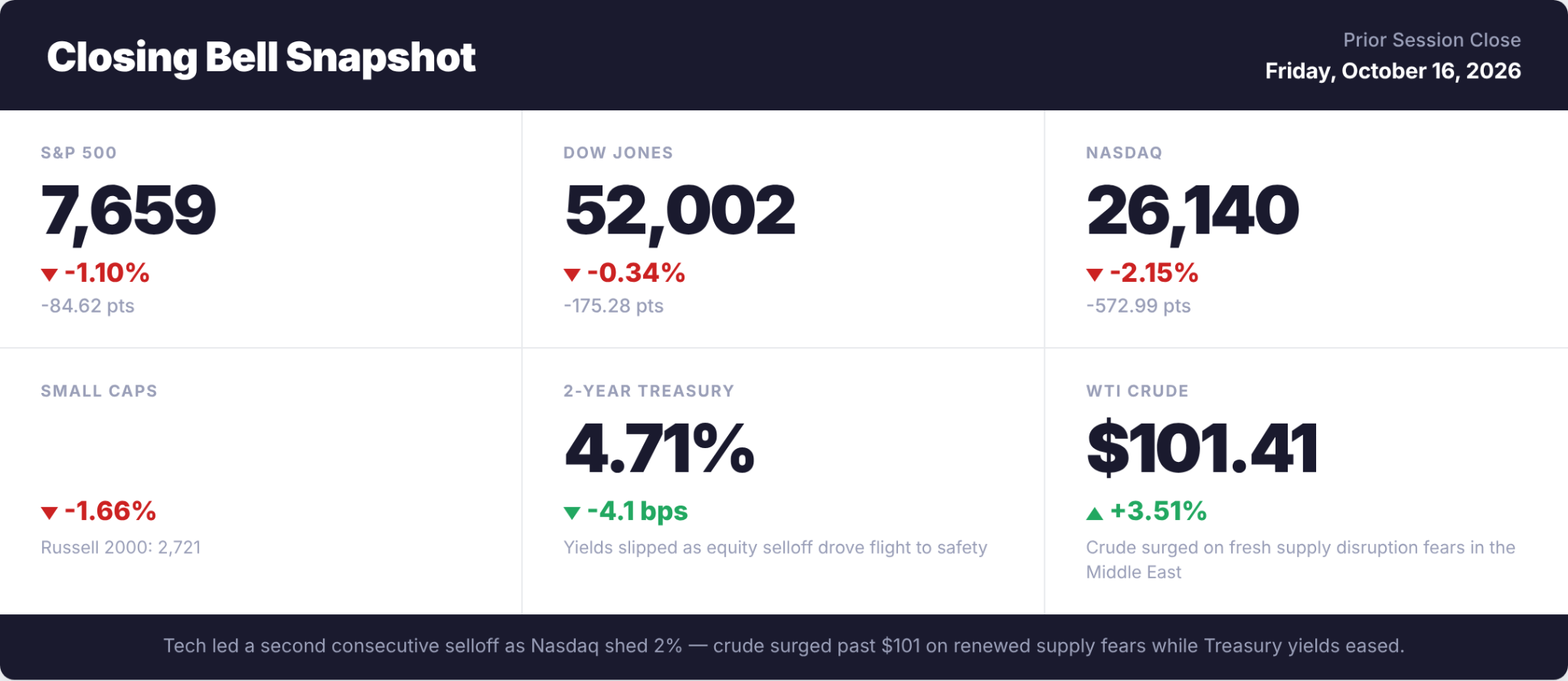
But before we get to that, let's take a quick look at the markets and the three moves that set up the day.
3 MOVERS IN 3 MINUTES
1. Oil fell into a weekend of threats: Brent dropped about 2% to roughly $107.60 early Monday, sliding from Friday's five-month-high settlement, and later pared some of the drop. That came even as Iran's Revolutionary Guards claimed another tanker hit a mine near Hormuz, a claim with no matching entry yet on the UK maritime agency's incident log. The selling had cover. President Trump on Friday waived key Russia sanctions and tariffs under the Graham Act, and Secretary of State Rubio said the president would take up to 60 days to assess their impact. Energy Secretary Chris Wright said Gulf oil flows are back to about 80% of pre-war levels. China's 4.5% third-quarter growth, ahead of the 4.4% forecast, didn't lift crude at all.
The futures market is pricing flows normalizing. The physical market wasn't, as of last week: a cargo of North Sea crude cost about $20 a barrel more than Brent futures. Those two prices can't keep disagreeing about supply for long, and the waiver's duration is still unclear.
2. Microsoft reportedly walked away from a data center the grid can't reach until the 2030s: Microsoft (MSFT) has pulled out of a deal to anchor Nscale's first British data center in Loughton, Essex, the Telegraph reported. Microsoft didn't comment to the Telegraph. Nscale says its relationship with Microsoft "remains strong and long-term" and that it's weighing other power sources and U.K. sites. Authorities have told it not to expect grid power until the 2030s. The timing is awkward. Nscale is reportedly seeking up to $3 billion in a U.S. IPO, and Microsoft and Anthropic account for about 85% of its contracts, according to its filing.
Microsoft isn't short of appetite. Last Friday it locked in about 1,100 megawatts in northwest Indiana, with service starting in 2028. The customer didn't leave the AI buildout. It left a site without grid power. For a neocloud selling a concentrated customer book to IPO buyers, that's the risk investors now have to price.
3. JPMorgan put bank deposits on a public blockchain: JPMorgan (JPM) said Monday it's bringing JPM Coin (JPMD), its dollar deposit token for institutional clients, to the Ethereum mainnet. It launched on Coinbase's Base network last November. The bank cited Ethereum's "established depth of onchain liquidity and tokenized assets." Last week, BNY and Citadel Securities ran a tokenized Treasury repo, but kept the token on BNY's own ledger, with no public chain involved. The largest U.S. bank just made the opposite bet with actual deposits, and put bank money on the same rails as stablecoins.
3 SIGNALS FOR TODAY
1. The bounce meets the bell. Nasdaq 100 futures were up about 1% early, after the Philadelphia chip index fell 11.4% last week in its longest losing streak since 2008. Watch the borrowers, not just the chipmakers. One CoreWeave bond was headed for a fifth straight weekly drop and its default insurance crossed 1,000 basis points. If CoreWeave (CRWV) and its leveraged peers lag a broad rally, last week's selectivity hasn't gone anywhere. Fifth Third (FITB) reported before the open, and Zions (ZION) reports later today, an early read on whether bank credit looks as calm as the high-yield index.
2. France gets a week to price the riots before Moody's does. Paris took the first hit after a weekend of violent cost-of-living protests. The CAC 40 fell about 1.3% early, the euro slipped near $1.121, and the 10-year French yield rose about 7 basis points to roughly 4.85%. Moody's is due to review France on Friday, while Prime Minister Lecornu's minority government still has to pass a 2027 budget. A widening gap over German yields this week would tell you investors expect the unrest to cost the budget, not just storefronts.
3. Brazil's two betting markets split after the debate. Lula and Flávio Bolsonaro's first runoff debate on Sunday night was mostly personal attacks, with no consensus winner. Polymarket's Flávio contract drifted to about 78.75 cents by early Monday, while Kalshi's traded up to 81 during the debate and sat near 80. Pollsters see a near-tie, though Flávio led 10 of 12 polls with fieldwork from Oct. 3 to 15. The first post-debate poll tests whether nearly 4-to-1 market odds can coexist with a coin-flip electorate before Sunday's vote.
Last week's AI credit scare left one question unanswered: did lenders lose their nerve, or just their tolerance for certain borrowers? An Australian waste company may have just answered it.
7 Stocks That Could Become the Market’s Next Giants
Apple, Google, Tesla…
Sure, they’re household names now, but these companies and the other members of the original Magnificent 7 didn’t start out obvious.
They earned their place over time.
Our analysts believe the next generation of market leaders is forming now…
And we’ve identified the 7 companies that fit the “Magnificent” pattern.
You can see the full list for free today
Don’t wait until everyone’s talking about them.
The Sip
The Lenders Didn't Leave. They Got Picky.
EQT's infrastructure arm signed a binding deal over the weekend to buy Australian waste and recycling company Cleanaway Waste Management for A$3.095 a share in cash, or A$3.13 counting a dividend already paid. That values the company at about A$9.3 billion (US$6.5 billion) including debt, and the A$3.13 is 32.1% above where the stock traded before the approach became public in August. The board unanimously recommends it, absent a superior proposal and subject to an independent expert. Cleanaway shares jumped about 20% Monday to close at A$2.97, their best day since October 2011.
On its own, that's a big Australian take-private. Put it next to last week, and it's a map of where the capital is willing to go.
The other half of the credit market
Last Thursday, JPMorgan and Goldman Sachs had to sweeten Volta's $5 billion AI loan to sell it. It priced at 95 cents on the dollar, below the 97 to 98 cents floated at the start, and the yield ended above 11%. The banks added a prepayment penalty and extra investor protections, and they underwrote only the $1.3 billion lease piece, selling the $3.7 billion GPU loan on a best-efforts basis. Anthropic has a six-year deal to buy computing capacity at the site, according to people familiar with it.
Cleanaway's financing went the other way. EQT has assembled a debt package of about A$5.6 billion with roughly 20 lenders, the Australian Financial Review reported Monday. Two weeks ago, the AFR reported 15 lenders jostling to underwrite it.
Same month. Very different reception. One borrower paid up to get money out the door. The other drew a crowd.
Why trash gets 20 lenders
The difference isn't only size. Cleanaway's reported package, about US$3.9 billion, is in the same league as Volta's $5 billion loan. The lender pools differ too: Volta went to U.S. institutional loan buyers, Cleanaway to a bank club. But the shape of the cash flow is the likeliest explanation.
A waste business collects from municipalities and businesses that can't stop producing waste, and it owns landfills that are hard to replicate. That's why an infrastructure fund, not a buyout fund, is the buyer. EQT is paying roughly 20 times Cleanaway's last full-year underlying operating profit for those cash flows, and on the reported numbers, lenders are funding around 60% of the A$9.3 billion enterprise value.
AI data centers sell capacity to a handful of very large customers under long contracts, then borrow against hardware that loses value as new chips arrive. That's a fine business while the customer stays. Last week suggested lenders now charge more for untested AI borrowers, and for the risk that a big customer walks. Over the weekend, Nscale's anchor tenant in Essex reportedly did exactly that.
Middle East Conflict Lights Fuse on US Debt Bomb
America was already drowning in $38 trillion of debt, but the recent conflict in the Middle East just accelerated the timeline.
As oil spikes, a 100-year-old stock market signal that accurately predicted the 2008 and 2020 crashes is flashing a massive "Sell" on dozens of popular U.S. equities.
If you hold the wrong stocks when this debt crisis hits, it could wipe out years of gains.
Click here to see the 10 popular stocks to dump immediately
11780 US Highway 1, Palm Beach Gardens, FL 33408-3080 Would you like to edit your e-mail notification preferences or unsubscribe from our mailing list? Copyright © 2026 Weiss Ratings. All rights reserved.
Catalyst Funds' Larry Holzenthaler put it plainly: "The market is being very selective and really singling out anything that has more leverage." Monday may show the other side of that sentence. Lenders don't appear to be avoiding leverage. Cleanaway's buyout carries plenty of it. They appear to be pricing leverage on cash flows that are harder to underwrite.
It wasn't one deal
Cleanaway had company. On the same Monday, Pacific Equity Partners' SG Fleet signed a binding deal for rival FleetPartners at A$5.30 a share, about A$1.13 billion and an 87.3% premium to its undisturbed price. Brookfield's US$2.53 billion takeover of plumbing-parts maker Reliance Worldwide cleared its go-shop with no rival bid.
Bins, car fleets and pipes. Private capital is buying boring, contracted, essential cash flows off the Australian exchange at full prices.
Meanwhile the exit door for AI infrastructure keeps narrowing. Blackstone's AirTrunk put off a $1.5 billion Singapore listing until early next year, after Firmus dropped its planned Australian float. Money is flowing into private ownership of steady assets and getting harder to raise for the ones tied to AI's pace.
What the deal also says about EQT
EQT says this single deal takes its sixth infrastructure fund to 85% to 90% invested. A flagship fund that close to fully deployed usually means a successor fundraise isn't far behind. If LPs back it, that's another signal that "essential and boring" is where institutional money wants to sit right now.
The catch
None of this makes Cleanaway riskless. Debt equal to roughly 60% of the enterprise value of a business with landfill and environmental obligations leaves less room if its growth spending runs over. Approvals from the shareholders, the Federal Court, Australia's foreign-investment board and its competition regulator are still ahead, with completion targeted for the end of March 2027. And the stock still trades about 4% below the cash price, which says the market isn't treating completion as certain.
There's a market cost too. Every take-private like this removes a listed, essential-service company from the index, the kind of steady name public investors use to balance riskier bets.
What would prove the thesis wrong
If Cleanaway's debt has to be priced with concessions when its full terms surface, the "picky, not scared" reading weakens: lenders would be charging everyone more. If the next big AI financing clears without discounts, last week looks like a CoreWeave problem rather than a sorting of risk.
So far, the evidence leans toward sorting. The money didn't leave. It just started asking what it was funding.
A "bloodbath" Is Coming

Silicon Valley billionaires are hoarding guns, gold, and even military grade gas masks... or fleeing the country altogether. What do they know that you don't? This AI insider is stepping forward with this time-critical message: Move your money before October 31st, ahead of the dangerous next phase of the AI market. Here's the one urgent move you need to make with your money immediately.
This ad is sent on behalf of TradeSmith at 1125 N. Charles Street, Baltimore, Maryland 21201. If you're not interested in this opportunity, please click here.
The MarketSips Takeaway
Read last week's AI credit stress as a repricing of specific cash flows, not a closed credit market, until evidence says otherwise.
Watch now: the full terms of Cleanaway's debt package and the independent expert's valuation; how Nscale's IPO prices without its Essex anchor; and Meta's capital-spending commentary Wednesday night, the clearest read on whether AI's biggest customers keep signing.
What confirms it: more infrastructure-style take-privates financed by large bank clubs at tight terms, while AI-linked borrowers keep paying concessions.
What breaks it: concessions showing up on "safe" deals like Cleanaway, or an AI financing clearing at par with no sweeteners.
Second-order: essential-service companies still listed in Australia, the U.K. and Europe are the obvious next targets. On the other side, neoclouds with concentrated customers and unpowered sites face a tougher IPO window. Blue Owl's Oct. 29 results will show how one of the largest private lenders is sorting the two.
UNTIL THEN, SIP SLOWLY!
The Market Sip Desk
Today’s reply prompt: Would you rather lend to a garbage collector or to an AI data center at 11%? Hit reply and tell us why.
Rates Just Reset. Who Feels It First?
On January 2, the 10-year yielded 4.19%. By September 30, 5.29% — most of it in one quarter.
Some companies earn from higher rates. Some pay. Each runs on a different clock.
We traced three: IBKR, WRB and FIS. One has already reported. The other two report next, and the report tells you the exact line to check.
Free report, texted to your phone.