

SpaceX reported a quarter last night in which AI, not rockets, did most of the work. Its Super Intelligence unit brought in $7.56 billion, more than four times what the rocket business did.
Then the CFO guided fourth-quarter capital spending to $35 billion to $40 billion. That is more than twice the revenue SpaceX just reported.
On the same call, Elon Musk said SpaceX and Tesla have formed committees to discuss combining.
Tesla reports tonight. Its shareholders now have a reason to read SpaceX's numbers as if they were their own. So does anyone holding the companies that sell into that spending, or the funds that lend against it.
But before we get to that, let's take a quick look at the markets and the three moves that set up the day.
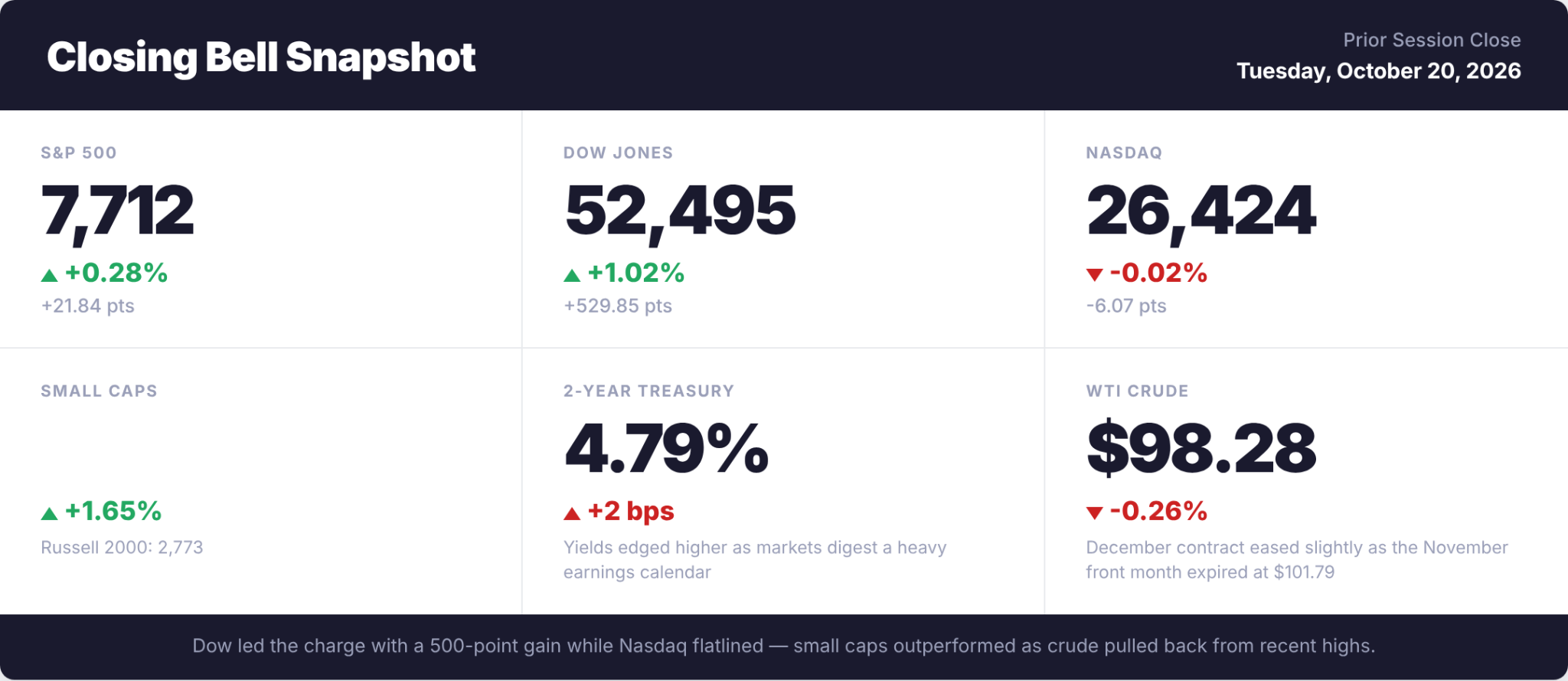
3 MOVERS IN 3 MINUTES
1. Super Micro sold $4 billion more than it planned. The stock is still a third below its high. Super Micro (SMCI) now estimates fiscal first-quarter revenue of $18.5 billion to $19.5 billion, against its own guidance of $14.5 billion to $15.5 billion and an LSEG consensus of $15.23 billion. It also lifted its gross-margin estimate to 12.0% to 12.5%, from a guided 10.4% to 10.8%. Analysts had expected about 10.15%.
The two beats compound. At the midpoints, gross profit comes to about $2.33 billion, roughly 46% above the level its guidance implied. A company that sold more and kept more of each dollar has changed its earnings power by more than the revenue line suggests.
2. Netflix beat its own margin plan. Investors priced the ad plan instead. Netflix (NFLX) earned 87 cents a share against 82 cents expected, with a 34.6% operating margin versus its own 33.2% forecast. Netflix said the gap was primarily the timing of expenses, which means some of it comes back later. The numbers investors priced were in the outlook. Netflix now expects 2026 ad revenue near $2.7 billion, down from about $3 billion, citing a slower rollout of some ad product capabilities. Fourth-quarter revenue guidance of $13.44 billion came in a little light, and free cash flow for the year is now expected at about $12.0 billion instead of $12.5 billion, mainly because of a real estate transaction.
3. An Australian private credit fund went from a 1% gate to a full freeze. MA Financial suspended all applications and redemptions in its MA Secured Loan Series, a real estate credit fund, citing a weakening housing market that is lengthening sales and refinancings and making some borrowers' repayment timing less certain. In August it had capped withdrawals at 1% a month. The halt is reported to run until at least March 31, 2027, and an A$100 million retail fund that invests in the series is reported to be winding up.
The sequence is the part that travels. U.S. semi-liquid credit funds typically cap withdrawals at about 5% a quarter, and the structures aren't identical. But a cap became a freeze here in about two months, once the loans underneath started repaying slowly. Ares warned this week that Australia's A$200 billion private credit market faces further stress. Blue Owl reports Oct. 29.
3 SIGNALS FOR TODAY
1. The bond that pays more than the longest one. The Treasury sells 20-year bonds at 1 p.m. Eastern. The 20-year closed Tuesday at 5.47%, five basis points above the 30-year, and has out-yielded it every day this month. The curve around it has flattened fast. Since Oct. 1, the 30-year yield has fallen 19 basis points while the 2-year is up 1, narrowing that gap to 63 basis points from 83, as December hike expectations pin the front end. Strong demand would back the bond market's bet that a tightening Fed slows growth later. A weak sale would say the long-end rally leaned too hard on softer oil, and long-dated borrowers, including the ones building data centers, would feel it first.
2. Oil is back at $110, and United already did the math. Brent touched $111.99 Tuesday, settled at $108.79 and was back above $110 early Wednesday. Iranian media reported Tehran told Pakistan's army chief there would be no talks with Washington until its demands are met, and industry data showed a U.S. crude draw of 4.93 million barrels against about 1.3 million expected. Polymarket's contract on a U.S. announcement ending the Iran blockade by Oct. 31 gave back all of Tuesday's gain, to 8.5 cents.
The government's inventory report and United Airlines' (UAL) call both hit at 10:30 a.m. United's third-quarter revenue rose a record 17.4% on capacity growth of just 1.3%, but fuel expense rose 62%. It guided fourth-quarter adjusted EPS to 50 cents to $1.50, against a $1.76 consensus, on jet fuel about 45 cents a gallon above analysts' assumption, a gap it puts at about a dollar a share. If crude holds here, that cautious guide becomes the base case, and Southwest reports after the close.
3. Bitcoin briefly poked above its ceiling on thinner money. Bitcoin edged past Tuesday's high near $83,344 overnight, reaching about $83,600, and was back at that level by about 7 a.m. The flows behind it shrank. U.S. spot bitcoin funds took in $23 million Tuesday, after $527 million Monday, and ether funds have lost about $1.08 billion in October, with outflows on 13 of 14 trading days. Ether's selling has continued through rallies and dips alike, which looks more like allocation than reaction. A close above $84,000 with inflows back above $100 million would say a base is forming. Without that, Monday looks like one allocation, not a turn.
Now, back to the call that changed the subject.
Unusual Passive Income Investment (Found on a Golf Course)
One man turned $1,000 into a decadeslong passive income stream... eventually reaching $70,000 per year after 60 years!
All from a single golf course tip.

The Sip
The merger Musk likes, and the bill attached to it
SpaceX (SPCX) grew third-quarter revenue 161% to $14.58 billion, against a Bloomberg consensus near $12.7 billion. It earned $4.40 billion, after losing $1.05 billion a year earlier. Adjusted EBITDA rose 306% to $8.81 billion. Shares were indicated about 8% higher before the open.
Then Musk said SpaceX and Tesla (TSLA) have each formed a special committee of independent directors, at shareholders' request, to discuss a combination. "I think it would be a good idea," he said. He also said he is excluded as a conflicted party, that no terms are agreed and that there is "no guarantee" there will be. Neither company had filed anything on the committees as of early Wednesday.
The headline is the merger. The numbers that will decide it came first.
Not the company that listed in June
The Super Intelligence segment brought in $7.56 billion, up from $813 million a year ago, about 52% of revenue. Starlink's Connectivity unit added $5.25 billion, up 69%. Rockets, the business the company is named for, grew 6% to $1.77 billion.
Even Starlink is growing differently than it used to. Consumer subscribers nearly doubled to 13.6 million, but revenue per user fell to $69 a month from $83 a year ago. SpaceX is buying scale with price, which works as long as the network keeps filling.
That AI business is what Musk pointed to when he said there is "a lot of merit" in combining. He cited shared work on AI software, robotics and a project he calls Terafab. Strip out the rhetoric and the overlap is real. So is the difference in what each company is now: one sells cars and energy storage, the other is becoming an AI infrastructure provider that also launches rockets.
The spending line
The AI unit spends like one. SpaceX put about $19.6 billion into capital projects last quarter, $16.44 billion of it in Super Intelligence. That is more than the company's entire revenue. CFO Bret Johnsen guided fourth-quarter capex to $35 billion to $40 billion, roughly double, and compute capacity to 2.5 to 3 gigawatts by year-end, from 1.7 now.
Revenue is supposed to chase it. Johnsen guided first-quarter 2027 revenue to $33 billion to $37 billion, about 2.4 times the third quarter, and said SpaceX is on track for $100 billion of annualized revenue by year-end, measured on December. Musk floated $500 billion to $1 trillion by the end of 2027. That was an aspiration, not guidance.
Until revenue catches up, the gap gets financed. SpaceX raised $99.8 billion in the first nine months of the year. That is the backdrop to Signal 1: when a company's build-out runs ahead of its revenue, the price of long-dated money stops being a macro footnote.
The profit carries footnotes too. Net income topped operating income of $2.79 billion partly on $1.03 billion of other income and a $390 million tax benefit. The Super Intelligence segment's $431 million of operating income absorbed $1.2 billion of share-based compensation tied to the Cursor acquisition. And investors still can't see the customer list behind the AI revenue. The 10-Q is where that shows up.
Elon's audacious plan to double U.S. energy,
without building a single new power plant…
People think he's crazy.
But Adam O'Dell says he's already deployed 4,000 units of his solution across 14 states — and used them to power the largest supercomputer on the planet.
With Microsoft, Amazon, Google and Facebook set to spend $680 billion this year on AI data centers that can't get enough power to run, Elon's solution is about to be in extraordinary demand.
Go here now to see how he's going to do it — and get one of Adam's top picks to play it absolutely free.
The fit is the pitch. The price is the decision.
At Tuesday's close, SpaceX was worth about $2 trillion and Tesla about $1.48 trillion. In a stock-for-stock deal, the exchange ratio decides how much of the combined value each set of holders keeps. Overnight, SpaceX was indicated up about 8% and Tesla less than 2%. Whatever drove each move, the starting point for that ratio shifted before anyone sat down to negotiate.
Then there is approval. Musk said Tesla would need a majority of all outstanding shares, not just shares voted, which he called "quite a high hurdle." Abstentions count as no votes under that bar. He controls a majority of SpaceX's voting power, so the hard vote sits with Tesla. No merger proposal is on the agenda for Tesla's Dec. 3 meeting. Barclays analysts were reported last week to expect an announcement tied to that meeting or within six to 12 months.
Put simply, Tesla holders would be voting on how much of their company to trade for a share of an AI build that plans to spend at least $35 billion this quarter. Some will want that exposure. Others own Tesla precisely because it isn't that.
What the bettors kept
On Polymarket, the contract on a merger announcement in 2026 jumped to 23.5 cents within about 45 minutes of the first reports, fell back to 18.5, rose to 22 cents overnight and was near 20 cents by 6:40 a.m. The 2027 contract held near 68 cents. Kalshi, whose contracts require a definitive, binding agreement, had its before-2028 contract unchanged at 77 cents.
The books are thin, with about $35,400 of liquidity in the Polymarket 2026 contract, so direction matters more than the exact level. But the shape fits Musk's own caveats. Traders priced a process, not a deal.
What tonight can settle
Tesla reports after the close, and Musk can be asked about the committees on a second call. Three things would change the read.
A filing naming advisers to the committees would mark the first step from discussion toward negotiation. Any framework for valuing the two companies against each other would put a number on the exchange ratio for the first time. And a comment ruling out an announcement this year would test the near-dated bet directly.
Meta (META) reports at the same time. If its capex guide climbs too, SpaceX's spending looks like the industry's pace rather than an outlier, and the funding question gets bigger for everyone.
Renowned tech investor James Altucher – the man who called the rise of Nvidia, Apple and SpaceX years in advance – just uncovered Elon Musk’s latest breakthrough idea…
And according to James, it’s going to be even bigger than the SpaceX IPO – creating up to 1.8 million new millionaires over the coming years.
The pieces behind it are inside this briefcase – which he reveals 100% FREE in this video.
The Market Sips Takeaway
SpaceX showed how fast its AI business can grow. A merger would ask Tesla holders to own a share of what that growth costs.
- What would confirm a real process: a filing naming committee advisers, or Tesla's call setting out a timeline.
- What would cool it: Musk ruling out a 2026 announcement tonight, or SpaceX's 10-Q showing AI revenue concentrated in a few customers.
- Where it shows up next: Meta's capex outlook after tonight's close, the 20-year auction's read on long-term funding costs, and Polymarket's 2026 contract, near 20 cents.
Musk made the case for the fit. The committees will have to put a price on the bill.
UNTIL THEN, SIP SLOWLY!
The Market Sips Desk
Today’s reply prompt: If you held Tesla, what would it take to get your vote?
Same Rate Move. Three Different Bills.
The 10-year went from 4.19% to 5.29% this year. Every company on your screen felt that. They don't feel it on the same schedule.
Some earn more when rates rise. Some pay more. The difference shows up in earnings, one report at a time.
We traced three of them: IBKR, WRB and FIS.
FREE Special Report: Rates Just Reset. Who Feels It First?
Who earns it fast. Who earns it slowly. Who pays. One has already reported. The other two report next, and the report tells you the exact line to check.
We'll text the report straight to your phone.
Text Me the Three Names → (free)