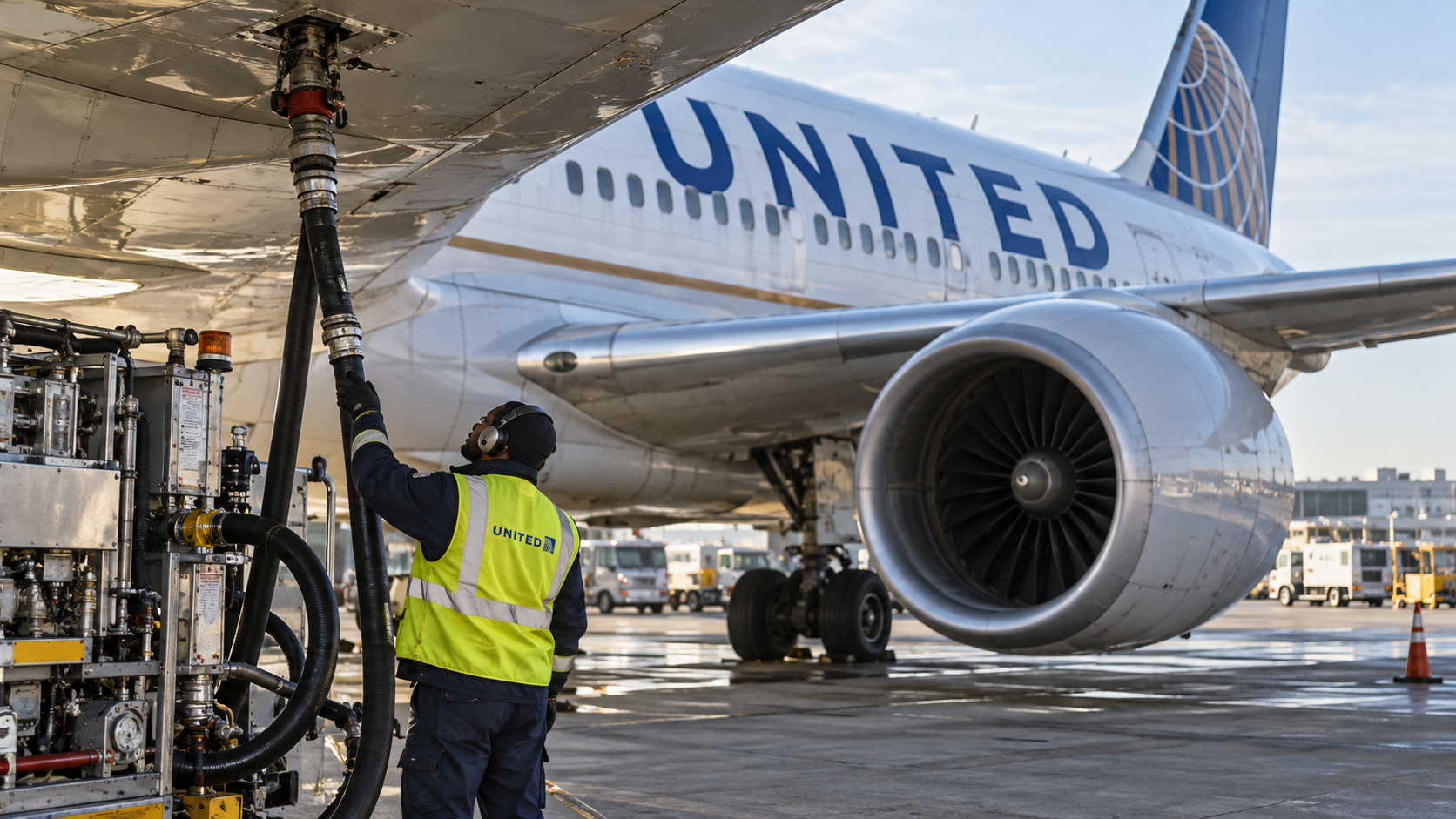
United guided fourth-quarter adjusted earnings to 50 cents to $1.50 a share, against a $1.76 consensus, while assuming jet fuel about 45 cents a gallon above analysts' consensus assumption. Third-quarter revenue rose a record 17.4% on capacity growth of just 1.3%.
United Airlines' outlook looks like a warning about demand. Its own numbers say it is mostly a bet on fuel.
United guided fourth-quarter adjusted earnings to 50 cents to $1.50 a share. The $1.00 midpoint is 76 cents, or about 43%, below the $1.76 LSEG consensus. United did not publish a new full-year range; its investor update leaves that line blank. The fourth-quarter guidance implies a full-year result below the $9.00 to $11.00 a share it forecast in July.
The fuel price behind the forecast explains most of the gap. United is planning on jet fuel at $4.80 a gallon in the fourth quarter, based on the Gulf Coast jet fuel forward curve as of Oct. 16. The company said that is about 45 cents above analysts' consensus assumption and worth about $1 a share.
The shares closed Tuesday at $97.77, up 2.27%, and were indicated about 0.8% lower at about 4:46 a.m. Eastern on Wednesday.
Removing the fuel cushion
That sensitivity changes how the guidance reads. If fuel came in at analysts' assumption rather than the forward curve United used, the company's own estimate implies a midpoint closer to $2 a share, above the consensus. The forecast is cautious on fuel, not on bookings: United expects fourth-quarter revenue to grow more than 20%.
That does not make the risk imaginary. United's figure comes from the forward curve, not from a deliberately cautious pick, and Brent crude was back near $110 a barrel early Wednesday.
Fares running ahead of flying
The third quarter shows the pricing power. Revenue rose 17.4% to a record $17.88 billion, while capacity rose only 1.3%, and total revenue per available seat mile rose 15.9%. Nearly all of the growth came from charging more per seat.
Fuel took much of it back. Fuel expense rose 62% to $4.84 billion. Adjusted earnings were $2.54 a share, inside the company's July range of $2.50 to $3.50 but 3 cents below the $2.57 LSEG consensus. Reported earnings were $3.14 a share, up from $2.90, and net income rose 8.5% to $1.03 billion. United expects about $7.5 billion of adjusted capital spending this year.
Market implications
One reading is that United's guidance rests on a fuel price above where analysts see it, and the market's muted reaction recognizes that. Fares are rising faster than costs other than fuel, revenue growth is accelerating, and a normal fuel price would put earnings above forecasts.
A second reading is that fares cannot outrun fuel indefinitely. Fuel expense has already risen more than 60%, and if oil stays high, the question becomes how long passengers keep paying about 16% more in revenue per seat mile, a measure that also includes cargo and loyalty income.
What to watch
United's call at 10:30 a.m. Eastern on Wednesday for any full-year figure and booking trends; jet fuel prices against the $4.80 assumption; Southwest's results after Wednesday's close; and fare trends into the holidays. A further rise in jet fuel above United's assumption would turn the cautious guidance into the base case.