PREVIEW. Swaps imply about a 94% chance the Bank of Canada hikes on Wednesday. New Zealand's central bank decides first, Tuesday night. Three major rate decisions land within about 18 hours.
The oil shock has pushed several central banks toward the same answer at the same time, and this week they give it.
The Reserve Bank of New Zealand announces its decision at 9 p.m. Eastern on Tuesday. The Bank of Canada follows at 9:45 a.m. on Wednesday, and the Federal Reserve at 2 p.m. that afternoon. Three decisions in roughly 18 hours will show how far each bank is willing to tighten into an energy-driven rise in prices.
Canada flipped
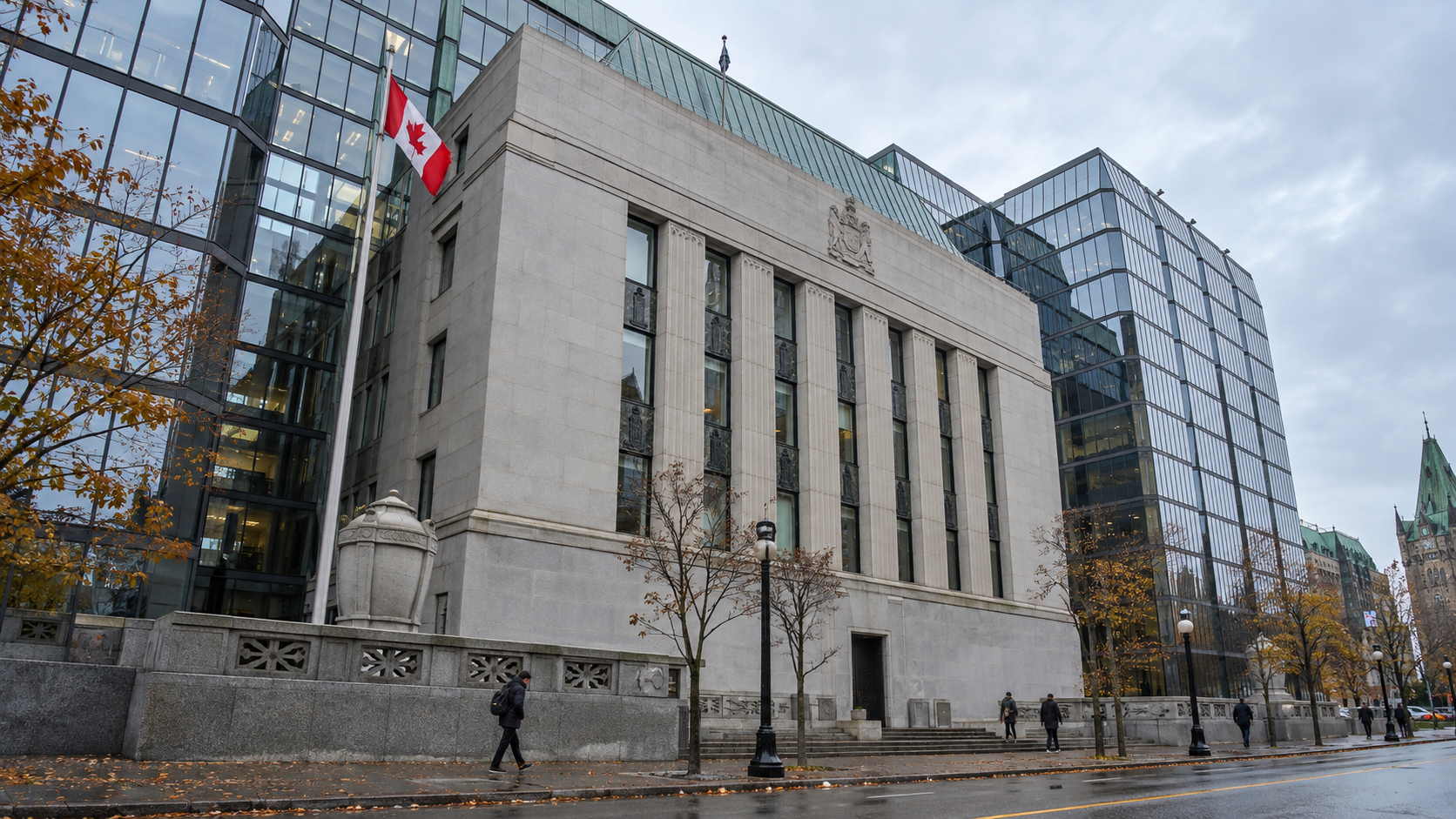
Pricing for the Bank of Canada changed quickly. Overnight index swaps implied about a 94% probability, according to BlueGamma's OIS tracker, of a quarter-point increase from the current 2.25%, as of Monday. On Oct. 21, at least one preview still had a hold as its base case, and on Friday the implied odds were near 78%, the Canadian Press reported. RBC expects a 25-basis-point move, but with "very low conviction."
The Canadian dollar was slightly weaker on Tuesday, with the U.S. dollar up 0.25% at 1.4047 Canadian dollars at about 1:47 p.m. Eastern.
Canada's decision also lands against an unresolved trade dispute: Washington and Ottawa are negotiating over steel and auto duties that President Donald Trump has said will climb to 50% at the start of 2027.
New Zealand goes first
New Zealand's central bank is expected to raise its rate to 3.00%. As of Oct. 21, markets put the odds of that move at about 80% to 85%.
The Fed holds, for now
The Fed raised rates in September and is expected to pause. In CNBC's survey, 93% of respondents expect no change on Wednesday and 76% expect a hike in December. The Bank of Japan, which meets Thursday and Friday, is expected to hold at 1.25%, and every respondent in a separate CNBC survey expects it to raise rates in December or January. The European Central Bank meets Thursday and is also expected to hold.
Why it is happening together
The common driver is energy. Brent crude has traded above $110 a barrel in recent days as conflict in the Gulf disrupted shipping, and that feeds directly into fuel, transport and headline inflation. Central banks that see inflation expectations rising may decide to act now rather than wait to see whether the price shock fades.
There is an irony in the timing. Oil fell on Tuesday, with West Texas Intermediate dipping back under $100 a barrel, and U.S. consumers reported a sharp rebound in confidence that the Conference Board tied to cheaper gasoline.
Two readings
One reading is that hikes now are cheap insurance. Inflation expectations are elevated, energy prices remain high, and banks that move early may need to do less later.
The other is that tightening into a supply shock risks hitting growth that is already soft. Higher oil prices act like a tax on households, U.S. housing is weak, and rate increases cannot add a barrel of supply. If energy prices keep easing, the hikes priced this week could look premature by spring.
What to watch
The RBNZ decision and statement on Tuesday night, the Bank of Canada's decision and Monetary Policy Report on Wednesday morning, the Fed's statement and press conference on Wednesday afternoon, and the Bank of Japan's outlook report on Friday.