

Every boom reaches the day it asks someone else to pay. Yesterday was AI's.
Meta priced $37.5 billion of new stock overnight, and Nvidia, the company that sells Meta its chips, says it will buy $3 billion of it. SpaceX put a $40 billion chip lease on file. Two structures, one question: who funds the buildout when cash flow can't keep up?
Meanwhile the two assets built for wars and inflation are the two worst performers of a year that delivered both. Brazil had its worst session since March 2020. And the Fed decides tomorrow, with hike odds that jumped Monday without a Fed comment to explain them.
Let's get into it.
AI just asked the public to pay for the buildout. The supplier raised its hand first.
Meta Platforms (META) priced $25 billion of common stock at $625, upsized from the $22.5 billion it launched Monday. It added $12.5 billion of mandatory convertible preferred paying 6.5%. Total priced: $37.5 billion, closing Oct. 29.
Then came the line that matters. Nvidia (NVDA) said it "will invest $3 billion in Meta's equity offering." That is 8% of the deal, written by the company Meta pays for hardware. AMD (AMD) and Broadcom (AVGO), which had also signaled interest, have not said whether they bought.
Now read Meta's own math. It expects $135 billion to $145 billion of capex this year. Operating cash flow through three quarters ran at a full-year pace of about $129 billion. That misses even the bottom of the range.
The structure says Meta expects a long build. The common is sold forward, so no cash arrives until Meta settles, on or before Nov. 19, 2027. The cash that lands now is the preferred, at about $813 million a year in dividends. A $60 billion at-the-market program waits behind it.
Meta was not alone. SpaceX (SPCX) disclosed that its "closed" $40 billion financing is a lease commitment with an Apollo (APO)-managed lessor. The rate is not set.
The market signal?
Monday's tape gave a first read. Meta fell 1.88% on the day it launched the sale. Nvidia rose about 2.4%, alongside AMD and Broadcom, in a firmer market. Meta holders carry the dilution. The suppliers get a customer with fresh funding. That trade holds only while public buyers keep funding at today's prices. If this week's hyperscaler capex also outruns cash flow, the question shifts from "who wins AI" to "who funds it next."
Man Who Tabbed AMD at $2 a Share Just Made His Biggest Call Yet

On March 6, 2009, Matt McCall went on FOX Business and gave away nine stocks. One was AMD, trading around two dollars. It has since soared as much as 25,000%.
Now he's giving away the name and ticker behind his next big call.
For the time being, you can watch him lay it all out, free, right here.
A war, an energy shock, a hiking Fed. The hedges never showed up.
The stat of the morning: through Oct. 23, bitcoin was down 7.3% and gold 7.5% for 2026. That makes them the bottom two of 21 asset classes tracked by Creative Planning's Charlie Bilello, who says they have never finished a year as the bottom two in his data, which goes back to 2011.
This is the year they were built for. Brent settled above $115 on Monday, and the Fed hiked in September. Bitcoin slipped to about $79,675 early Tuesday. The common thread is the rate. When the Fed is still raising in a war year, holding anything with no yield gets expensive. That cost appears to be beating the fear trade.
Now look at where the rate is set. The Treasury buys back up to $6 billion of long bonds this afternoon, maturing 2046 to 2056. Its own floor for these operations is $4 billion. The 30-year closed Monday near 5.30%, and Monday's two-year auction drew weak indirect demand, the bucket that includes foreign buyers.
Fed odds tell a split story: about 91% for a pause Wednesday, about 80% for a hike by December, per CME FedWatch early Monday. Kalshi's hike contract jumped Monday on heavy volume, with no Fed comment to explain it. About 40% of the day's trading came in the 1 p.m. hour, when the two-year auction results landed.
The market signal?
Watch the buyback result just after 2 p.m. The number is offers against accepted. Heavy offers mean long-bond holders want out, and that keeps pressure on every asset without a coupon. For bitcoin, the line Galaxy Research (which holds the coin) is watching is the 50-week average, about $76,540 last week. Bitcoin sits about 4% above it.
Bill Pulte posted twice. FICO's slide deepened.
Fair Isaac (FICO) said Friday it would hold its $10 mortgage score price for lenders in a new program. By Monday's close, the stock was down 13.15% at $708.07, on more than six times Friday's volume.
The drop came in two legs. The first came with broker calls: Wells Fargo downgraded, five firms cut targets, and FICO was down about 8.8% by late morning. The second coincided with two X posts by Bill Pulte, director of the Federal Housing Finance Agency. The agency is "taking more action this week to ensure competition is real and not fake, or manipulated," he wrote. Then: "abusive monopolies will not be allowed to take advantage of consumers anywhere in the mortgage market." FICO hit $671.51 shortly before 1 p.m.
Why the words land so hard: rival VantageScore 4.0 costs about 99 cents per mortgage pull, a tenth of FICO's price, and the FHA starts accepting it Jan. 1. The "freeze" also has a catch. Per Mizuho and UBS notes cited by HousingWire, enrolled lenders must pull a FICO score on every application. That locks in volume. Mizuho now models zero price growth for 2027.
The market signal?
FICO is 62% below its 52-week high. A stock priced on pricing power now trades on a regulator's posting schedule. The FHFA has not said what "more action this week" means, so every post is a catalyst. Equifax (EFX) and TransUnion (TRU) fell about 2% each, a sign the market sees the bureaus inside the blast radius too.
1 Free Thing American Citizens Can Do to Target More Income
It's not investing in CDs, Treasurys, or even getting a second job. Wall Street insider Rob Spivey has uncovered an income engine hidden beneath Elon's empire. He calls it Elon's "Shadow Trust." It consists of a handful of little-know companies that have paid out a steady stream of income going back 20 years... They've paid out $4 billion in the past 12 months… over $100 million in the past few weeks…and the next payout hits November 4. Details here…
This ad is sent on behalf of Altimetry, 110 Cambridge Street, Cambridge, MA 02141. If you would like to optout from receiving offers from Altimetry pleaseclick here.
Traders did not price peace in Iran. They priced a calendar.
Polymarket's contract on the U.S.-Iran ceasefire holding through Oct. 31 climbed gradually overnight to 92.5 cents from 86.5 cents, hours after Monday's talks in Tehran with Saudi, Pakistani and Turkish officials had ended. Those talks produced an agreement to keep talking, and little else. Fewer days left for a strike likely explain part of the rise.
The interesting part is the ladder. Read as probabilities, prices imply about a 7.5% chance of a qualifying U.S. strike by Oct. 31. By Nov. 8, that jumps to about 30.5%. By Nov. 15, about 45%. The biggest step sits right across the Nov. 3 midterms. President Trump said Oct. 8 the U.S. would not attack Iran before the election. On Sunday he said it was "getting to be decision time."
Oil is trading the same split. Brent settled down 0.8% at $115.81 as traders appeared to weigh diplomacy over incident reports that arrived days late, including an Oct. 23 tanker strike in Hormuz. Iran's foreign ministry still said "the American side is not serious about negotiations."
The market signal?
These are thin markets, about $189,000 traded in a day on the Oct. 31 contract, so treat them as a read. But the shape is clear. Near-term risk has eased. The rest has been pushed into the window that contains Nov. 3. For crude, that argues for a sticky premium into mid-November. Watch the gap between the Oct. 31 and Nov. 8 contracts.
Celestica got the boom. Amkor got the bill.
Celestica (CLS) had the night's loudest number. Third-quarter revenue rose 83% to $5.83 billion, above the top of its own guidance. Then it guided 2027 to $40 billion of revenue, roughly 90% above this year. Shares jumped about 16% after hours.
The cash line says something else. Celestica cut its free cash flow forecast to $460 million from $600 million. It plans up to $2.0 billion of capex next year and has completed a $3.45 billion equity offering. Celestica tied the cut to working-capital investment for 2027 growth.
Same night, other end of the chip. Cadence (CDNS), which sells chip-design software, booked a record $8.2 billion backlog and raised its growth forecast to 21%. Amkor (AMKR), which packages and tests the chips, posted sales of $1.991 billion, slightly below forecasts, and guided flat. Its gross margin guide is 18% to 19%, against about $2.5 billion of capex this year.
Read those together. Design gets paid on contracted backlog. Manufacturing spends now on revenue its guidance does not yet show. Asia's data rhymes: profits at China's larger industrial companies rose 14.4% in September, while electronics profits more than doubled for the year. The boom is real. It is also concentrated.
The market signal?
This is Daybreak from the supplier's side. Meta raises equity to buy hardware. Celestica raises equity to build it. Everyone in the chain is funding ahead of revenue, which works only while hyperscaler budgets hold. Wednesday's capex numbers matter more to Celestica than anything on its own call.
Brazil's Treasury bought back the bonds it had just stopped selling
Monday's crash was loud. The Ibovespa fell 13.88%, its worst day since March 2020, and the dollar rose 8.21% against the real. The iShares MSCI Brazil ETF (EWZ) lost 19.82%, and XP (XP) about 48%.
The response is the part worth studying. Brazil's Treasury cancelled this week's fixed-rate and inflation-linked auctions, then spent about R$14.8 billion buying the same kinds of bonds back. The real recovered about a third of its intraday fall.
Now look at the curve. The January 2027 rate future rose about 26 basis points. The January 2031 contract rose about 260. A shock that lifts the front of the curve by about a quarter point while long rates jump about 2.6 points looks less like a bet on the next central bank meeting. It looks more like a higher price for holding Brazilian government risk over many years.
Here is the mechanical problem. With fixed and linker sales paused, the Treasury is funding only with floating notes tied to the Selic rate. Keep that up and the debt gets shorter and more exposed to policy rates. JPMorgan cut the real and local bonds to marketweight and sees local yields up to 15.5% in an adverse case.
The market signal?
Buybacks fix disorderly trading. They do not remove a fiscal premium. The real test is when the Treasury returns to sell fixed-rate debt, and at what yield. Until then, Brazil-linked U.S. listings like Nu Holdings (NU) and Petrobras (PBR) trade against a curve the state itself stepped in to buy on Monday.
Jim Rickards Predicts: Trump's Next Big Buy
This tiny $2 stock holds the exclusive rights to the largest gold reserve in the country.
And it has the potential to be the biggest fortune maker in Trump’s second term.
According to Jim Rickards...
Trump is about to take a direct stake in this $2 stock.
And if you’d like to learn how to stake your claim in this asset before President Trump and his administration make a move…
You need to act before November 3rd.
Click here to see Jim’s big prediction: “Trump’s Next Big Buy.”
- Today is a supply day before a Fed day: the $70 billion five-year auction, then the buyback from 1:40 to 2:00 p.m. ET. A second soft auction would say the front end expects more than the Fed has said. Israel's exit polls land at 4 p.m. ET, a fresh input for the Iran ladder.
- Wednesday is the main event. The Fed announces its decision at its first meeting since hiking in September, with a pause priced near 91%. Microsoft (MSFT) and Alphabet (GOOGL) report capex plans the same day, Amazon (AMZN) on Thursday. Those numbers decide whether the supplier rally has a funded customer.
- Watch for a deal too. DoorDash (DASH) is reportedly in advanced talks to buy Instacart for about $17 billion. A Reuters source said as soon as Wednesday. DoorDash shed about $4.7 billion of market value Monday, about half of it before the first report, while Instacart (CART) added about $1 billion. The buyer's holders were already selling.
- The market signal across all three? This week prices the cost of money from three directions: the Treasury's long end, the Fed's front end, and Big Tech's capex bill. A weak auction, a hawkish statement and a capex number above cash flow would land on the same trade. Watch them as one story.
That's it for today's Slate. Five-year auction at 1, buyback at 1:40, Israel tonight, and the Fed tomorrow. Stay close to the feed.
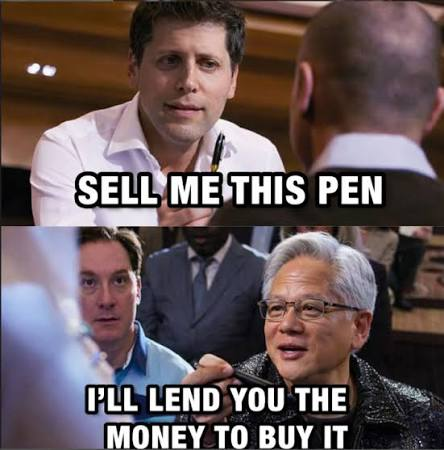
Today's reply prompt: Nvidia says it will put $3 billion into a customer that buys its chips. Smart alignment or a warning sign?
Rates Just Reset. Who Feels It First?
On January 2, the 10-year yielded 4.19%. By September 30, 5.29% — most of it in one quarter.
Some companies earn from higher rates. Some pay. Each runs on a different clock.
We traced three: IBKR, WRB and FIS. One has already reported. The other two report next, and the report tells you the exact line to check.
Free report, texted to your phone.