
TQ Morning Briefing
The 10-year auction drew deep real-money demand. Brent jumped almost 5% before the open. The 30-year sells at 1 p.m.
The Bond Market Got Its Buyers. Then Oil Changed the Question.
Wednesday answered one question for the bond market. Thursday morning asked a harder one.
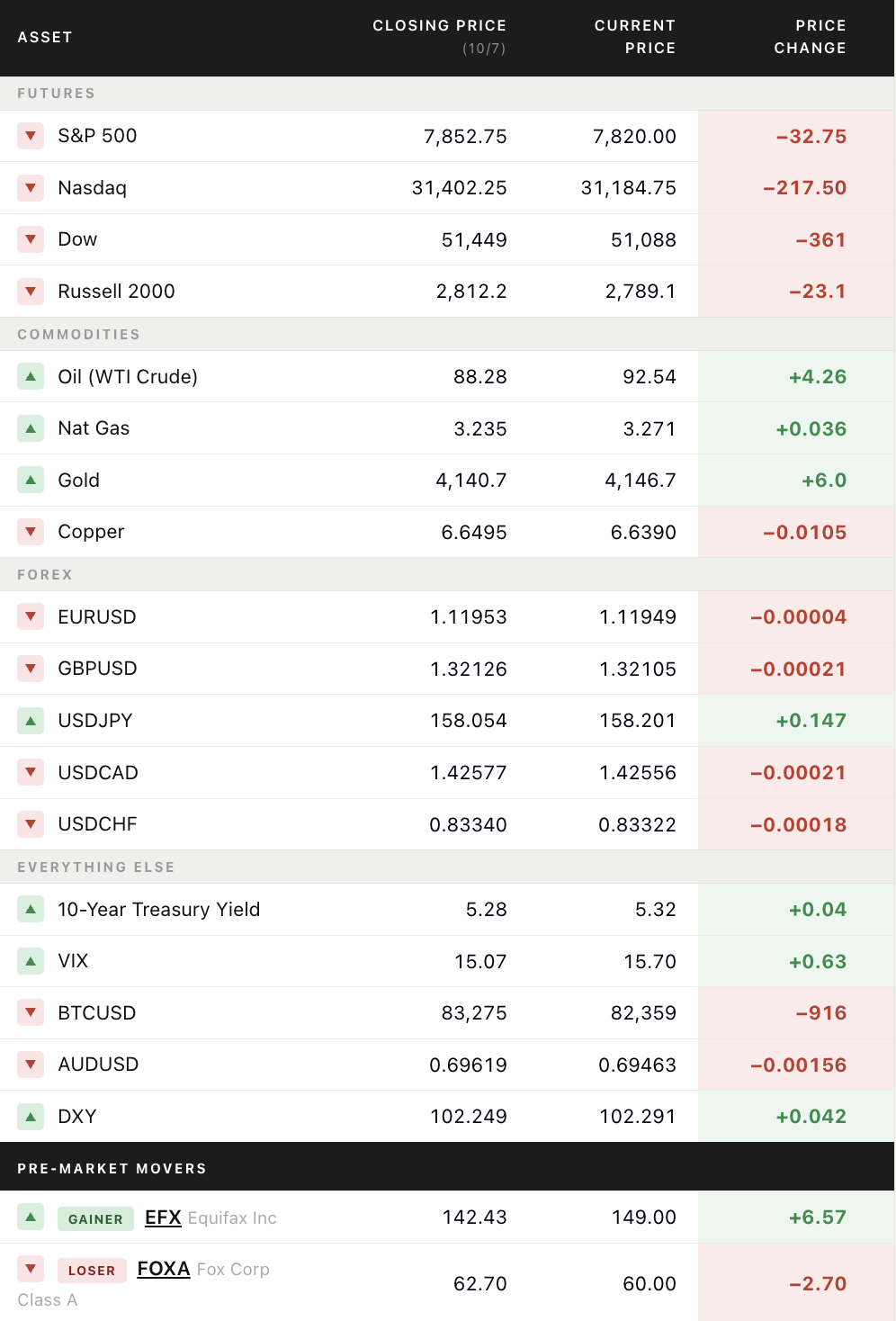
The 10-year yield touched about 5.36% on Wednesday, its highest since 2002. A strong auction pulled it back to about 5.28%. The S&P 500 slipped 0.2% a day after a record.
Then oil moved. Brent traded near $105 early Thursday, up almost 5%. WTI was near $92.50 after settling at $88.28 on Wednesday. The 10-year held near 5.3%, and the 30-year sat near 5.66%.
Bitcoin traded around $82,400 before the open. That is below Wednesday's low, already the lowest of October.
Market Implication
Dealers took 2.5% of Wednesday's 10-year sale against a 9.4% average, so 97.5% went to real money. That is what finding buyers looks like. The 30-year at 1 p.m. asks the same question with Brent near $105, and long duration carries the most exposure to an oil shock.
The Big AI Story Nobody Knows

There's a website called RentAHuman.ai. Its tagline: "Robots need your body."
721,000 people across 100 countries have signed up.
And according to Alexander Green - the man who bought Apple under $1, Netflix at $1.62, Amazon under $2* - this is the clearest signal yet that Phase 2 of the AI supercycle has arrived. (Split adjusted prices)
He's identified three companies set to dominate this next phase.
Real Money Took the 10-Year. The Fed Named a New Rival for It.
Treasury sold $39 billion of 10-year notes at 5.30%. Dealers took just 2.5%, against a 9.4% average. Indirect bidders took 80.3%.
The Fed's September minutes followed at 2 p.m. Most participants judged another increase "would likely be appropriate by year end." Kalshi's October hike contract held at 17 cents on heavy volume after the release.
The minutes also named a new force in the bond market. A few officials cited "increased expectations for AI-related borrowing" among the reasons longer-term yields rose. Fed staff said spreads on hyperscaler debt stayed wide on heavy issuance.
The same day, the Financial Times reported that SpaceX is in talks to raise about $40 billion to buy Nvidia (NVDA) chips. The package would pair about $10 billion of bank loans with $30 billion of investment-grade debt. Apollo is expected to lead. The talks are early and could fail.
Structural Setup
The question is whether private AI borrowing competes with Treasuries for the same long-duration buyers. Hyperscaler spreads and the dealer share at each auction will answer it. Wednesday said not yet.
The S&P Lost 0.2%. Small Caps Lost Six Times as Much.
The index barely moved. The stocks under it did. The Russell 2000 finished roughly 1% above its correction line. A close at or below 2,761.58 would mark a 10% drop from its peak.
Transports are further along. All 20 Dow Jones Transportation Average components fell in the morning, and the index sat about 18.5% below its 23,933.14 peak. A bear market starts near 19,147. Diesel at record prices and freight volumes under pressure have been doing that work for six weeks, and Brent near $105 does not ease it.
Industrials took the heaviest hit. Caterpillar (CAT) fell 5.8% amid a reported analyst downgrade. Deere (DE) fell 3.8% as the FTC and USDA opened a farm-equipment inquiry, though CNH Industrial (CNH) and AGCO (AGCO) were already lower before it.
Crypto money kept leaving. Spot bitcoin ETFs lost about $485 million on Wednesday, per Farside Investors. Ether funds posted a seventh straight day of outflows.
Staples are trading against their own numbers. Constellation Brands (STZ) shipped 5.5% more beer while distributors sold 0.6% less. The stock still rose 2.4% Wednesday.
Sector Read
The VIX sat near 15.1 at Wednesday's close, so the damage is in the constituents, not the price of protection. The Russell's 2,761.58 line is where that trade would first show up in an index.
Wall Street veteran goes ALL in on Bank of Elon
A 20-year Wall Street veteran – who worked at a $10 billion hedge fund – is putting ALL his money in Elon Musk's new bank. He says he can see the writing on the wall for traditional banks. And he's not the only one. See if you should join him here (not just for the 6% yield).
This ad is sent on behalf of InvestorPlace Media at 1125 N. Charles Street, Baltimore, Maryland 21201. If you're not interested in this opportunity, pleaseclick here.
Oil Is Pricing a Storm and a Strike List
Two supply threats stacked up overnight. Gulf producers shut in more than 500,000 barrels a day ahead of Hurricane Isaias, Euronews and AP reported. Euronews also cited a report in The Atlantic that the White House sought strike options against Iran before the Nov. 3 midterms.
Prediction markets had already marked down a fast fix. Polymarket's contract on the Hormuz blockade ending this month fell from 24.5 cents to 18.5 cents early Wednesday.
Kalshi, meanwhile, filed to list a WTI oil contract with no expiry.
Watch Signal
A storm outage is temporary. A pre-election strike plan is not. If Brent holds near $105 after Gulf output restarts, the premium is about Iran, not the weather.
Investors Asked Barings for 10.7%. They Got Under Half.
Barings Private Credit Corp. prorated its tender for a third straight quarter. Holders asked to redeem about 10.68% of shares against a 5% cap. The fund filled about 46.84% of each request.
Fill rates were about 44% and 46% in the first two quarters. In December 2025, with only 3.8% tendered, the fund paid every request in full.
The exit price is the second signal. In a separate auction run by Nasdaq Fund Secondaries and LODAS Markets, some interval-fund shares cleared at a 15% discount to net asset value.
The Read
Barings pays tendered shares at NAV. The secondary market quotes a discount. That gap is the price of quarterly liquidity. If fourth-quarter requests keep rising past 10%, funds face bigger secondary sales or new redemption terms.
Landmark Executive Order 14241 Unleashes
TRUMP’S NEW DOLLAR
Republican or Democrat – whether you support or oppose Trump’s New Dollar – every American could soon be forced to use it
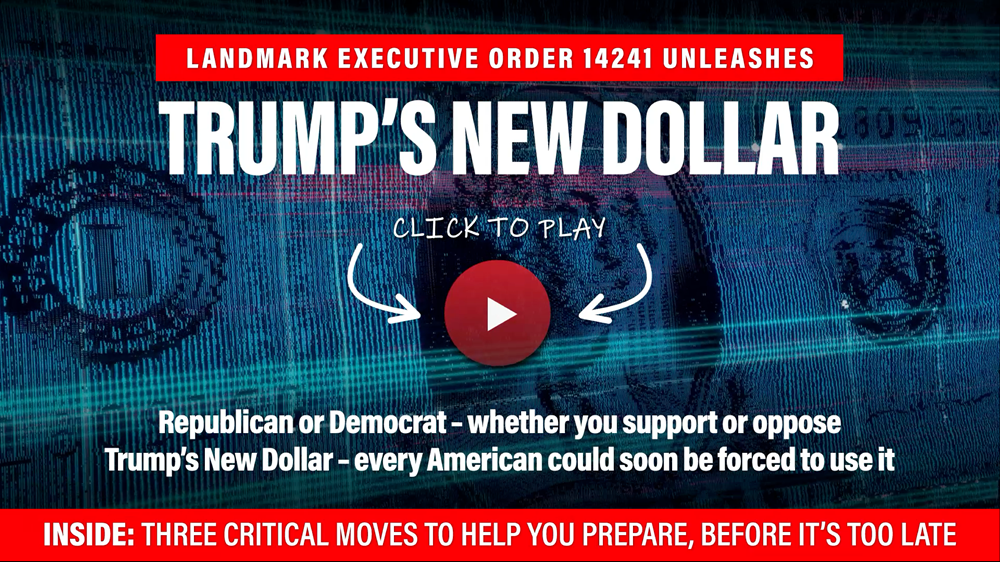
Discover three critical moves to help you prepare, before it’s too late
Economic Data: Weekly jobless claims, 8:30 a.m. $22 billion 30-year auction, 1 p.m. September CPI, Oct. 14.
Earnings: PepsiCo (PEP) reported before the open. Core EPS rose 2% to $2.34. It cut its full-year core EPS growth outlook to 2.5% to 3.5%, from the low end of 5% to 7%. North American beverage volume fell 2%.
Overnight: Shares fell across Asia. Europe opened lower, with the Euro Stoxx 50 down about 1%.
Wednesday's 10-year sale showed buyers will take duration at 5.3%.
Thursday's 30-year asks them to do it with Brent near $105 and most Fed officials leaning toward a hike by year-end.
Stocks have already sorted themselves by rate exposure. The tell at 1 p.m. is the dealer share. Wednesday left 97.5% with real money, and a number anywhere near that says the Treasury is still winning the long-duration buyer. A heavy dealer take says it had to be bought rather than wanted.
3 Stocks at a Major Turning Point
Something unusual is happening beneath the surface of three widely followed stocks.
In each case, the fundamentals are saying one thing... while institutional activity, management signals or the options market are saying something else.
That kind of disagreement can matter.
Because when the evidence stops lining up, the next move in the story often comes down to a handful of signals most investors never think to watch.
Our new FREE Market Tell Special Report breaks down three of these situations, and shows you exactly what we’re watching next.