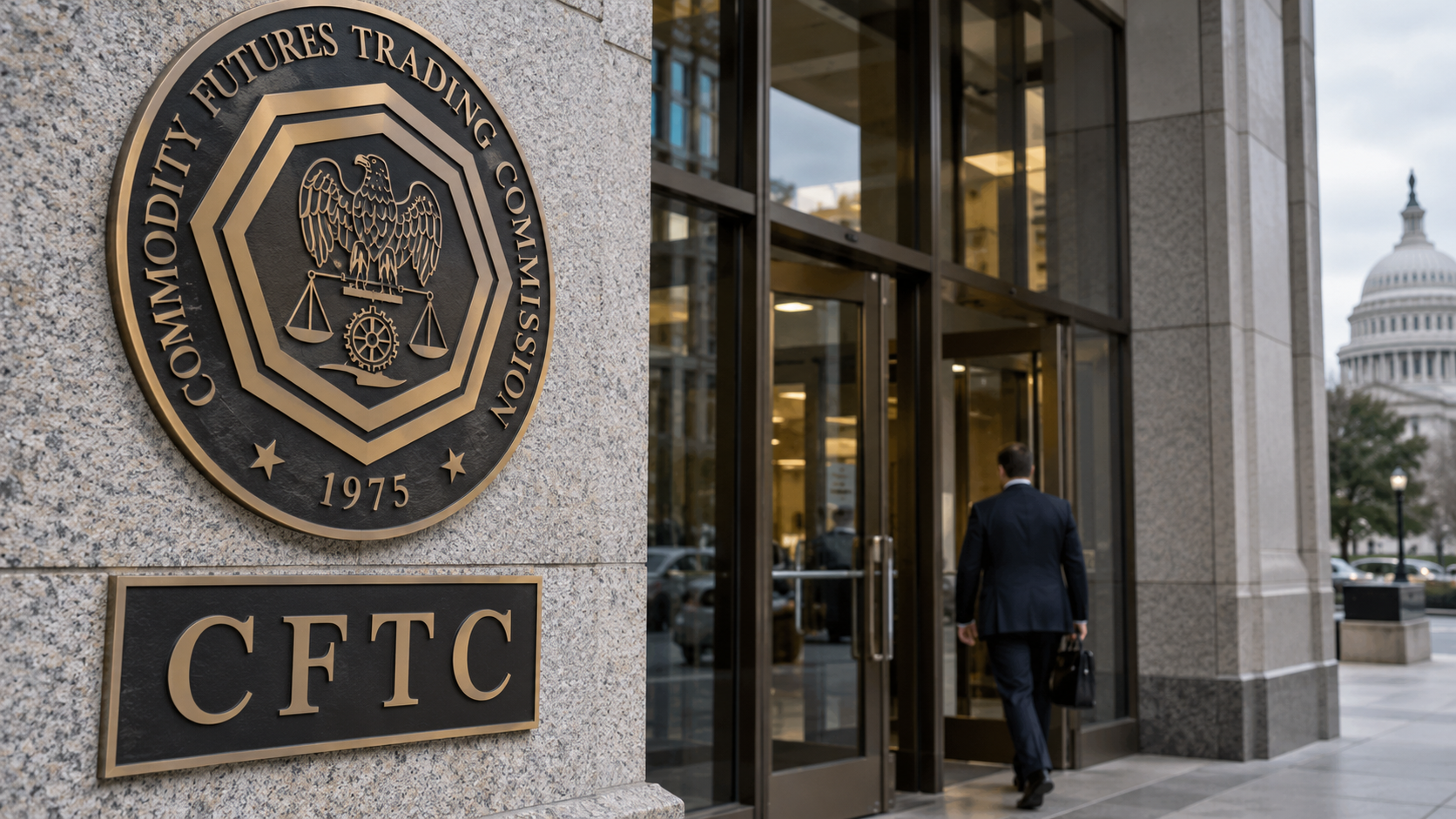
The agency's chair spoke 11 days before the midterms. Kalshi's lobbying spending rose sharply last quarter, Polymarket is suing Ohio, and two Polymarket Iran contracts sit unsettled past their deadlines.
The federal regulator for prediction markets says it is paying attention to the contracts that matter most before an election, and to the ones almost nobody trades.
Michael Selig, chairman of the Commodity Futures Trading Commission, said in an interview with Bloomberg released on Friday that the agency and the exchanges it oversees monitor political prediction-market contracts for manipulation, including contracts with low trading volume. He declined to discuss any investigations.
The comments came 11 days before the Nov. 3 midterm elections.
Why thin contracts are the risk
Manipulation is easier where there is little money on the other side. In a contract with deep liquidity, moving the price takes a large amount of capital. In a thin one, a few orders can swing the implied probability, and that swing can then be cited as a signal of what traders believe.
Prediction-market prices are increasingly quoted in coverage of elections, wars and central banks. That gives anyone who can move a small market an incentive to do so.
The gap between busy and quiet contracts is wide. On Polymarket, the contract on whether Democrats will control the Senate after the midterms traded at about 66.5 cents early Sunday, with about $1.94 million of liquidity. On Kalshi, the contract on a quarter-point Fed rate increase in October saw 139 trades over about 15 hours into Saturday morning.
A settlement test in plain view
Polymarket's contract on whether the U.S.-Iran ceasefire held through Oct. 22 offers a different kind of test. By early Sunday, about 60 hours after its deadline, the contract remained unsettled and its resolution status was still listed as disputed. Traders were paying about 99.65 cents for "yes." The Oct. 24 contract passed its own deadline on Saturday afternoon with no qualifying strike reported, and it had not been settled by Sunday morning either. The contract's rules turn on whether a U.S. strike hit Iranian territory before the deadline, and the grounds of the dispute have not been made public.
Settlement disputes are not manipulation. But they show how much weight these markets place on the process for deciding what happened, at a time when regulators are watching more closely.
The industry is lobbying and litigating
The platforms are pressing their own case. Kalshi's federal lobbying spending rose 40.4% in the third quarter, according to its lobbying disclosures, as the CFTC works on a rule governing event contracts.
Polymarket's U.S. arm, QCX LLC, sued Ohio on Oct. 16, seeking an injunction against the state's enforcement of sports-betting restrictions against it. Kalshi faces a Nov. 9 deadline to respond to New Jersey's petition at the Supreme Court.
Oversight as validation or constraint
For the platforms, active federal monitoring can be an argument in their favor. It supports their claim that they are regulated financial exchanges overseen by the CFTC, not gambling operators subject to state rules.
For critics, the same comments are a reminder that election contracts carry risks that traditional derivatives do not, and that thinly traded political markets can be moved by small amounts of money.
What to watch
Any CFTC action on political contracts before or after Nov. 3, the settlement of Polymarket's Oct. 22 and Oct. 24 Iran contracts, the progress of the event-contract rule, and the court fights in Ohio and New Jersey.