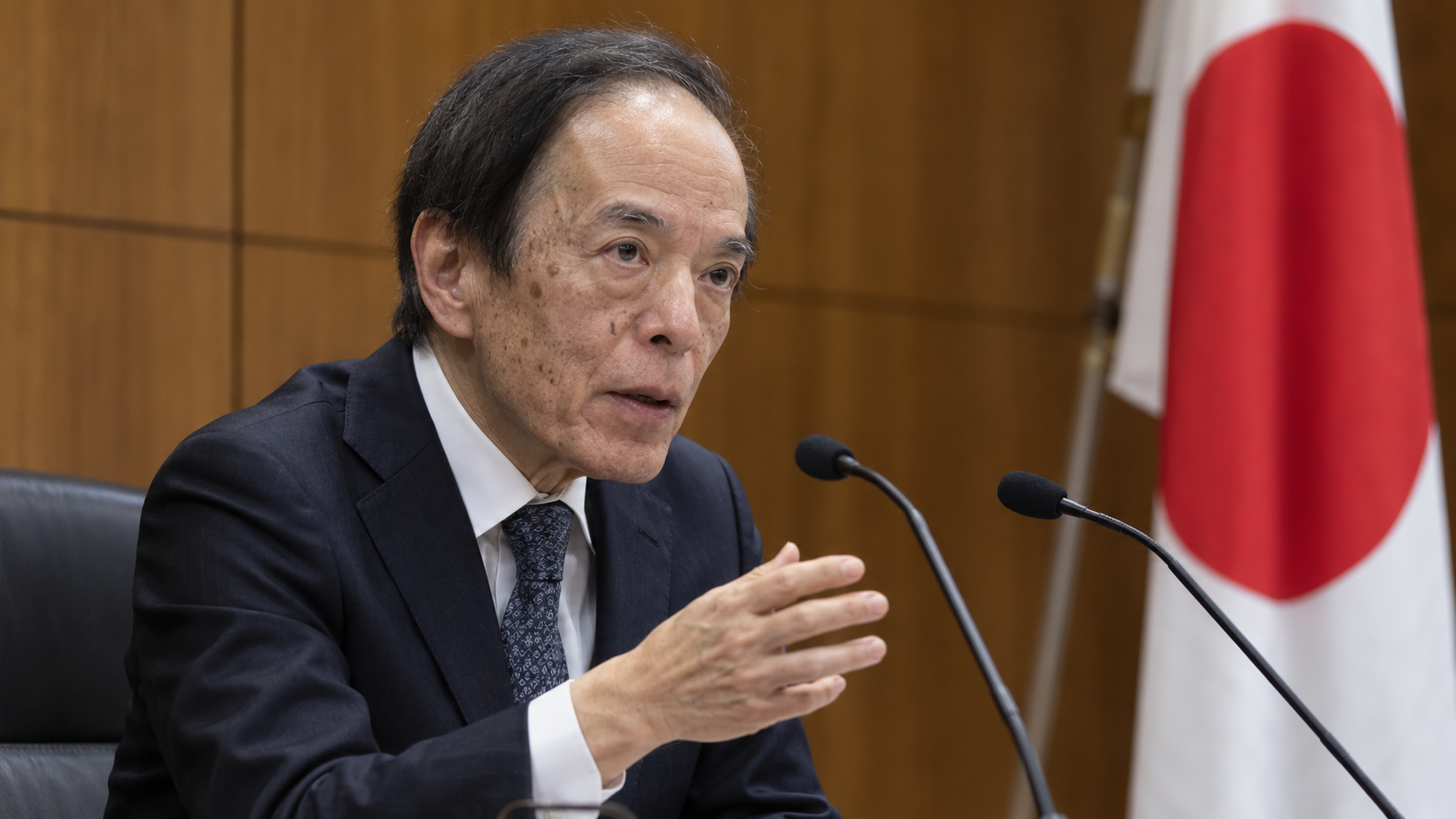
The central bank kept its policy rate at about 1.25% in an 8-1 vote, with one member pushing for 1.5%. Separately, it agreed unanimously to raise the pace of its exchange-traded fund sales to about 860 billion yen a year at book value from January.
The Bank of Japan did not raise interest rates on Friday. It did decide to unwind one of its most unusual holdings faster.
The bank held its short-term policy rate at about 1.25%. The vote was 8-1. Board member Takata proposed raising it to 1.5%. Governor Ueda reiterated that the bank expects to keep raising rates if its outlook is realized.
Selling Japan's stock market back
The bigger change concerned the bank's stockpile of exchange-traded funds, built up over more than a decade of buying Japanese equities to support markets. The board voted unanimously to raise the pace at which it sells those funds to about 0.1% of market trading value. That works out to about 860 billion yen a year at book value, up from about 330 billion yen, or roughly 2.6 times the current pace. At market value, the bank estimates the annual sales at about 2.46 trillion yen. The new pace begins in January 2027.
The gap between book and market value says something about the size of the holding. Because the funds were bought years ago at far lower prices, each yen of book value now represents nearly three yen of stock.
Why it matters for investors
For Japanese equities, the decision adds a steady seller. For the central bank, it is a form of quantitative tightening that runs through the stock market rather than the bond market.
The scale cuts both ways. About 2.46 trillion yen a year is a large sum in absolute terms. At roughly 0.1% of trading value, it is also designed to be small relative to daily turnover, which is why the bank can sell without trying to time the market.
The Nikkei 225 closed 2.1% lower on Friday at 63,290.11. That decline came on a day when technology stocks fell across Asia following results from Amazon and Intel, so it cannot be attributed to the bank's announcement.
Prices and the yen
The bank's outlook report said underlying inflation is in line with its target. Tokyo's core consumer price index rose 2.6% in October. The dollar was at about 157.20 yen early Friday, near the 157.40 level it reached after the decision.
A divided week for central banks
Japan's hold completes a week in which the major central banks split. The Bank of Canada raised rates on Wednesday. The Federal Reserve held the same day, with two officials voting for a hike. New Zealand's central bank held in a 4-3 vote, and the ECB held on Thursday after debating an increase. Takata's dissent puts the Bank of Japan, too, on the list of central banks with a member arguing for tighter policy now.
Slow drain or nonevent?
The headwind view: the bank is committing to sell equities for years, at about 2.6 times the current pace, and that supply will be there regardless of market conditions.
The nonevent view: sales equal to about 0.1% of trading value are small next to daily flows, the start date is two months away, and the forces moving Japanese stocks right now, such as global technology spending, are much larger.
What to watch
Takata's reasoning in the bank's summary of opinions, Tokyo and national inflation data, the yen near 157, and the next policy meeting, where a rate increase would test how much further the bank is willing to go.