

Yesterday we said Alphabet and Meta had already gone to the stock market to pay for AI, and that any sign Microsoft needed outside money would make it three. Microsoft didn't need it. Alphabet's filing last night showed what the other path looks like a quarter later. Through September of last year, Google's parent spent $39.8 billion buying back its own shares. Through September of this year, it bought back none, sold $42.9 billion of new ones and drew on its at-the-market share program for the first time. Its cloud business more than doubled, and the stock was indicated about 10% lower anyway, well below the $355 it sold shares at in June. Microsoft spent less than expected and was indicated higher. Oracle promised to cap its capital-markets fundraising and rose 11% on Wednesday. The AI trade may have a new scorecard, and it isn't only how much you build.
But before we get to that, let's take a quick look at the markets and what matters today…
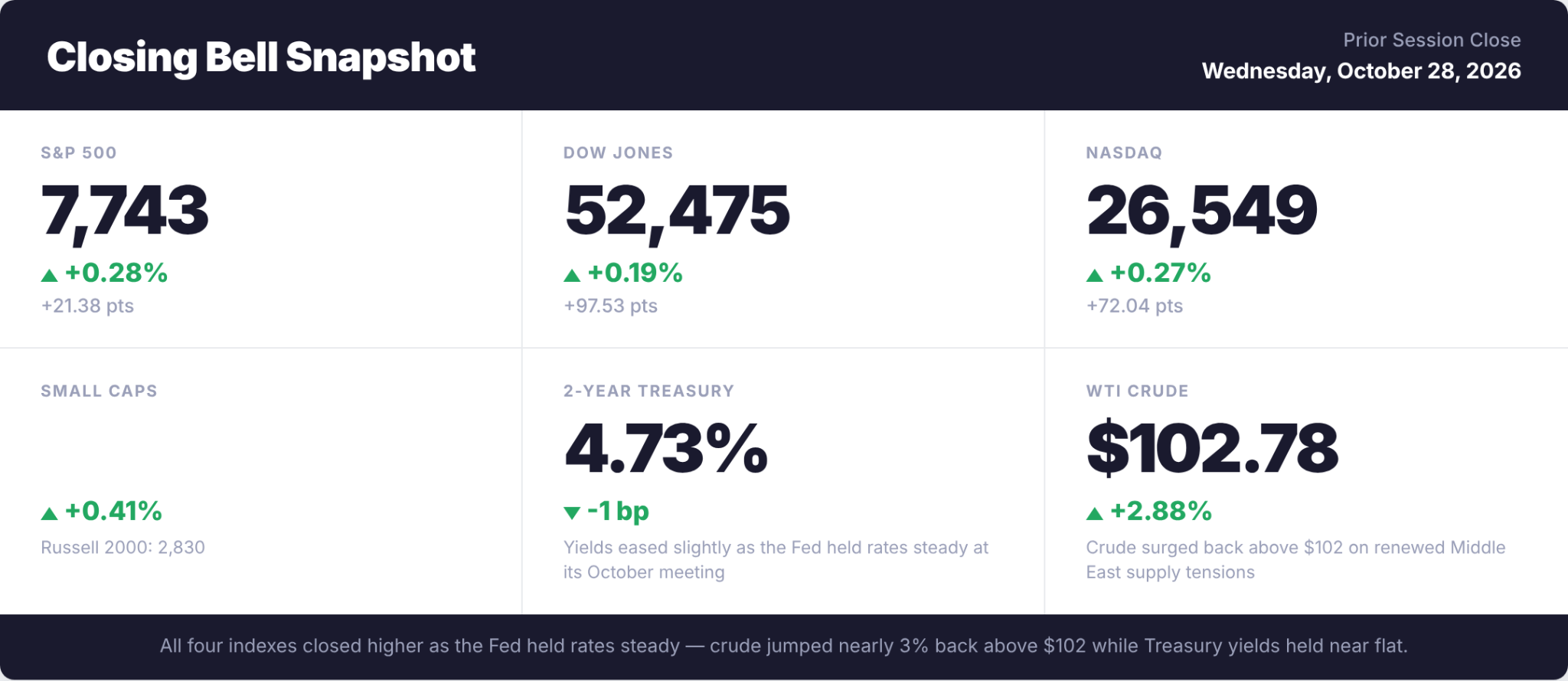
3 Movers in 3 Minutes
1. ServiceNow pitched "no capital or compute constraints." Early quotes say investors weren't buying. ServiceNow (NOW) was indicated about 19% lower before the open, near $122, after a quarter that looked fine on its face. Revenue rose 20.5% to $4.11 billion, it raised its AI contract target to $1.7 billion and it guided subscription growth to accelerate to 22.5% to 23% next quarter. Its release went further: "What other company at the forefront of the agentic enterprise has no capital or compute constraints?" Adjusted earnings of $1.00 a share missed by 2 cents, and one forward line drew attention. Current remaining performance obligations, the contracted revenue due over the next 12 months, are guided to grow 18.5% next quarter, down from 20.5%. The finance chief said early renewals pulled into the third quarter supplied about half of its cRPO beat, and that a higher mix of on-premises deals weighs on the measure. Bloomberg tied the drop to lingering fears that AI will disrupt the software maker. One reading: software is being priced on the slope of future bookings, not this quarter's revenue. On the same night Alphabet showed what owning the infrastructure costs, being the capital-light AI company didn't protect the multiple in early trading.
2. Marvell went shopping, and its own shareholders paid. Bloomberg and Reuters, each citing unnamed sources, reported that Marvell (MRVL) is in advanced talks to buy Lumentum (LITE), the laser and optical-parts maker Nvidia backed with a $2 billion investment in March. No agreement has been announced; Bloomberg said one could come as soon as next week. Lumentum was worth about $83 billion at Wednesday's close, roughly 38% of Marvell's value. In early premarket trading Marvell was about 11% lower and Lumentum about 5.5% higher. By our arithmetic, Marvell's holders lost about $24.5 billion while Lumentum's gained about $4.6 billion, though Marvell had already slipped about 2% after hours on the Big Tech reports before the deal news broke. Marvell held $3.93 billion of cash at the start of August, and Bernstein told Reuters a deal that size "would likely require additional financing." No terms have been reported, but early quotes suggest investors expect a large, stock-heavy purchase at a peak-cycle price, with the buyer's shares as the currency.
3. Utah turned a $114.87 sting into felony charges against Kalshi's founders. Utah filed 14 criminal counts against the prediction-market operator and co-founders Tarek Mansour and Luana Lopes Lara on Wednesday, including 12 third-degree felony counts of online gambling promotion. Each of the 12 third-degree counts maps to one of 12 sports contracts an undercover state investigator bought from a Utah account opened Sept. 13, risking $114.87 in total, as described in the charging documents. Kalshi called it "crazy overreach" and said "Utah is clearly playing politics." The state issued summonses, not arrest warrants, and no one has been convicted. Earlier this week, the Justice Department and the CFTC had sued Utah, arguing federal law pre-empts state gambling rules. Yesterday we noted that Robinhood now makes more from event contracts than from stocks or crypto, and that about 70% of that activity is sports. The legal risk underneath that revenue line just moved from civil suits against companies to criminal charges naming executives, and sports contracts are where the states are pushing hardest.
3 Signals for Today
GDP grades the Fed's investment boom at 8:30 a.m. On Wednesday, Fed Chair Kevin Warsh said business investment was "likely rising at about a double-digit pace" and that "high-tech investment is leading the acceleration." Hours later, Alphabet and Microsoft both reported capital spending below estimates: $51.4 billion against about $55.1 billion, and $45.2 billion against $50.7 billion. Microsoft blamed late deliveries of third-party capacity, guided above $50 billion this quarter and trimmed its 2026 outlook to about $170 billion from about $175 billion, citing the same delays. On the companies' own account, the undershoot looks more like timing than retreat. Economists surveyed by the Wall Street Journal expect third-quarter growth of 3.1%, and September PCE inflation lands at the same time, expected at 3.7% headline and 3.1% core. What it could change: strong equipment and software investment plus hot core inflation hardens a December hike, already priced near 85% in futures, and keeps pressure on the long end of the curve, which is exactly where Big Tech is now borrowing.
Blue Owl reports before the bell from the other side of the AI money trade. When hyperscalers would rather not carry data centers on their own books, private capital does. Meta's Hyperion campus in Louisiana sits in a joint venture with Blue Owl-managed funds, financed partly with $27.3 billion of privately placed bonds, and Blue Owl has about $3 billion of equity in the New Mexico campus being built for Oracle and OpenAI, a person familiar with the matter told Reuters. Oracle sent the project's developer, a Blue Owl unit, a force majeure notice in September. Blue Owl (OWL) closed at $9.67, about 44% below its 52-week high, and investors asked to pull $4.2 billion from its two non-traded credit funds last quarter, down from $4.7 billion. What it could change: if Blue Owl's infrastructure pipeline and fundraising are still growing, private credit remains a release valve for the buildout. If they are shrinking, more of the AI bill lands on public bond and stock markets, the path Alphabet just took. The call is at 10 a.m.
Amazon closes the AI spending week tonight, and Coinbase reports into new Wall Street plumbing. Amazon (AMZN) reports after the close, with consensus near $1.97 a share on about $202 billion of revenue, and the stock indicated about 1% lower. After Alphabet, the number that matters is less AWS growth than whether operating cash still covers the capex. If Amazon funds its buildout from cash, last night looks like a Google problem. If it doesn't, it looks like an industry one. Coinbase (COIN) and Strategy (MSTR) also report, with bitcoin near $80,000, down about 1.5% overnight. They report a day after the Depository Trust & Clearing Corp., which holds more than $114 trillion of assets in custody, launched its tokenization service with 20 firms signed up, including JPMorgan, Bank of America, Citi and Morgan Stanley. It runs on the Canton Network and DTCC's own private network, not on open public chains. Wall Street's version of on-chain finance is being built on rails the incumbents control, and crypto platforms will have to show where they fit.
7 Income Machines Built to Make You Rich
The 7 Stocks to Buy and Hold Forever aren’t just plays for the next quarter - they’re built to deliver for decades.
These are blue-chip companies with fortress balance sheets, elite dividend track records, and the staying power to outperform in bull and bear markets alike.
Some are Dividend Kings, others are on the path there, and all are proven wealth compounding machines.
Download the full list now - before it disappears behind the paywall.
And with that out of the way, let's get to today's big story: the night Google's buyback machine ran in reverse.
The Sip
A Great Quarter, a 10% Drop
On almost any operating measure, Alphabet (GOOGL) had a strong third quarter.
Revenue rose 25% to $127.6 billion. Google Cloud revenue more than doubled to $30.7 billion, and its operating income tripled to $11.1 billion. The company said year-over-year growth in search queries was the fastest in five years.
The stock was indicated about 10% lower before the open, near $291. On early quotes, that's more than $400 billion of market value.
Some of that is ordinary earnings math. Advertising revenue came in about $1.4 billion short of forecasts, according to LSEG data cited by Reuters, and adjusted earnings of $2.67 a share missed the $3.02 analysts expected. A paper loss on its investment holdings, mainly its SpaceX stake, cut reported earnings by 55 cents a share.
But the line that changes what it means to own Alphabet sits further down, in the cash flow statement.
From Buyer to Seller
Through the first nine months of 2025, Alphabet spent $39.8 billion repurchasing its own shares. Through the first nine months of 2026, it spent nothing.
It went the other way. In June, Alphabet sold about $20.7 billion of common stock at roughly $355 a share, $19.3 billion of mandatory convertible preferred paying 6.25% and $10 billion of stock to Berkshire Hathaway, and set up a $40 billion at-the-market program. The underwritten part was the largest U.S. follow-on offering on record, according to LSEG data. Last quarter Alphabet drew on the at-the-market program for the first time, selling $12.4 billion of Class A and Class C shares. It has said that program's proceeds are primarily meant to cover tax obligations on employee stock grants. The cash still lands on the same balance sheet that's funding the buildout, and $27.6 billion of room remains.
All told, Alphabet has raised $42.9 billion from common stock this year. It also raised $85.2 billion from debt, which took long-term borrowings to $125.1 billion at the end of September from $46.5 billion at the end of 2025.
The cost is already visible. Interest expense was $967 million last quarter, against $143 million a year earlier.
So is the share count. Alphabet had 12.09 billion shares outstanding at the end of last year and 12.29 billion at the end of September. The buyback that used to shrink that number is gone, and new supply has replaced it.
And the June buyers are underwater. Shares sold at about $355 were indicated near $291 on Thursday, roughly 18% lower. Meta, which sold stock at $625 a share this week, now has the same scoreboard to watch.
It Didn't Overspend. That's the Problem.
Here's the counterintuitive part. Alphabet spent less than Wall Street expected. Purchases of property and equipment were $51.4 billion, against estimates near $55.1 billion.
Free cash flow was still negative $9.1 billion, when analysts polled by LSEG had expected roughly breakeven, Reuters reported. The second quarter's negative $5.9 billion was the first negative quarter in Alphabet's 22 years as a public company.
The gap came from the other side of the ledger. Operating cash flow fell to $42.3 billion from $48.4 billion a year earlier, even as operating income rose 30%. Finance chief Anat Ashkenazi pointed to two causes: a $5.2 billion payment on a 2018 European Commission fine, and inventory built up for TPU system sales.
The fine is a one-time hit. The inventory is not. Google now sells its custom AI chip systems to outside customers, and a hardware business ties up cash in a way search advertising never did.
Then there's the forward line. Ashkenazi said capital spending will "increase significantly" in 2027, on top of $195 billion to $205 billion this year. The funding question isn't a one-quarter patch. It's the operating model for next year.
People paid $8,000… yours for FREE

Some people have paid $8,000 to be in the room with Luke Lango in Las Vegas. But he believes the new Elon venture he's uncovered (not space or AI) is so big that EVERYONE needs to know about it. See how to get in while we're still early here.
This ad is sent on behalf of InvestorPlace Media at 1125 N. Charles Street, Baltimore, Maryland 21201. If you're not interested in this opportunity, pleaseclick here.
Three Report Cards in One Night
Set Alphabet next to the other two AI builders that updated investors this week.
Microsoft (MSFT) also spent less than expected, $45.2 billion against a $50.7 billion estimate. It also trimmed its 2026 spending outlook to about $170 billion from about $175 billion, citing the same delays. It still produced positive free cash flow and returned $10.2 billion to shareholders in dividends and buybacks last quarter. Its stock was indicated about 3% higher.
Oracle (ORCL) burned about $23.7 billion of free cash flow in its last fiscal year. On Wednesday it promised to cap new capital-markets funding at $20 billion through fiscal 2030, on top of a $20 billion stock sale already done, and put a date on positive free cash flow. Its 2030 revenue target matched what analysts already had. The stock rose 10.6% anyway.
One reading of the three: investors have stopped grading AI spending by its size and started grading it by who funds it. Microsoft pays from cash. Oracle drew a ceiling. Alphabet showed an open tap, with equity capacity left and more spending coming.
It is one reading, not the whole story. Alphabet's ad shortfall and earnings miss would have hurt the stock on their own. But a 10% drop on a quarter with 103% cloud growth says the market is weighing more than the income statement.
Where the Bill Lands
The second-order effects run through three markets.
The first is bonds. A Bank for International Settlements bulletin published this week found that in 2026, hyperscaler bonds with maturities of 10 years or longer made up about 24% of corporate issuance at those maturities and about 13% of gross Treasury issuance, up from about 3% and 1.5% in 2024. The same bulletin found that bond-market spillovers on AI-financing news days have so far been small and short-lived, but warned that sustained issuance at this pace could change that. Long yields are already under pressure: the 10-year closed at 5.04% on Wednesday, the day the Fed held rates, after its biggest one-day rise since Sept. 28. Every long bond Alphabet sells competes with Washington's.
The second is the stock market's plumbing. For years, mega-cap buybacks were one of the steadiest sources of demand for these shares. When the biggest repurchasers become issuers, that bid doesn't just pause. It flips into supply.
The third is the supply chain. Neocloud stocks that rent out AI capacity fell after hours as investors weighed lower-than-expected capex from Microsoft and Alphabet. CoreWeave (CRWV) was indicated about 6% lower. Less spending than planned and more expensive funding is not the mix the buildout's middlemen want.
What Would Change the Read
The bull case for Alphabet stands on its own numbers. Cloud revenue more than doubled, cloud profit tripled, and the company is now selling its chips to others. If 2027's spending turns into revenue at that pace, today's financing looks like a builder borrowing against a full order book. Alphabet also still holds $265.1 billion of cash and marketable securities, including $90.4 billion of stock holdings.
The bear case is the trajectory. Spending rises significantly next year, the share-sale program is still open, interest costs are compounding, and the core ad business just missed.
What settles it comes in stages. Tonight, Amazon shows whether this is one company's funding gap or the industry's. Alphabet's next earnings call should put a number on 2027 capex. In between, watch the ATM: whether Alphabet keeps selling shares near $290, and whether a single dollar of buybacks returns.
Elon's audacious plan to double U.S. energy,
without building a single new power plant…
People think he's crazy.
But Adam O'Dell says he's already deployed 4,000 units of his solution across 14 states — and used them to power the largest supercomputer on the planet.
With Microsoft, Amazon, Google and Facebook set to spend $680 billion this year on AI data centers that can't get enough power to run, Elon's solution is about to be in extraordinary demand.
Go here now to see how he's going to do it — and get one of Adam's top picks to play it absolutely free.
The Market Sips Takeaway
For two years the AI trade asked one question: how much will the giants spend? Last night it may have started asking a second one: who pays for it? Alphabet answered with bonds, preferred stock and $42.9 billion of new shares, and early quotes marked it down about 10% in a quarter when cloud revenue doubled. Microsoft paid from cash and was indicated higher. Oracle capped its fundraising and jumped. The shift would be confirmed if Amazon's free cash flow disappoints tonight and Alphabet keeps tapping its share program at lower prices. It would break if 2027 spending plans arrive with cloud revenue strong enough to make the financing look cheap, or if buybacks quietly come back. Don't watch only the spenders. Watch who takes the other side: long-dated Treasuries, investment-grade credit and private lenders like Blue Owl. The cash machine just became a borrower. The market is starting to price it like one.
Until then, sip slowly!
The Market Sips Desk
Reply prompt: Would you rather own the AI giant that funds its buildout from cash, or the one raising money to build faster? Hit reply and tell us which, and why.
Rates Just Reset. Who Feels It First?
On January 2, the 10-year yielded 4.19%. By September 30, 5.29% — most of it in one quarter.
Some companies earn from higher rates. Some pay. Each runs on a different clock.
We traced three: IBKR, WRB and FIS. One has already reported. The other two report next, and the report tells you the exact line to check.
Free report, texted to your phone.