

This week the AI build-out was priced in three markets, and all three asked for a discount.
Chip stocks fell 6.7% Thursday. Insurance on Meta's debt hit a record. After Thursday's close, the third market showed up: reports said OpenAI's funding talks had moved to a $1.25 trillion valuation, $150 billion below the number on the table earlier this month.
That's still a markup. But this time the private price moved toward the public one, not away from it.
That's today's Sip.
But before we get to that, let's take a quick look at the markets and the three moves that set up the day.
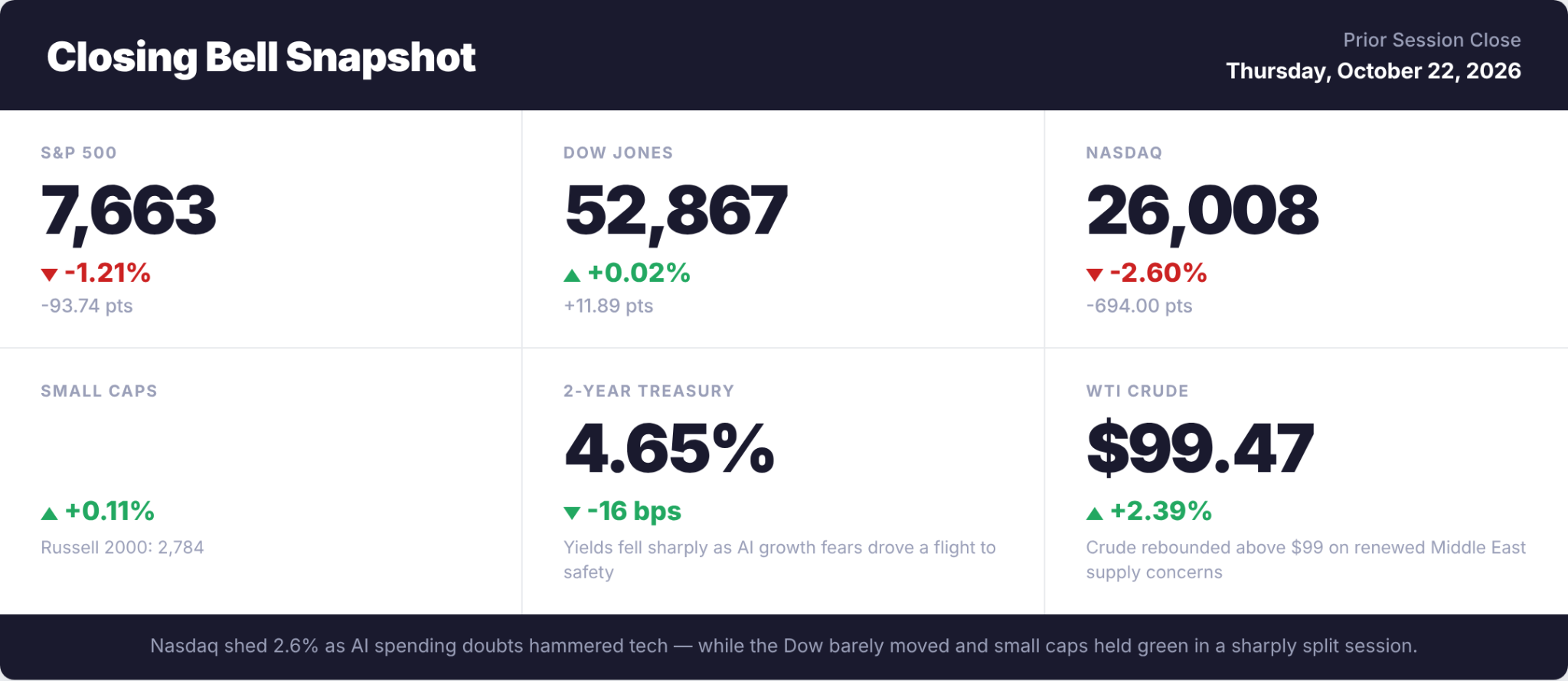
3 MOVERS IN 3 MINUTES
1. Western Digital beat, raised, and still got sold. Western Digital (WDC) reported revenue of $4.38 billion, up 55%, and adjusted earnings of $4.64 a share against about $4.08 expected. It guided next-quarter revenue up 66% to 72%. The shares had already fallen 6.4% in Thursday's selloff before the report. After hours they rose about 4%, then fell more than 8% as management flagged rising input costs and higher capital spending. They were about 4% lower early Friday.
Bloom Energy (BE) raised its full-year outlook after revenue jumped 138%, and it fell after hours too. Thursday's selloff hit power and turbine stocks harder than chipmakers, and the Philadelphia Semiconductor Index closed down 6.7%. For AI suppliers, the beat is now the entry fee. The question is what the next dollar of growth costs to build.
2. Bitcoin funds gave back more than half of three days' buying in one. U.S. spot bitcoin ETFs had about $635 million of net outflows Thursday, per Farside and SoSoValue, the biggest one-day withdrawal since June by SoSoValue's count. BlackRock's IBIT lost about $254 million. The three sessions before had brought in more than $1 billion.
3. Deckers raised profits on tariff refunds and cut sales on shoppers. Deckers (DECK), the maker of HOKA and UGG, grew sales 3.5% to $1.48 billion, short of the roughly $1.51 billion expected. It lowered its full-year sales outlook to $5.70 billion to $5.725 billion and raised its earnings outlook to $7.80 to $7.95 a share. That earnings range includes about $0.52 a share of refunded tariffs. The CEO cited "a challenging consumer environment." The stock was about 8% lower early Friday. The profit raise came from Washington. The sales cut came from customers.
3 SIGNALS FOR TODAY
1. American Express and SLB reported before the bell. American Express (AXP) earned $4.68 a share adjusted, against about $4.50 expected, as revenue rose 9% to $20.1 billion and card spending grew 8% to $454 billion. It raised its full-year forecast. SLB (SLB) earned $0.64 a share excluding charges, against about $0.62, on revenue up 6% to $9.45 billion, with its Middle East business up 13% from the prior quarter despite late-quarter disruptions. Amex's card spending grew 8% a day after Deckers flagged a challenging consumer; its 8:30 a.m. call is where that gap gets explained. SLB's stock at the open says whether WTI above $100 is reaching the companies that drill, not just the ones that pump.
2. The growth test, now in two time zones. Europe answered first. France's composite PMI fell to 48.4 from 51.1, back in contraction, and the eurozone slowed to 51.9, below the 52.7 expected. The U.S. flash PMI lands at 9:45 a.m. Eastern, with forecasters looking for 57.6 from 58.4. A soft U.S. print backs Thursday's bond rally. Moody's then reviews France's rating after the European close, with its private sector contracting by the PMI's measure on the day of the decision.
3. Brazil votes Sunday, and the odds and the polls disagree. Datafolha's final-week poll has Flávio Bolsonaro and Lula tied at 50% of valid votes, after Bolsonaro led 51-49 a week earlier. On Polymarket, Bolsonaro's contract dipped about 2.5 cents after the poll and was back near 77 cents early Friday. A contract price is a probability of winning, not a vote share, so a tie doesn't mean 50 cents. But if Sunday's count runs close, that 77 is the number most exposed.
Now, back to the most expensive private company in AI.
The 7 Stocks Built to Outlast the Market
Some stocks are built for a quarter… others for a lifetime.
Our 7 Stocks to Buy and Hold Forever report reveals companies with the strength to deliver year after year - through recessions, rate hikes, and even the next crash.
One is a tech leader with a 15% payout ratio - leaving decades of room for dividend growth.
Another is a utility that’s paid every quarter for 96 years straight.
And that’s not all - we’ve included 5 more companies that treat payouts as high priority.
These are the stocks that anchor portfolios and keep paying.
This is your chance to see all 7 names and tickers - from a consumer staples powerhouse with 20 years of outperformance to a healthcare leader with 61 years of payout hikes.
The report is free for a limited time - go here to get it now.
The Sip
OpenAI's price came down $150 billion. It's still a 47% markup.
OpenAI is close to raising up to $30 billion at a $1.25 trillion valuation. Earlier this month the number on the table was $1.4 trillion. Coatue is in talks to co-lead, alongside several investment funds from the United Arab Emirates. Bloomberg says commitments could be finalized by the end of next week, and that details could still change.
In March, OpenAI raised $122 billion at $852 billion, including the new money. So this is an up-round, roughly 47% higher in seven months. Nobody is calling it a down round, and nobody should.
But the direction of the talks matters more than the level.
Three markets, one message
This week the AI build-out was priced three ways.
In stocks, the Philadelphia Semiconductor Index fell 6.7% and Western Digital's beat-and-raise got sold.
In credit, Meta's five-year default swaps hit a record a day after it reported capital spending above its operating cash flow.
In private markets, reports after Thursday's close showed the price under discussion for the largest AI company had moved down $150 billion before signing.
None of these markets said AI is broken. All three said the same thing: the next dollar of AI growth should cost the investor less than it did a month ago.
Who is setting the price
The buyers matter. Coatue invests in public and private tech, so it trades the same tape that sold chip stocks Thursday. The Gulf funds bring scale few others can match, with Brent above $114 amid attacks on Saudi Arabia. One reading: a round led by those two is priced by investors who watch public markets daily, not by venture funds marking their own books.
A "bloodbath" Is Coming

Silicon Valley billionaires are hoarding guns, gold, and even military grade gas masks... or fleeing the country altogether. What do they know that you don't? This AI insider is stepping forward with this time-critical message: Move your money before October 31st, ahead of the dangerous next phase of the AI market. Here's the one urgent move you need to make with your money immediately.
This ad is sent on behalf of TradeSmith at 1125 N. Charles Street, Baltimore, Maryland 21201. If you're not interested in this opportunity, please click here.
Not every private round is bending. China's DeepSeek is wrapping up a roughly $15 billion round after raising its target at least twice, with corporations like CATL and Tencent among the biggest backers. The gap between private markups and public markdowns is the story to track.
A public price is coming
That gap gets tested soon. OpenAI has said it won't go public this year. Anthropic's IPO is expected next month, by Bloomberg's account.
That makes Anthropic's listing a rare case of public investors, not a private syndicate, putting a price on a frontier AI lab on its own. If they pay up, OpenAI's $1.25 trillion looks conservative. If they don't, every private AI round signed this year, OpenAI's included, gets a reference point it didn't choose.
What would change the read
Next week brings the evidence. Microsoft and Alphabet report Oct. 28 and Amazon Oct. 29, with each one's capital spending plan a direct read on how much AI demand they still want to buy. If the round closes at $1.25 trillion and the full $30 billion, the $150 billion was a negotiation. If the price slips again before signing, it's a trend.
On December 10th, a powerful new law signed by President Trump
will trigger a radical shift in America’s money system...
When a small group of private companies — not the Fed — will perform a major mint of a new kind of money.
And those who act before this new system fully kicks in could see gains as high as 40X by 2032.
But those who fail to prepare will be blindsided by this sea change to the U.S. dollar.
Go here now for the details — before the December 10th mint hits the market.
The Market Sips Takeaway
Private AI valuations didn't break this week. They bent toward public prices.
- What confirms it: OpenAI's round closes below its earlier ask or smaller than $30 billion, and Anthropic's IPO prices below the private marks around it.
- What breaks it: the round closes at $1.25 trillion in full, hyperscalers raise capex plans next week, and chip stocks recover Thursday's losses.
- Where it shows up next: crossover funds and listed vehicles that hold private AI stakes, AI suppliers whose orders depend on those rounds closing, and Meta's credit spreads.
The private market didn't mark AI down. It just stopped marking it up on request.
UNTIL THEN, SIP SLOWLY!
The Market Sips Desk
Today’s reply prompt: If Anthropic lists next month, would you pay more or less than private investors did? Hit reply.
Same Rate Move. Three Different Bills.
The 10-year went from 4.19% to 5.29% this year. Every company on your screen felt that. They don't feel it on the same schedule.
Some earn more when rates rise. Some pay more. The difference shows up in earnings, one report at a time.
We traced three of them: IBKR, WRB and FIS.
FREE Special Report: Rates Just Reset. Who Feels It First?
Who earns it fast. Who earns it slowly. Who pays. One has already reported. The other two report next, and the report tells you the exact line to check.
We'll text the report straight to your phone.
Text Me the Three Names → (free)