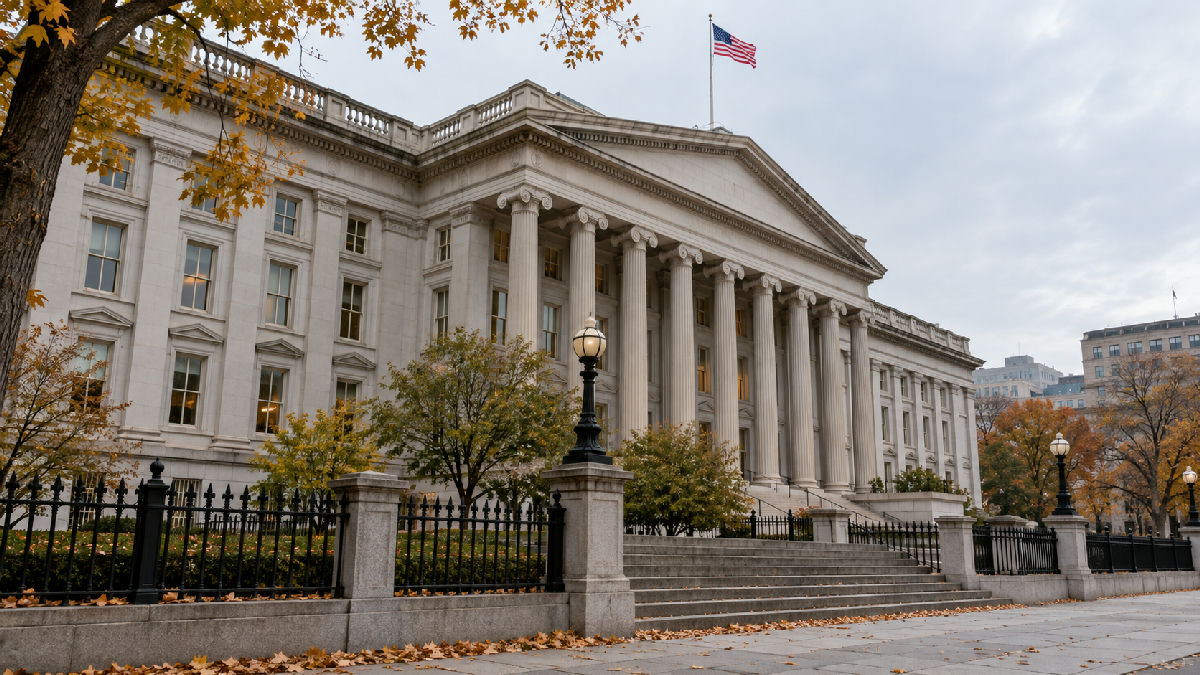
The 10-year yield dropped to about 4.93%, its lowest in seven weeks, as the Nasdaq slid about 3%. On the same day a Fed official said another increase is needed "soon," and prediction markets still put the odds of a December hike near three in four.
The Treasury market and the Federal Reserve are sending investors opposite signals on the last trading day of October.
By early afternoon Friday the 10-year Treasury yield was about 4.93%, down roughly 5 basis points from Thursday's Treasury close of 4.98% and at its lowest level in seven weeks. The two-year yield, the maturity most tied to Fed policy, traded below 4.61% after closing there on Thursday. Treasuries are heading for their sharpest monthly gain in about three years, Reuters calculated.
Nothing in the Fed's own messaging points that way. The central bank held its benchmark rate at 3.75% to 4% this week, with two policymakers dissenting in favor of a hike. On Friday, St. Louis Fed President Alberto Musalem said "additional firming of monetary policy will be necessary, and soon." Kalshi's contract on a quarter-point increase in December traded at 73 cents, up 2 cents since early Friday.
What came with the buying
The bond rally arrived with a broad retreat from risk. The Nasdaq Composite fell about 3.1% and the PHLX Semiconductor index about 8%, as Intel's forecast and Amazon's cash-flow figures renewed questions about the price of the AI buildout, Reuters and the Wall Street Journal reported. Amazon's free cash flow over the past 12 months was an outflow of about $42.4 billion, after a $94.8 billion increase in capital spending. The VIX volatility index rose above 21.
The rest of the tape looked like a classic haven day. The dollar index fell about 0.35% to 101.84, a utilities ETF rose about 1% and homebuilders edged higher. Credit was calmer than stocks: a widely traded high-yield bond ETF slipped only about 0.3%.
Two readings of the rally
One reading is that long-term yields have started to trade on growth risk rather than inflation. If the AI spending cycle produces less cash than investors assumed, the economy's strongest source of business investment could slow, and long bonds could rally even if the Fed raises rates once more.
The other reading is that this is a month-end flight to safety that leaves the inflation picture untouched. Prices for personal consumption expenditures rose 3.6% from a year earlier in September, with core prices up 3.1%. Brent crude is on course for a gain of nearly 14% in October, and the Bank of Canada raised rates this week. On that view, a firm payrolls report or heavy Treasury supply could reverse Friday's move quickly.
The two-year yield is the tell. It fell alongside the 10-year on Thursday and again on Friday. A sustained decline at the short end would mean traders are starting to doubt the hike itself, not just the economy beyond it.
What to watch
Treasury's financing estimates on Monday, Nov. 2, and its refunding statement on Wednesday, Nov. 4; the ISM manufacturing survey on Monday; the October jobs report on Friday, Nov. 6; and the Fed's Dec. 8-9 meeting.