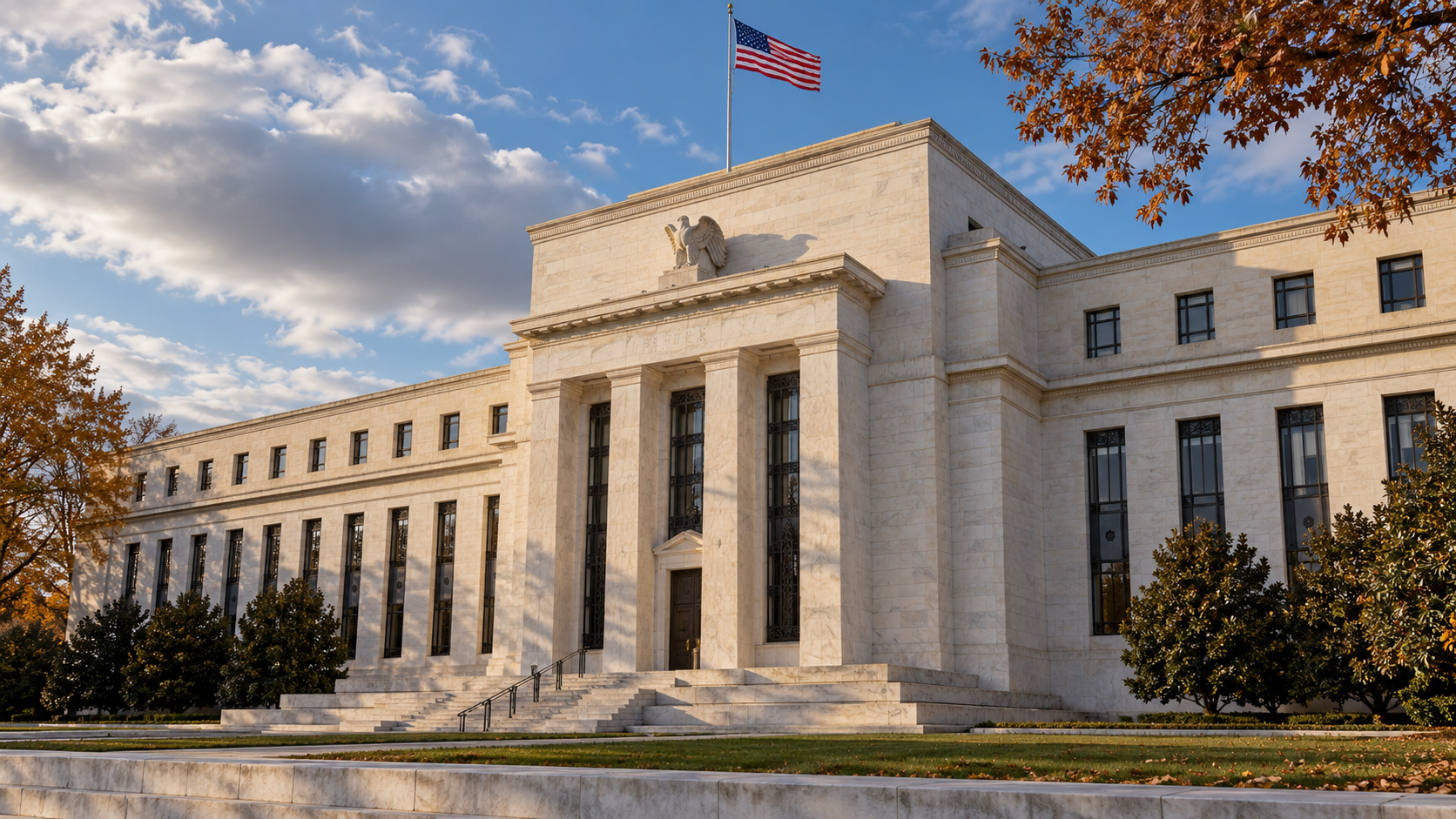
The record of the September meeting shows a unanimous increase, a majority leaning toward one more and a few officials naming AI-related borrowing among the forces lifting long-term yields. Futures still put October odds near 20%.
The Federal Reserve's account of its September meeting arrived on Wednesday with the headline sentence many traders expected. The less-quoted passages explain why policymakers think rates may have further to go.
"Most participants assessed that another increase in the target range for the federal funds rate would likely be appropriate by year end," the minutes said. The committee voted 12 to 0 at that meeting to raise its benchmark range by a quarter point to 3.75% to 4%, its first increase since 2023. Officials described future decisions as meeting by meeting and dependent on incoming data.
The neutral rate
Three passages go beyond the year-end line. "Several participants stated that they viewed the current policy rate as not restrictive or only mildly restrictive." "A couple of participants remarked on having increased their estimate of the neutral federal funds rate," the level that neither speeds up nor slows the economy. And "many participants emphasized that a higher path for the target range would be prudent on risk-management grounds," while "a number" said a higher path was necessary on their central forecasts.
Taken together, those statements describe a committee in which some members think policy is barely tight at 3.75% to 4%. If the neutral rate itself has moved up, a given policy setting does less work than officials once assumed, which would leave room for further increases without policy becoming especially restrictive.
Inflation expectations
The minutes also show unease about how long inflation has stayed high. "Some participants expressed concerns that, after more than five years of inflation above 2 percent, elevated inflation rates could begin to affect inflation expectations and wage- and price-setting decisions." Participants generally saw inflation risk tilted to the upside, and some said it had become more so in recent months.
Fed staff estimated that total inflation as measured by the personal consumption expenditures index ran at 3.6% in August, with the core measure at 3.2%, under the Commerce Department's new methodology. Officials cited energy prices, including crude and refined products, and "surging AI-related investments" among the sources of pressure.
Long-term yields
On bond markets, "a few participants" listed possible reasons for the recent climb in long-term Treasury yields: data pointing to a stronger economy, "increased expectations for AI-related borrowing," and geopolitical developments. "Many participants" said financial conditions still appeared supportive of growth despite that climb.
Timing
The minutes describe a meeting held and 16. Since then, the August inflation report came in softer and the government reported that employers added only 29,000 jobs in September, with unemployment at 4.2%. Futures traders price roughly a 20% chance of an increase at the and 28 meeting and about an 85% chance by December.
The S&P 500 traded near its best level of the session within about 20 minutes of the 2 p.m. release, down about 0.2%. The 10-year Treasury yield sat near 5.28%, close to where it had been just before the minutes came out.
Two readings
One reading is that the minutes confirm a tightening bias that has not changed, with the October pause in market pricing a question of timing rather than direction. On that view, a higher neutral-rate estimate and five years of above-target inflation leave officials inclined to move again.
Another reading is that the document is a snapshot that later data have already overtaken. The jobs report and the softer inflation print both arrived after the meeting, and traders repriced October accordingly.
The data ahead
The September consumer price index on is the last major inflation report before the Fed meets. Any change in how officials describe the neutral rate in speeches before then, and whether December odds hold near 85% after that release, will show which of the two readings the committee is closer to.