
Productivity gains "remain elusive," one bank says. Washington wants to win the race.

$30 trillion
What the world could spend on data centers by 2050, by one projection. That is almost the value of all U.S. Treasuries.
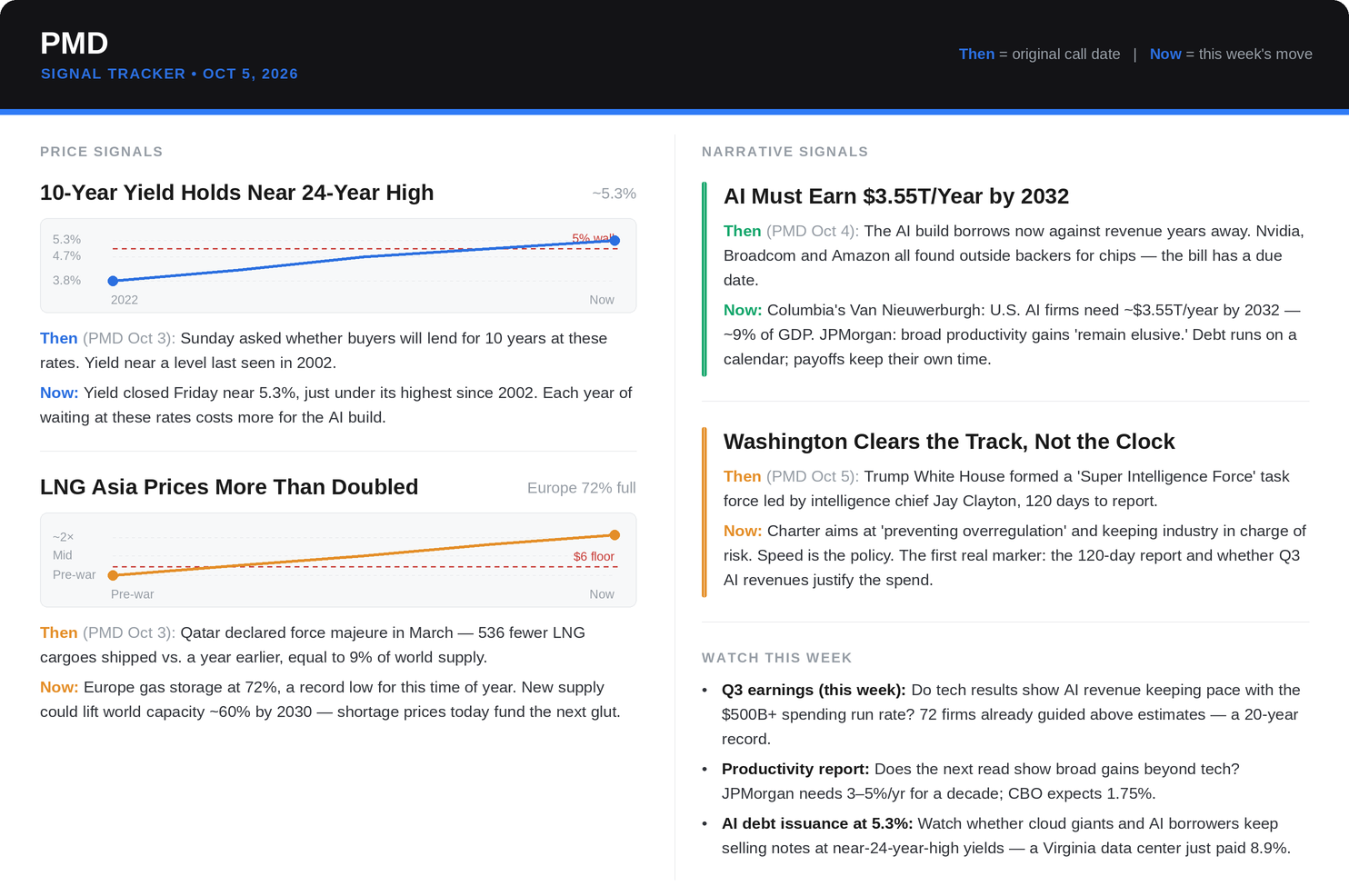
The 10-year yield closed Friday near 5.3%, just under its highest since 2002.
OPEC+ held its November output steady Sunday. Anthropic aims to list in mid-November, according to people familiar with the plans.
PMD LENS
Friday PMD weighed what the AI build must earn by 2032. Sunday asked whether buyers will lend for ten years at these rates. This morning the two threads meet.
The Iran War Didn't Just Make Headlines.
It broke the gold market wide open.
Investors are racing into the one asset Wall Street can't print.
But the metal isn't where the real money gets made.
There's one tiny company sitting on more gold than France, Italy, and China combined.
It moves 10x faster than the metal — and it's still trading at a 99% discount to what it's actually worth.
The ticker is waiting for you.
Get the full gold briefing — including the stock name and buy-up-to price
The AI Build Is Racing a Clock. Revenue Has to Arrive Before the Loans Come Due.
Never has so much money poured into a new technology. That $30 trillion data-center figure is PwC's. Anthropic plans to spend $518 billion in coming years, its IPO filing shows, a report said. That is more than 100 times what it took in last year.
Columbia's Stijn Van Nieuwerburgh estimated what a 10% return takes. U.S. AI firms need about $3.55 trillion a year by 2032. That is roughly 9% of GDP, about what Americans spend on food. They earn far less now.
The payoff rests on productivity. Broad U.S. gains "remain elusive," JPMorgan wrote in August. Nvidia's value alone needs productivity to grow 3% to 5% a year for ten years, it figured. Congress's budget office expects 1.75%.
"Entirely new markets must emerge," Bain wrote. It says cloud giants and others need more than $4.2 trillion of new revenue in five years. "The question is whether the applications arrive in time to pay for it," Bain said. Past breakthroughs took 10 to 50 years to lift productivity, said Diane Coyle of Cambridge.
Alphabet, Amazon and Meta have seen yearly free cash flow turn negative. Once "the Mount Rushmore of corporate credits," the cloud giants now must borrow, one credit analyst said. Their ratings have held so far, as expected earnings growth offsets the new debt. A fully leased Virginia data center paid nearly 8.9% on new notes.
Much of the build is borrowed. So a modest slip in demand, timing or asset values "can therefore produce much larger losses," Van Nieuwerburgh wrote. Coyle sees a floor. Even a bust leaves the build behind for later gains, she said.
The Revenue Has to Beat the Debt
The build now runs on two clocks. Loans come due on fixed dates. History says productivity keeps its own time. High yields make each year of waiting cost more. Watch three things over the next 60 days. Do third-quarter results show AI revenue keeping pace with spending? Does the next productivity report show broad gains? Do AI borrowers keep selling debt at these yields?
SIGNAL 1: A Record 72 Companies Guided Profits Above Forecasts. Tech Supplied 44.
FactSet counted 116 S&P 500 firms with quarterly profit forecasts. Of those, 72 beat estimates, the most in about 20 years of tracking. Tech supplied 44 of them. Results start this week.
Tech's earnings are expected to jump more than 65% this quarter, by one forecast. The rally leans on that. Friday the Nasdaq hit a record. Only about one in five S&P 500 stocks sat above their 50-day averages. Beneath the index, "the feet are paddling like crazy," one strategist said.
Record Confidence, Narrow Base
The forecasts lean on the same AI spending the In Focus weighs. A record built on one trade is a bet on that trade. If tech stumbles, few other stocks are strong enough to carry the index.
SIGNAL 2: The Gas Crunch May Seed a Glut. Ship Attacks Near Hormuz Resumed.
Qatar declared force majeure in March. It has since shipped 536 fewer LNG cargoes than a year earlier. The shortfall equals 9% of last year's world supply. LNG prices in Asia have more than doubled since the war began. Europe's gas storage is 72% full, the lowest on record for this time of year.
Yet the crunch is speeding new supply. New projects could lift world supply nearly 60% by 2030, while demand grows more slowly. Suppose Qatar returns in full and every project gets built. Supply could then top demand by 55 million to 75 million tonnes. Prices could fall below $6, analysts said. The worse the crunch now, the bigger the later glut, said Aimie Parpia of Six One Commodities.
Seven ships were hit near the Strait of Hormuz from Sept. 28 on, a Royal Navy-linked agency said. It reported another strike Sunday. Brent oil closed Friday above $100.
Shortage Prices Pay for the Next Surplus
High prices today fund the capacity that ends them. Friday's AI math assumes firms still charge shortage prices in 2032. Gas shows how fast a shortage can flip. Nearer term, $100 oil keeps pressure on the yields that fund the build.
SIGNAL 3: Washington Formed a "Super Intelligence Force." Its Charter Warns Against Overregulation.
President Trump formed a White House task force on AI, led by intelligence chief Jay Clayton. It has 120 days to report on risks and gains. Its charter calls for plans against "SI-enabled threats." It also aims at "preventing overregulation and regulatory capture" that could slow innovation.
"The risk of not being first is high," Clayton said. Industry stays in charge of risk, officials said. Treasury chief Scott Bessent and chief of staff Susie Wiles have pushed Washington to do more. Skeptics say self-policing falls short.
Speed Is the Policy
Washington's answer to the race is to clear the track. That helps a build that needs years of spending. It does little to show whether the revenue arrives. The first marker is the 120-day report.
Debt runs on a calendar. Payoffs keep their own time. The build borrows now against revenue years away, while yields sit near 24-year highs. Earnings forecasts lean on the same bet. Underwrite the timing, not just the size.
Last week PMD followed the AI money. Nvidia offered to back buyers' loans. Broadcom agreed to lend to a lab that rents its chips. Amazon sought outside owners for its chips. Now the bill has a due date. The payoff has to land before the loans do.
3 Market Signals Most Investors Aren't Watching
The headline is usually the last place the story shows up.
By the time everyone is talking about a stock… the signals underneath it may have been changing for weeks.
• Institutional money moves.
• Options activity changes.
• Management confidence shifts.
• Fundamentals improve, or quietly begin telling a different story.
That’s exactly what our analysts found in three stocks where the evidence stopped agreeing with itself.
And in all three cases, the story is still developing.