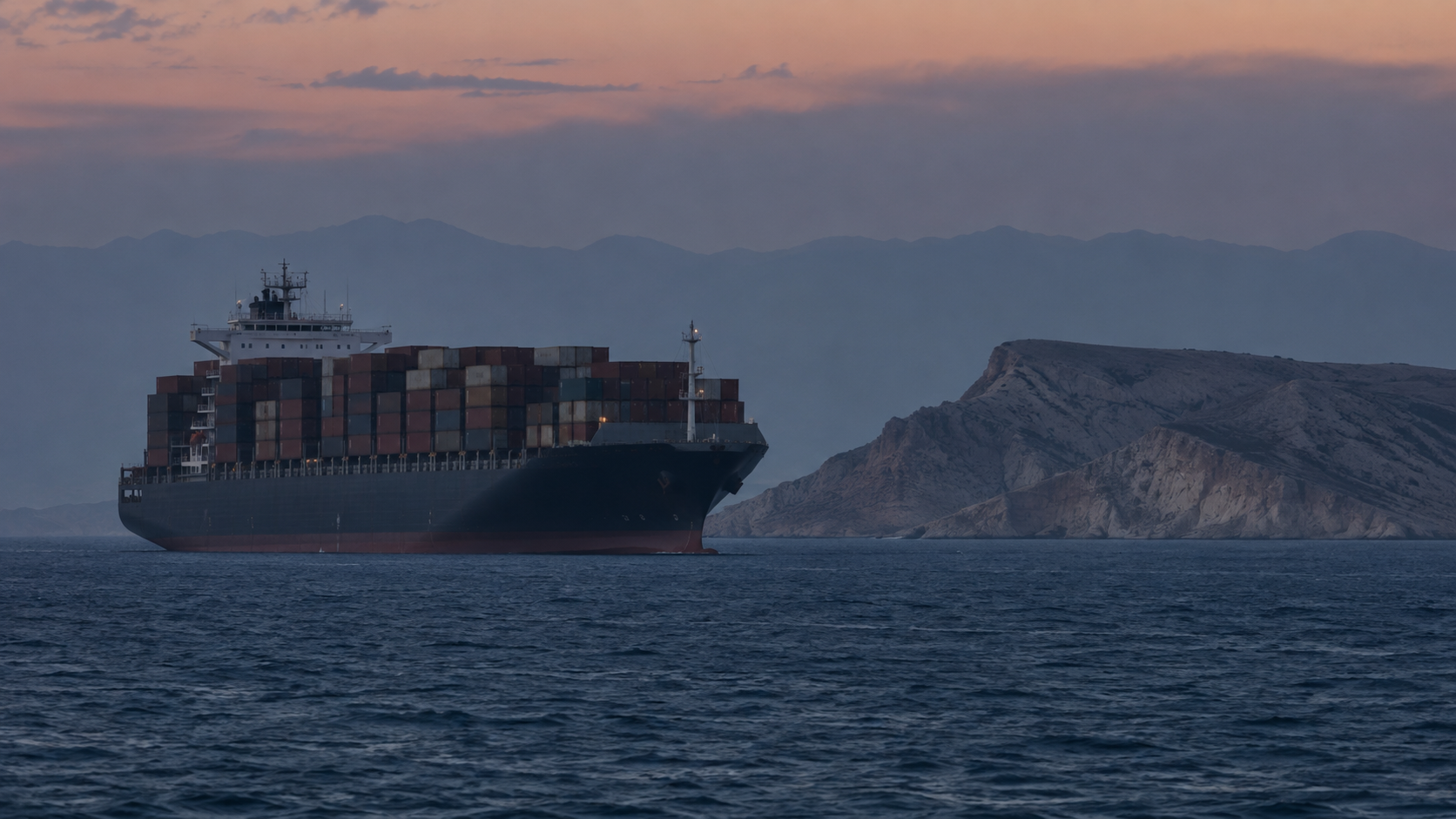
An Iranian-flagged vessel was struck by an unidentified projectile inside the Strait of Hormuz on Sunday, killing one crew member, in an attack no government has acknowledged.
An Iranian-flagged container ship was hit by an unknown projectile near Hengam Island in the Strait of Hormuz early Sunday, according to Hossein Amir Teymoori, the governor of Qeshm. A fire broke out and the crew was evacuated. One person was killed and several others were injured; accounts of the injury count vary between three and four.
No party has claimed responsibility. Iran has not blamed the United States. U.S. Central Command has not commented.
That vacuum is the story. In a corridor where every incident is immediately assigned to a side, an unclaimed fatal strike on a commercial vessel is a different category of risk for anyone routing tonnage through the strait, because there is no actor to deter, negotiate with, or predict.
The timing
The strike came hours before Oman announced that Monday's Iran and Gulf Arab states meeting on Hormuz shipping management would be postponed. The two events are closely spaced, and the postponement announcement did not cite the strike as a reason, attributing the delay instead to a joint decision taken in the interests of consensus. The sequence is documented. The causal link is not.
Traffic through the corridor
Vessel movements through the strait have collapsed. Throughput fell to seven vessels on , against a recent average of 13 to 15 a day and a pre-conflict baseline of roughly 125 a day. Whatever is deterring traffic, it was deterring it before Sunday's strike.
Set against that, there has been a partial lull in direct military exchanges. There were no new U.S. strikes for four consecutive days heading into the weekend, and no Iranian missile or drone launches for between four and eight days, by one day-by-day conflict count. Sunday's vessel strike happened inside that lull rather than during an exchange, which is part of what makes the absence of a claimant hard to explain.
What resolves it
Any claim of responsibility, any CENTCOM statement, or any Iranian government attribution would change the risk picture materially, because it would restore a counterparty to the incident. Until then, marine insurers and charterers are pricing an actor they cannot identify, and the throughput data suggests they have already decided how to treat that.