Washington's acknowledged strikes on Iranian government vessels, and a retaliation reaching Kuwait, Jordan and Bahrain, raise the question of how durable the Gulf's oil risk premium really is.
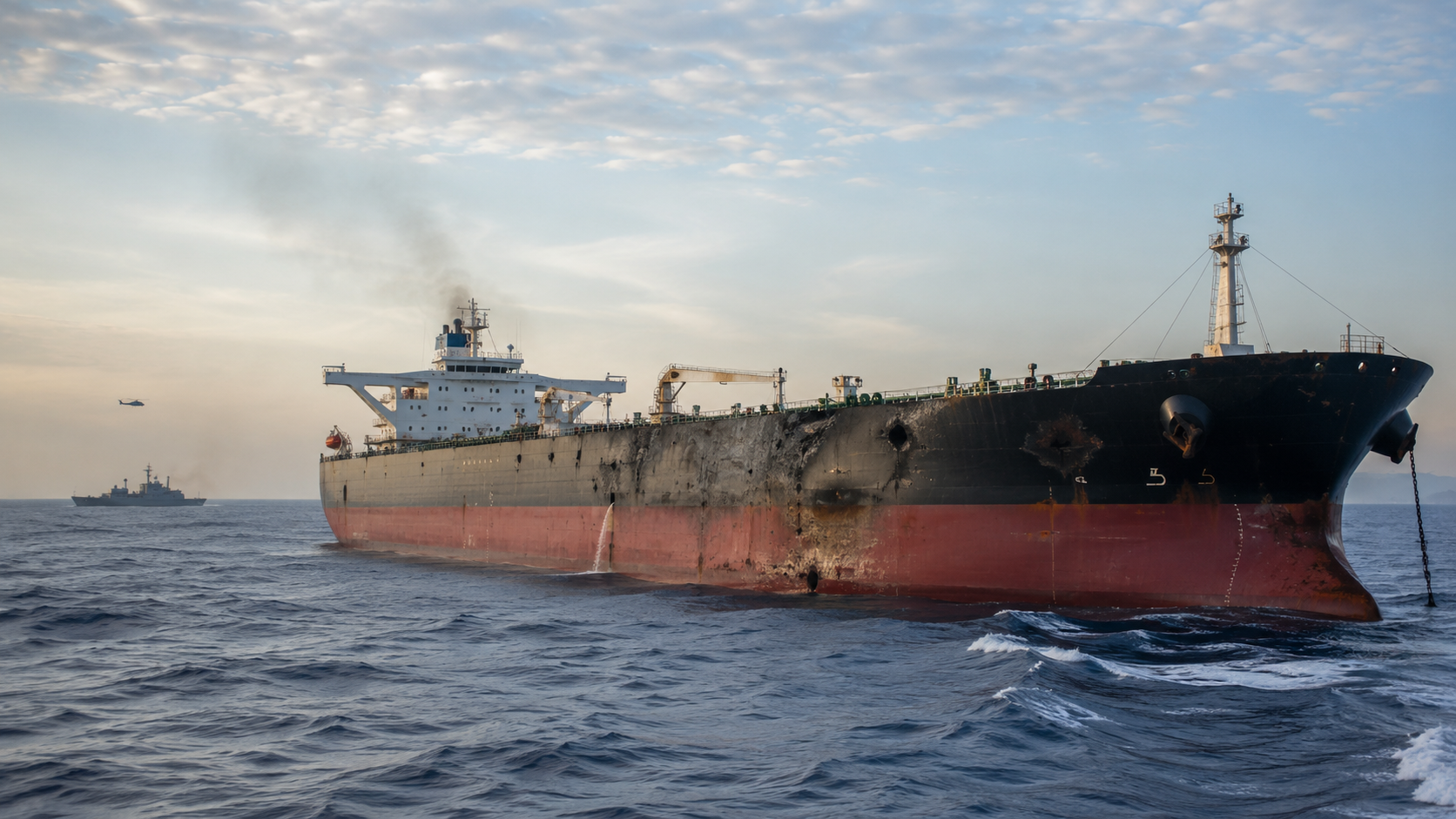
U.S. forces struck roughly 100 Iranian targets overnight, including air-defense sites, radar systems, mine-laying equipment and drone-launch infrastructure. For the first time in this conflict, the strikes also hit two Iranian government-owned tankers directly, a step beyond an earlier, unattributed attack on commercial vessels. A U.S. official said the operation was meant to buy at least a month of reduced Iranian threat capacity.
Iran retaliated across four countries. Roughly 25 ballistic missiles were fired toward a base in Jordan, with about half reaching Jordanian airspace and most of the rest intercepted. Bahrain's Sheikh Isa Air Base and sites in Kuwait were also targeted, along with a base near Erbil, Iraq. Kuwait and Bahrain said they intercepted the incoming fire. No U.S. casualties were reported.
The casualty count inside Iran remains disputed. Iranian state media said a strike hit a wedding in Sirik County, killing at least four people, including a child, and wounding dozens more, with additional deaths reported in Khuzestan province. A U.S. official said Iran "got nothing today," and a CENTCOM spokesman denied that U.S. forces target civilians. Neither account has been verified.
What changes here is durability, not just scale. Earlier tanker strikes attributed to the U.S. were unacknowledged; this time officials confirmed the operation and described it as a deliberate retaliation policy rather than an isolated incident. Treasury Secretary Bessent said Iran "does not have control of the Strait" and is "in a death spiral." President Trump warned of a stronger U.S. response if Iran retaliates again.
Oil markets have not treated this as a step change. Brent extended Tuesday's gains, trading roughly 2.6% to 3% higher, with WTI up a comparable amount, while U.S. equity futures were down less than half a percent. About 40 ships still transited the Strait of Hormuz on Tuesday with no reported hits, and Tuesday's throughput reached a record 17 million barrels, the highest since the conflict began. Record volume moving through the Strait alongside an active shipping-risk narrative points to a market pricing a risk premium, not a confirmed supply disruption.
Gold adds a further wrinkle. It fell to a three-week low even as the conflict widened, a move more consistent with rising expectations of a Federal Reserve rate hike this month than with a safe-haven bid. That divergence is explored in more detail below.
The question for investors is whether Wednesday's escalation, the largest strike total and broadest simultaneous retaliation of this conflict, marks a genuine repricing point or gets absorbed the way prior incidents have. A CENTCOM statement confirming the tanker strikes, independent verification of the casualty claims, and the full U.S. cash-session reaction would each help answer that. None had arrived as of this writing.