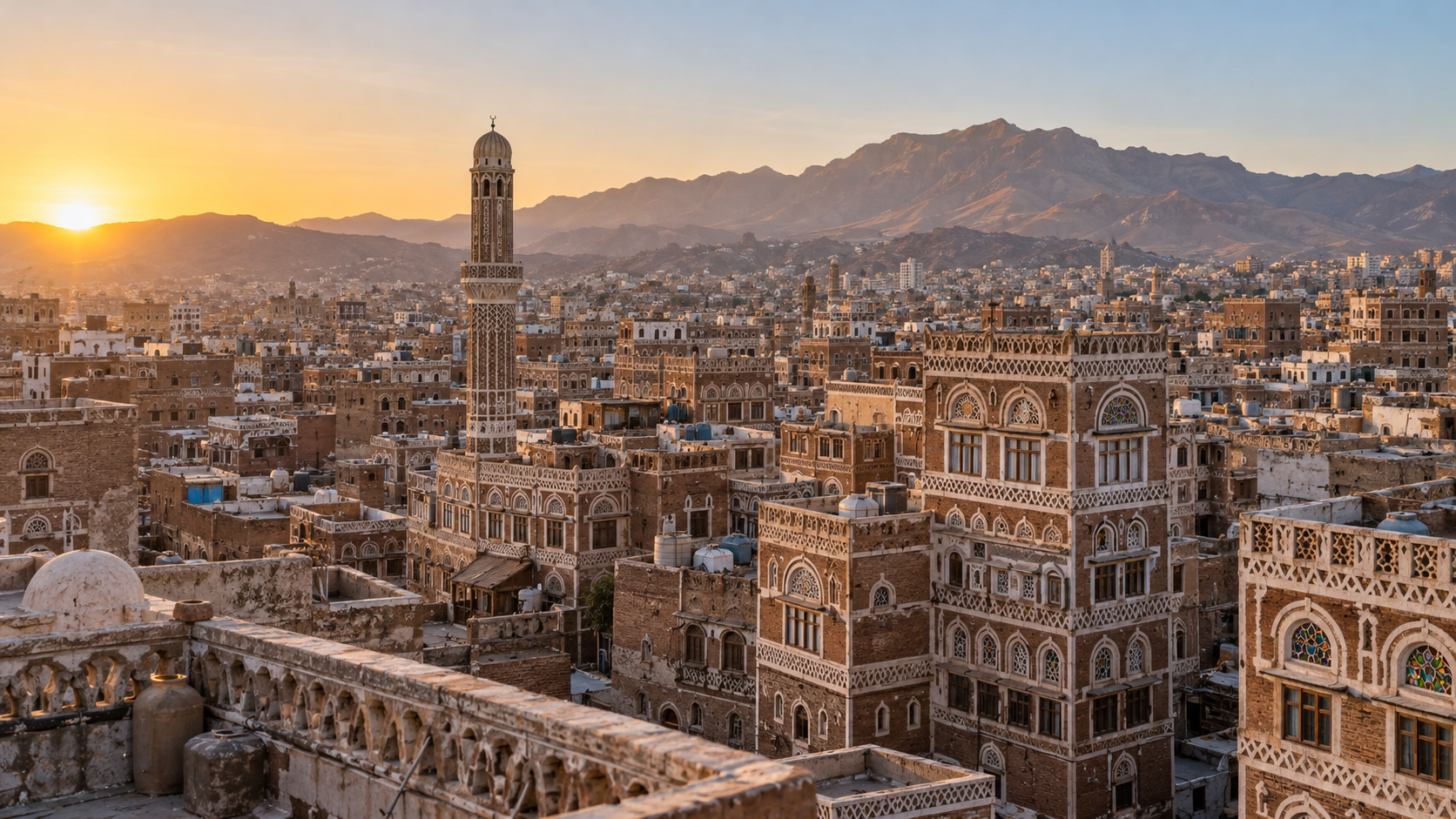
Saudi Arabia confirmed a Houthi hit on an Aramco office building in Dhahran, and fragments of downed missiles injured four people in Riyadh. Polymarket's no-U.S.-strike line for October gained 2 cents overnight, for a contract that expires before Election Day.
The war around Yemen reached Saudi Arabia's oil company on Tuesday. The U.S. president pointed to a date after the midterms. On Polymarket, the price of the contract that pays if the U.S. does not strike Yemen this month edged higher.
Saudi Arabia's energy ministry said an administrative building belonging to Aramco in Dhahran was struck on Tuesday evening, causing a "limited fire" and "no casualties or fatalities." The Houthis had named Aramco's headquarters in Dhahran as a target. The company itself has not identified the building, and nothing so far points to an effect on output.
In Riyadh, two Houthi cruise missiles were shot down over the capital, and falling fragments injured four people and damaged 15 homes, Saudi civil defense said on Wednesday. The Saudi-led coalition said it also intercepted missiles aimed at Dhahran and Haradh, and that it struck facilities in Sanaa and in Dhamar and Saada provinces that "supply the war effort."
What the president wrote
President Trump said in a post on Truth Social on Tuesday that "the Houthis are behaving very badly," and accused them of acting "probably at the behest of Iran" and "purposefully trying to drive up Oil Prices, probably prior to the U.S. Elections." He added, "I'm not running in the Elections, I've already won, IN A MASSIVE LANDSLIDE, but I'll be there after the Elections, and I will never forget!"
He did not announce a decision on U.S. military action. He has said he is considering joining Saudi strikes, and on Tuesday told reporters he "might" ask Turkish President Tayyip Erdogan to intervene in support of Saudi interests. If the U.S. joins in, "American interests in the region" become targets, warned Mohammed al-Bukhaiti of the Houthis' political bureau.
Two steps up overnight
The "U.S. x Yemen ceasefire" contract for Oct. 31 held at 85.5 cents through Tuesday afternoon and evening until 7 p.m. Eastern. It then gained a cent at 8 p.m. and another at 10 p.m., and was still 87.5 cents at 4:45 a.m. Wednesday. At that price, the market implies roughly a one-in-eight chance of a U.S. strike on Yemen before November under the contract's rules. The contract expiring Thursday climbed to 99.45 cents.
The rules matter. The contract resolves No only if American forces themselves hit Yemeni soil, with an air strike or a surface-to-surface missile strike; naval gunfire and artillery do not qualify. Saudi-led raids and Houthi missiles do not count, no matter how many there are.
The timing matters too. The contract runs through Oct. 31. Election Day is Nov. 3. Read literally, the president's post points beyond the contract's settlement date. That does not prove why traders bought, and both overnight moves came hours after the post, on thin volume.
The cost of the war for Riyadh
The International Monetary Fund said Tuesday it expects Saudi Arabia's economy to shrink 3.3% this year. Saturday's strike on Riyadh's main airport killed 13 people, and the World Health Organization said suspected cholera cases in Yemen tripled in three weeks.
Market implications
One reading is that the price reflects U.S. timing rather than regional calm. The fighting is escalating on Saudi soil, but the president has pointed past the contract's end date, he has floated a Turkish role, and Saudi Arabia's coalition is carrying out its own strikes.
The opposing view holds that a direct U.S. response is getting more likely, not less. Attacks now reach Aramco property and residential Riyadh, the Houthis have threatened U.S. interests, and a strike on Saudi energy production could force a faster decision than a post about the elections suggests. Small orders can move a thin market sharply.
What to watch
Thursday brings settlement of the Oct. 15 contract. For the end-of-month line, the triggers are a White House decision on Yemen or Iran, a Houthi hit on Saudi production or export sites, and Aramco's own description of what was struck in Dhahran.