A direct check of Kalshi's public data feed found Bitcoin-price and Fed-decision contract series carrying an identical, months-old timestamp, while a separate series on the same platform was current within days.
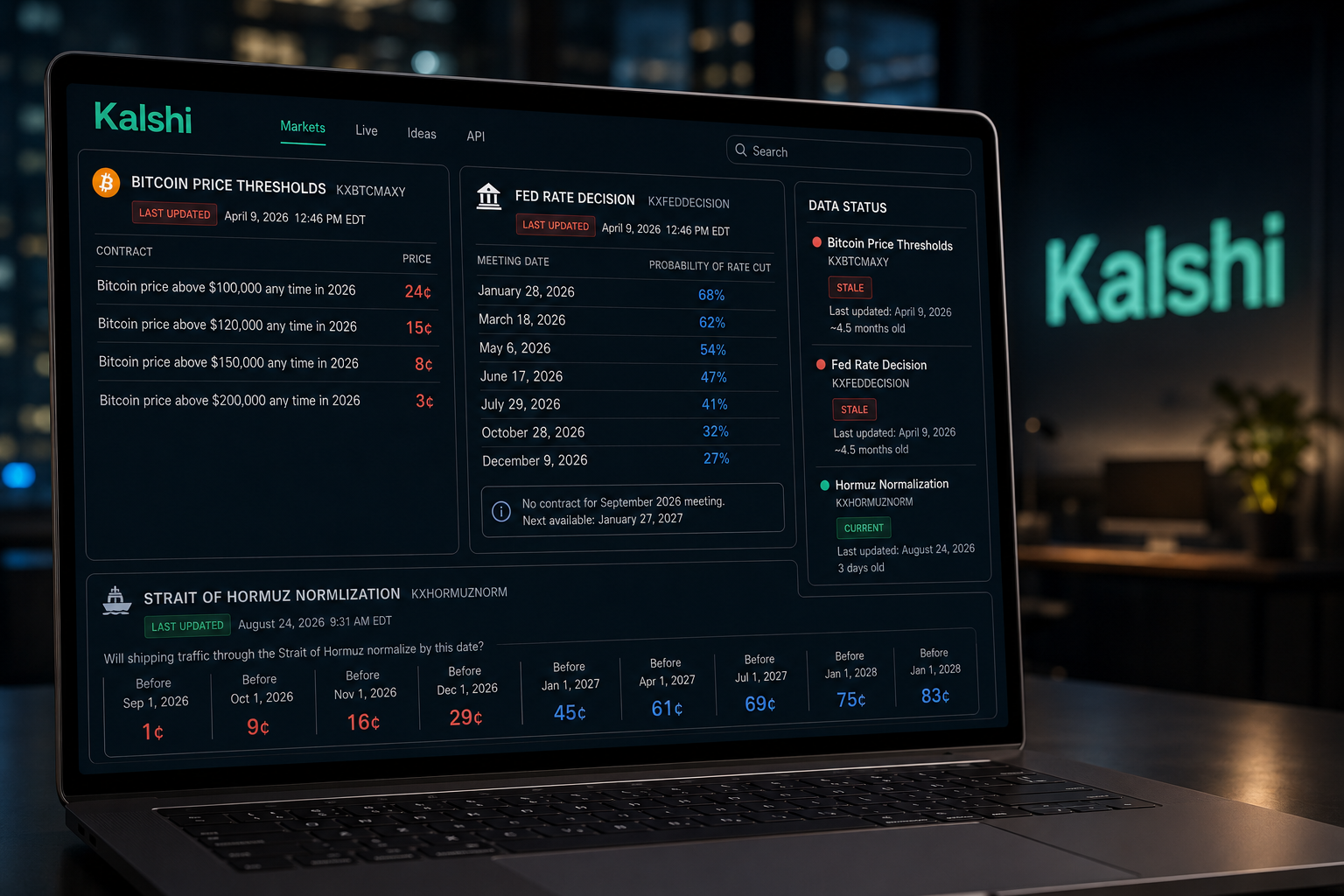
A direct fetch of Kalshi's Bitcoin-price-threshold contract series, KXBTCMAXY, returned a "last updated" timestamp of April 9, 2026, roughly four and a half months old as of today. The same series was independently re-fetched on a separate occasion and returned the identical stale timestamp, indicating the staleness is persistent rather than a one-time glitch.
A separate, unrelated series was checked as well. Kalshi's Fed rate-decision contracts, KXFEDDECISION, were fetched directly across seven different meeting-date sub-series spanning January 2026 through December 2026. Every one of those seven sub-series carried the same "last updated" timestamp of April 9, 2026, within the same narrow time window as the Bitcoin series' stale timestamp. That consistency across two otherwise unrelated series strongly suggests both were served from the same stale underlying data snapshot, rather than reflecting two independent staleness events. Notably, no contract specific to the September 2026 Federal Reserve meeting appeared in this data pull at all; the available sub-series jumped from a December 2026 date directly to a January 2027 date.
A third series tells a different story. Kalshi's contracts tracking whether shipping traffic through the Strait of Hormuz normalizes by a given date, KXHORMUZNORM, were also fetched directly and returned a "last updated" timestamp of August 24, 2026, three days old at the time of this check. That series' full pricing ladder showed active, differentiated pricing across ten date-bound contracts, from 1 cent for normalization before September 1, 2026, up to 83 cents for normalization before January 1, 2029, the kind of granular, spread-out pricing one would expect from a contract series being actively traded and updated.
The contrast matters. It confirms the staleness found in the Bitcoin and Fed-decision series is not a platform-wide condition affecting every Kalshi contract equally. Some series are current within days. Others, including two of the more closely watched categories on the platform, Bitcoin price thresholds and Fed policy decisions, are showing timestamps nearly five months old. What explains that difference is not established by this data. It could reflect differences in how specific series are maintained, technical issues isolated to certain series, or something else entirely. The public feed does not reveal why the series differ.
For anyone using Kalshi's public feed to gauge current market sentiment on Bitcoin price levels or Fed policy, the practical implication is straightforward. A prediction-market contract's displayed price is often treated as a live, continuously updated probability estimate. This finding shows that assumption does not hold uniformly across the platform, and checking a series' own "last updated" timestamp before treating its price as current is now a reasonable step rather than an unnecessary one.