

OpenAI told investors its annualized revenue for September was near $50 billion. Just over a week earlier, a figure near $70 billion had made the rounds. According to a source, most of that gap comes down to what gets counted.
Chip stocks, already lower, slid further anyway. The real question is why one private company's way of counting sales can move so much public money.
But before we get to today's big story, let's check in on the markets and what's worth watching.
3 Movers in 3 Minutes
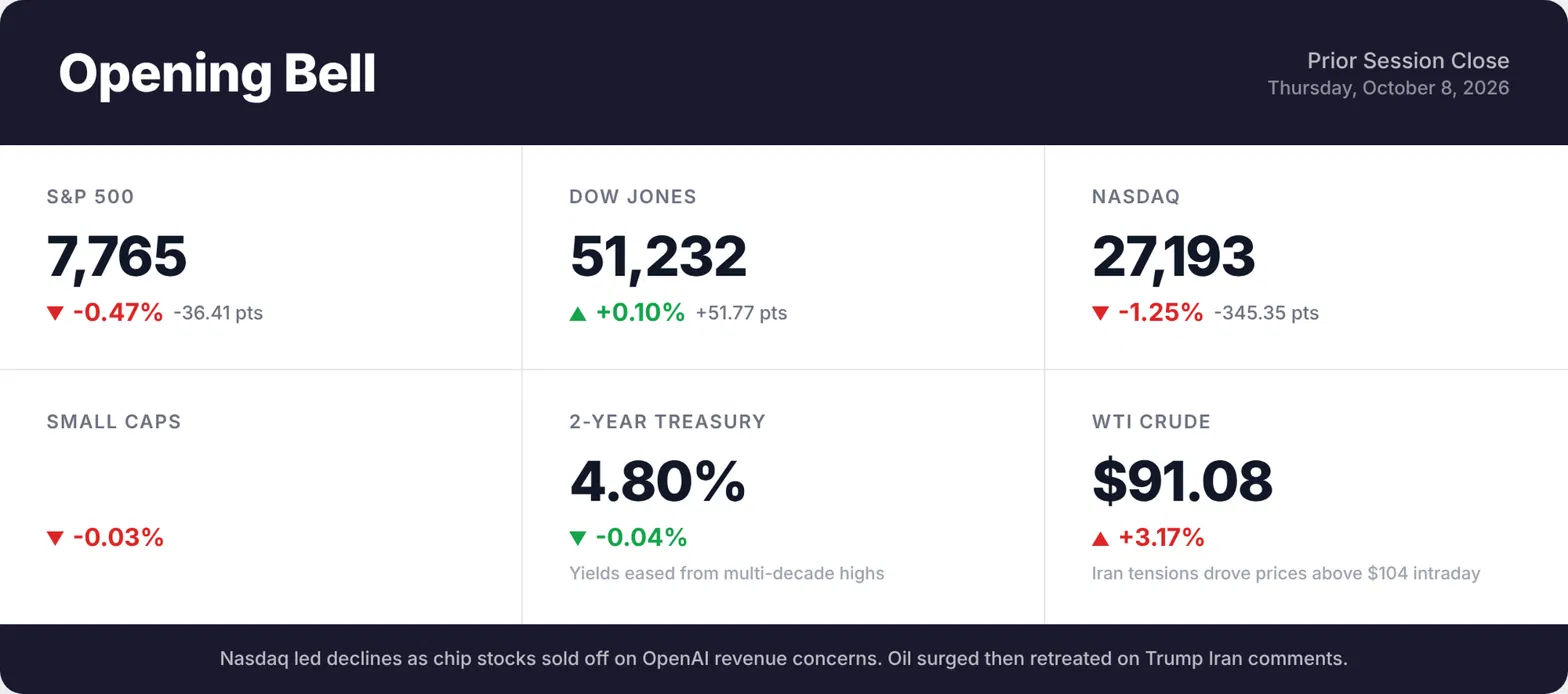
- Chips slid further after a report on OpenAI's revenue. The Philadelphia Semiconductor Index fell 3.4%, and the Nasdaq Composite dropped 1.25%, its worst day since mid-August. The Sip has the full story.
- Oil jumped on Iran and hurricane risk. WTI hit about $93 and Brent topped $105 on Middle East supply fears, with most Gulf of Mexico output shut ahead of Hurricane Isaias. President Trump then posted that the U.S. would not attack Iran before the Nov. 3 midterms. Prices dipped, then recovered: WTI settled up 3.6% at $91.49, Brent up 4.1% at $104.28. A post can calm one supply risk. It can't calm a hurricane.
- PepsiCo (PEP) beat, then cut. Q3 revenue rose 5.6% to $25.27 billion, and core EPS of $2.34 topped estimates. But it cut its full-year core constant-currency EPS growth outlook to 1% to 2%, from the low end of a 4% to 6% range, citing margin pressure in North America. Tariff refunds did some of the lifting in the quarter. The stock still rose 3.7%. The market paid for the quarter, not the year.
3 Signals for Today
Delta's fuel bill meets the open. Delta (DAL) reported this morning: adjusted Q3 EPS of $1.72 narrowly missed the $1.76 LSEG average, and it cut its full-year outlook to $5.10 to $5.60 a share, from $6.50 to $7.50. CFO Erik Snell's explanation: "All of it's fuel." Adjusted revenue still rose 16%. Today's trade shows whether investors see a fuel problem that passes or a margin problem that sticks, and with oil up about 4% yesterday, every airline faces the same test.
Big banks report Tuesday. JPMorgan (JPM), Goldman Sachs (GS), Wells Fargo (WFC) and Citigroup (C) all report before the bell on Oct. 13. Loan demand shows whether companies are still borrowing to spend; trading revenue shows who profited from the swings.
CPI lands Wednesday. September CPI is out Oct. 14 at 8:30 a.m. ET. The 2-year yield sits at 4.75%, and Fed minutes released this week showed most officials saw another hike as likely by year-end. A hot print could push yields back toward recent highs. A soft one gives long bonds, fresh off their strongest session in weeks, more room.
Now to the number that moved chips, and why it moved them so much.
Elon Musk's $2.1 Trillion Hit List

The SpaceX IPO made Elon Musk the wealthiest man who has ever lived.
Now he's spending it to complete his dynasty...
He's already acquired a $40 billion AI firm and a $1 billion turbine company.
But a handful of companies still stand between him and total control of the space economy.
Click here to see why early investors could walk away with a fortune.
The Sip
Same Revenue, Two Rulers
Same month, two numbers: almost $50 billion in OpenAI's latest telling, near $70 billion in the figure that circulated earlier. A source said the gap mainly reflects a comparison with rival Anthropic: OpenAI leaves out sales through cloud partners that Anthropic counts.
No guidance was cut. Mostly, this is the same business measured two ways.
The market still flinched. By the close, CoreWeave (CRWV) was down more than 7% and Oracle (ORCL) nearly 6%. AMD (AMD), Broadcom (AVGO), Micron (MU) and Intel (INTC) fell between 3.9% and 5.3%. Nvidia (NVDA) lost 3%. Together, those seven shed roughly $400 billion of market value.
Not all of that was OpenAI. Chips were already lower that morning. Most of Oracle's drop came after the report circulated, but CoreWeave did most of its falling before. Oil, a 30-year Treasury auction and a presidential post on Iran all hit the same afternoon, and the trading does not separate those effects.
Why a ruler moves markets
Because the buildout runs through one customer's checkbook.
OpenAI has targeted roughly $600 billion of compute spending through 2030. CoreWeave's OpenAI-linked contracts total up to about $22.4 billion, about half its market value. Oracle's OpenAI deal was reported at about $300 billion in September 2025, though neither company has disclosed its value. And Broadcom is in early talks to arrange more than $50 billion of financing for the custom chips it's building with OpenAI, the Wall Street Journal reported.
Buffett, Gates and Bezos Quietly Dumping Stocks—Here's Why

The world's wealthiest individuals are making huge moves with their money.
Warren Buffett just liquidated billions of shares. Bill Gates sold 500,000 shares of Microsoft. Jeff Bezos filed to sell Amazon shares worth $4.8 billion.
What is going on? One multi-millionaire believes they are preparing for a catastrophic event. But not a crash, bank run, or recession. It’s something we haven’t seen in America for more than a century.
So the chain is short. OpenAI's revenue pays its compute bills. Those bills fill Oracle's and CoreWeave's backlogs. Those backlogs become orders for Nvidia, Broadcom and Micron. Doubt at the top travels down the stack in an afternoon.
The rate matters more than the level
Set the counting debate aside and one real question remains: how fast is OpenAI growing?
Its April-to-June revenue was $6.7 billion, about $27 billion annualized, according to the Journal. It reportedly lost $12.3 billion from operations that quarter, including stock pay. An account of its investor presentation cited 77% run-rate growth in the third quarter. And CFO Sarah Friar warned colleagues in April that OpenAI could struggle to pay for future compute if growth lags.
That's the hinge. The stack is priced on the growth rate, not today's revenue. At 100% a year, revenue doubles in 12 months. At 70%, it takes about 16. Start at $50 billion and run five years: $1.6 trillion at 100%, about $710 billion at 70%. A modest change in the rate moves the endgame by hundreds of billions.
What settles it
Two numbers. A separate report says OpenAI expects to reach or exceed $70 billion in annualized revenue by year-end. If it gets there, Thursday looks like a measurement scare. Then Microsoft (MSFT), one of the largest buyers of AI infrastructure, reports Oct. 28 after the close. The four biggest hyperscalers have guided to roughly $720 billion to $745 billion of 2026 capital spending. If tha
Trump to build "biggest data center on the planet"

America's about to get its first national data center… Completely funded by taxpayer dollars. When it comes online just days from now… This device could change the history of Artificial Intelligence… And even human civilization. (It could also make early investors in this company very happy.) Louis Navellier believes it will secure America's dominance over China in the AI arms race… While completely sidestepping the dangers of Artificial Superintelligence. Donald Trump committed $1 billion to support the stock behind the coming breakthrough right now… Ahead of a potential announcement from the company that could hit soon. Get all the details – down to the company name and ticker – here, in Louis' brand-new presentation.
This ad is sent on behalf of InvestorPlace Media at 1125 N. Charles Street, Baltimore, Maryland 21201. If you're not interested in this opportunity, pleaseclick here.
The MarketSips Takeaway
Thursday was a stress test of how concentrated the AI trade has become. Watch three things: OpenAI's year-end run rate against the reported $70 billion target, where a shortfall would be a real growth signal rather than a counting quirk; how Broadcom's financing talks land, since tougher terms would mean lenders share the doubt; and Microsoft's spending outlook on Oct. 28. Oracle and CoreWeave, the names most tied to OpenAI by contract, are the cleanest gauges. If they recover as the counting debate fades, the buildout thesis holds. If they keep lagging Nvidia, the market is pricing customer concentration, not accounting.
Until then, sip slowly!
The Market Sip Desk
Reply prompt: Would you invest in OpenAI at an $852 billion valuation today?
3 Stocks at a Major Turning Point
Something unusual is happening beneath the surface of three widely followed stocks.
In each case, the fundamentals are saying one thing... while institutional activity, management signals or the options market are saying something else.
That kind of disagreement can matter.
Because when the evidence stops lining up, the next move in the story often comes down to a handful of signals most investors never think to watch.
Our new FREE Market Tell Special Report breaks down three of these situations, and shows you exactly what we’re watching next.