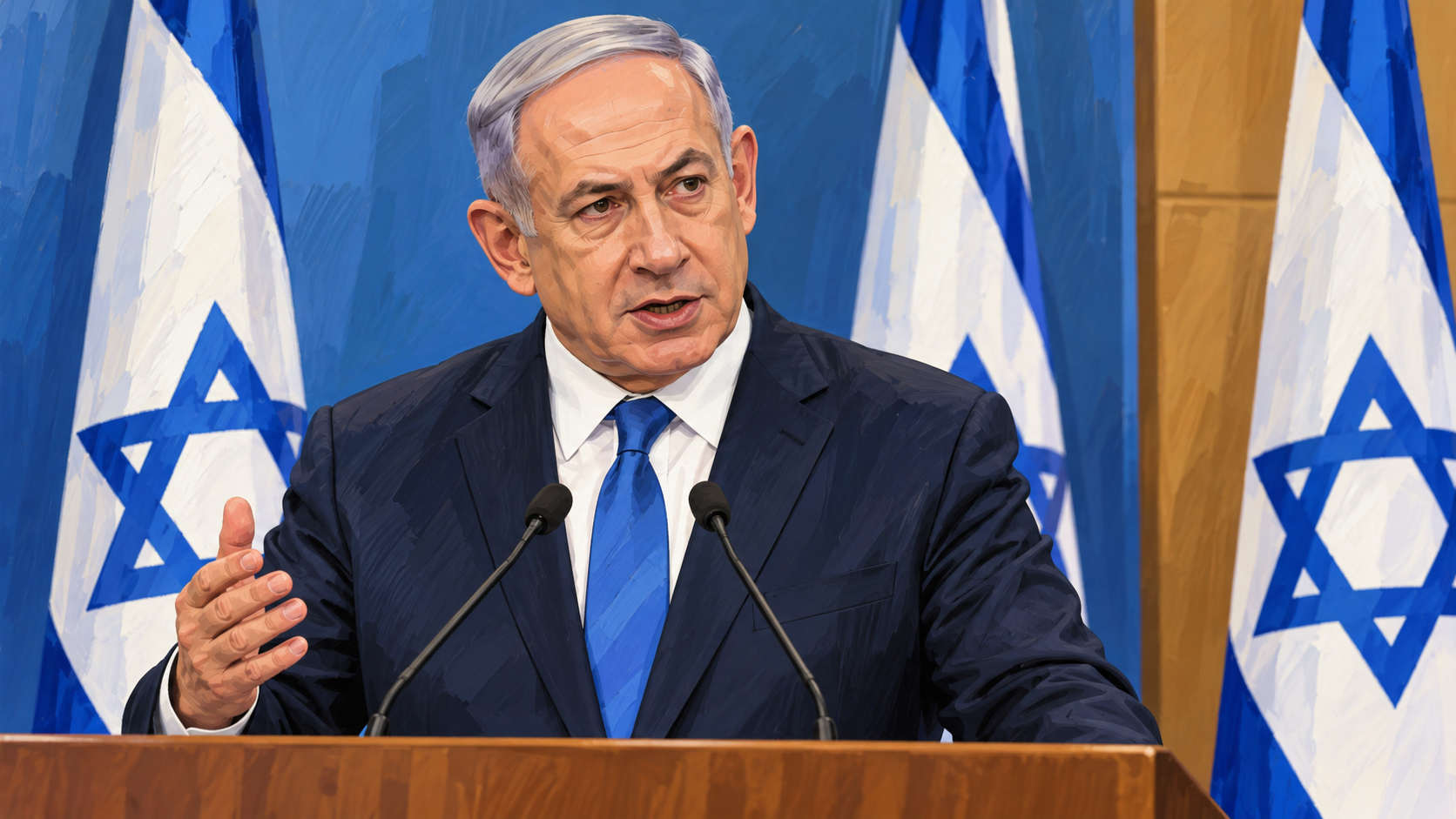
Benjamin Netanyahu's Polymarket contract rose to 49 cents from 31.5 cents after the exit polls, and Gadi Eisenkot's fell to 25 cents. On Kalshi, whose contract settles on government formation, "No one" traded at 60 cents late Tuesday. Tel Aviv stocks fell 1.4% to 3%.
Prediction Markets | FinancialMarkets.com | October 28, 2026
Tickers: EIS, ILS
Israel's election has not produced a winner. The two largest prediction markets have drawn different conclusions from that.
With about 72.5% of votes counted, partial tallies showed Prime Minister Benjamin Netanyahu's bloc at 54 seats, the opposition bloc at 48 and Arab-led parties at 18. Neither bloc is near the 61 seats needed for a majority in the 120-seat Knesset. The figures are unofficial projections from a partial count. Netanyahu said final results would come "over the next day or two."
Polymarket moved toward Netanyahu
On Polymarket, the contract on whether Netanyahu will be the next prime minister was at 49 cents at 4:46 a.m. Eastern on Wednesday, up from 31.5 cents shortly after the exit polls on Tuesday and as high as 52.5 cents at 4 a.m. It traded about $11.6 million over 24 hours. The contract on Gadi Eisenkot fell to 25 cents, from about 50 cents after the exit polls, after touching 22.5 cents late Tuesday night. More than $70 million has flowed into Polymarket's Israel prime-minister market overall, Ynet reported.
The move tracked the count. As tallies came in through the night, Netanyahu's bloc held a lead the exit polls had not shown. Those polls, released when voting ended, had the blocs tied or the opposition slightly ahead.
The two Polymarket contracts now sum to about 74 cents, which leaves roughly a quarter of the probability on someone else, or on no one, becoming prime minister.
Kalshi priced the deadlock
Kalshi's market reads differently, in part because it asks a different question. Its contracts settle on who becomes prime minister "as a result of government formation following the 2026 Israeli legislative election" and meets all constitutional requirements before Oct. 27, 2027.
In a snapshot at 9:07 p.m. Eastern on Tuesday, the "No one" contract was at 60 cents, up from 20 cents. Netanyahu was at 28 cents, Eisenkot at 13 to 14 cents and Naftali Bennett at 3 cents. Those prices are nearly eight hours older than the Polymarket quotes above and should not be compared as simultaneous. At that hour, Polymarket had Netanyahu at about 48.5 cents.
A contract that pays only if a government forms from this election can fall on a caretaker period or a repeat election, while a "next prime minister" contract may not. The gap between the venues is partly a gap in rules.
The politicians and the arithmetic
Eisenkot declared victory and claimed the first right to form a government. Netanyahu called for "a strong, national, right-wing government." Yair Golan of the Democrats urged the opposition to unite with the Arab parties, claiming a majority of 65 seats. Most opposition leaders have ruled out governing with the Arab parties, which leaves their 18 projected seats as the swing factor and no obvious 61-seat coalition on current numbers.
Tel Aviv repriced
Israeli markets, which had gained on Tuesday as turnout ran at record levels, reversed on Wednesday morning. The TA-35 fell 1.4% and the broader TA-90 3%. Banks fell about 3%, insurers 3.6% and construction stocks 4%. The 10-year government bond yield rose 6 basis points to 4.1%, and the shekel weakened about 1% to around 3.08 per dollar. The direction matches the prediction-market move, but the moves do not prove a link.
Two venues, two theories
Polymarket's prices make Netanyahu the most likely next prime minister. Kalshi's make "No one" the most likely outcome under its government-formation rule. Both can be partly right: a prolonged stalemate in which Netanyahu stays on without a new government could pay differently on the two platforms, depending on each venue's rules.
What to watch
The final count, whether Arab parties clear the electoral threshold, the president's consultations with party leaders, any opposition agreement with the Arab parties, and updated Kalshi prices.