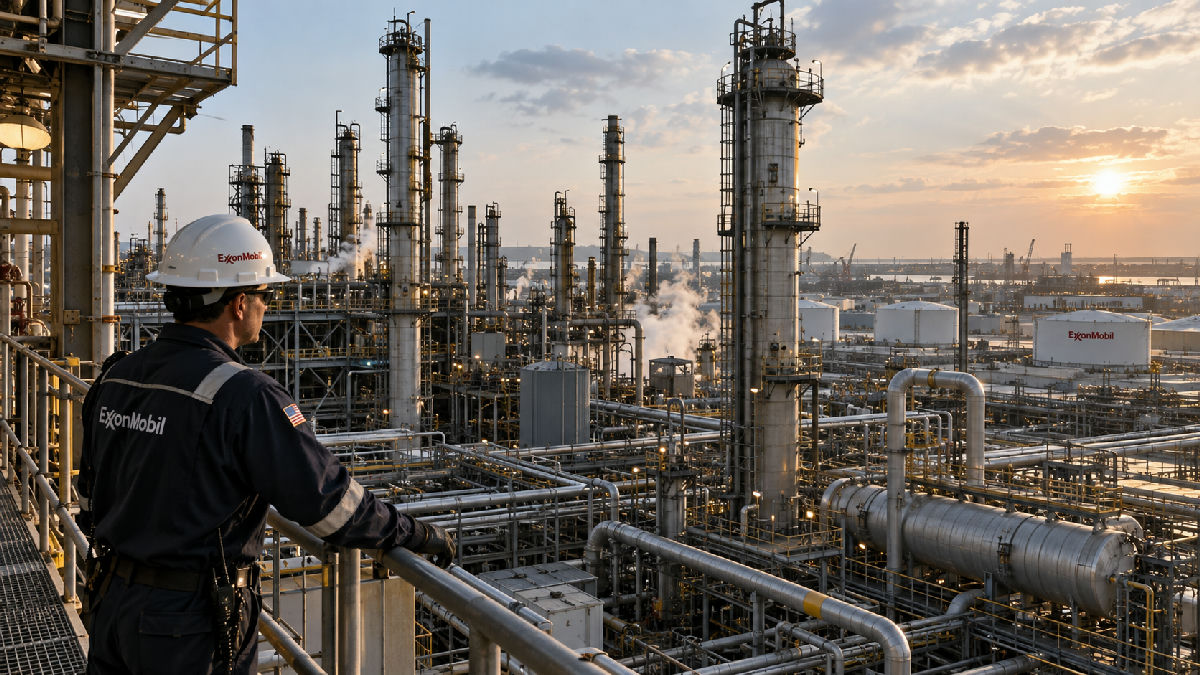
Exxon's adjusted earnings of $4.23 a share and Chevron's $5.28 beat forecasts as refining margins surged. Exxon set a $20 billion buyback for 2027.
The two largest U.S. oil companies beat expectations in a quarter when oil itself was cheaper.
ExxonMobil reported adjusted earnings of $17.5 billion, or $4.23 a share, for the third quarter, above the $4.08 analysts expected and up from $3.52 in the second quarter. GAAP earnings were $15.4 billion, or $3.72 a share. Revenue of $104.8 billion was in line with forecasts.
Chevron's adjusted earnings were $10.4 billion, or $5.28 a share, against an estimate of $4.89. That was well above the $1.85 a year earlier but below the $6.06 Chevron earned in the second quarter. GAAP earnings were $9.9 billion, or $5.06 a share.
Where the money came from
The mix explains the beats. Exxon's upstream business, which produces oil and gas, earned $7.3 billion, down about 20% from the second quarter. Its refining and fuels business earned $9.0 billion, up about 120%. Refining out-earned production.
Chevron's mix moved the same way, less sharply. Its upstream earnings fell about 30% from the second quarter to $5.7 billion, while downstream earnings held near $4.9 billion, more than four times their level a year earlier. Brent crude averaged $97 a barrel in the third quarter, down from $104 in the second, the company said. Its U.S. refineries ran a record volume of crude at 98% utilization. Return on capital employed was 18%.
Cash to shareholders
Exxon generated $25.7 billion of cash from operations and $19.1 billion of free cash flow. It returned $9.4 billion to shareholders, $4.3 billion in dividends and $5.1 billion in buybacks, set its fourth-quarter dividend at $1.07 a share and announced a $20 billion repurchase plan for 2027. It has cut net debt by about $11 billion this year.
Chevron paid $3.5 billion in dividends and bought back $2.5 billion of stock, with adjusted free cash flow of $14.2 billion.
"In the third quarter, we continued to rise to the challenge of meeting global energy needs, drawing on unmatched scale, integration, and technical capabilities," said Darren Woods, Exxon's chief executive.
The reaction
Exxon was up about 1.7% at $186.38 in early afternoon, after touching $188.50. Chevron rose about 1.5% to $234.95, after reaching $236.45. Both touched all-time highs, CNBC reported. The energy sector was the S&P 500's best performer on a day the index fell about 1.9%.
Durable or cyclical?
The bull case is that integrated companies are built for exactly this: when crude softens, refining picks up the slack, and the cash funds record buybacks.
The skeptical case is that refining margins at these levels depend on supply disruptions that can reverse, and that both companies' production earnings fell from the second quarter. Exxon's 2027 buyback commits cash against margins no one can forecast.
What to watch
Refining margins through the winter, crude prices into the fourth quarter and whether Chevron's quarter-on-quarter decline in adjusted earnings extends.