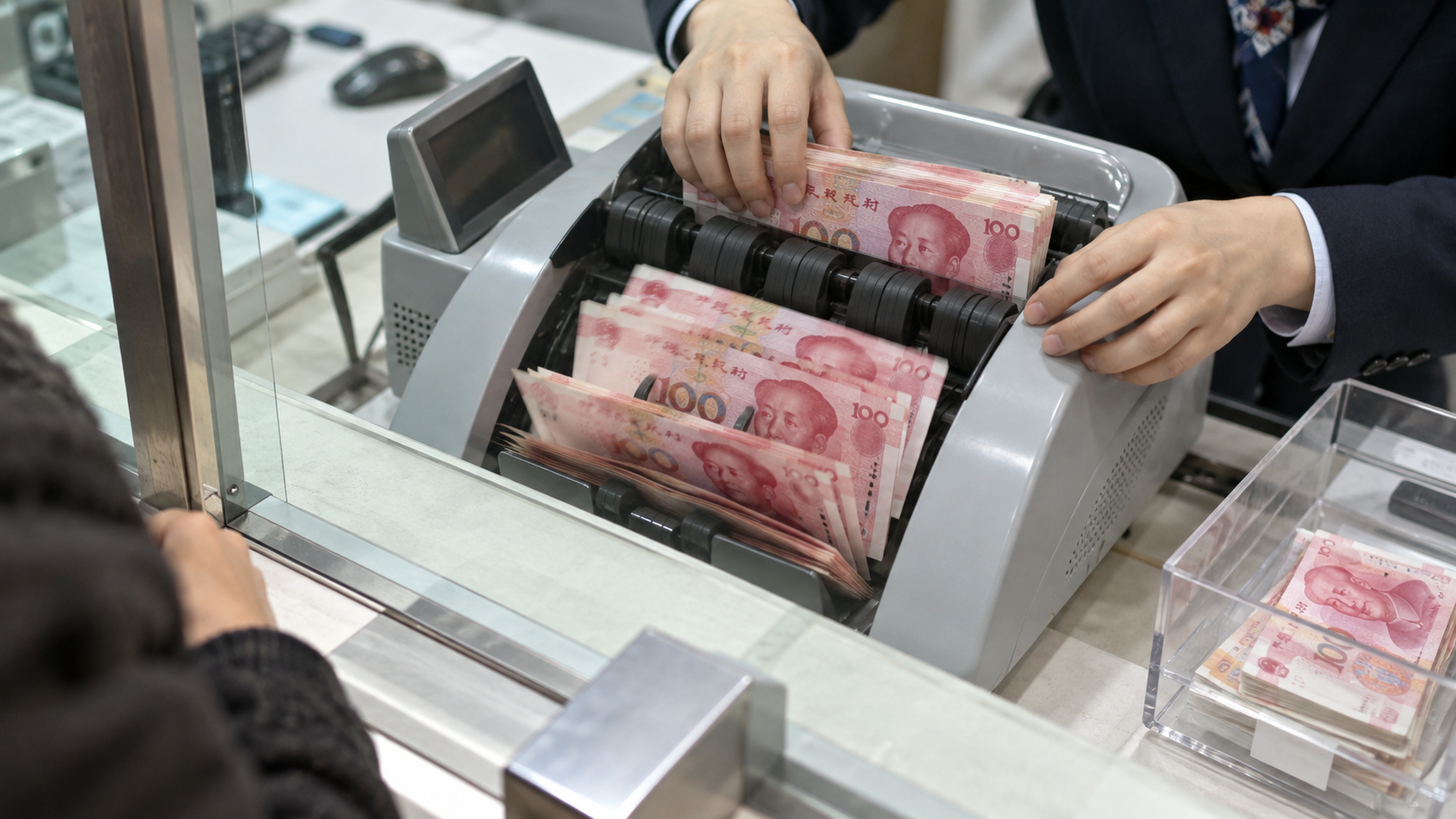
The central bank set its reference rate at 6.7162 per dollar, the strongest since February 2023 but 471 pips weaker than the market expected. The move came as the Communist Party's Fifth Plenum opened and Washington published its China investment rule.
China's currency hit its strongest level in four years on Monday. The government signaled, through a single number, that it would prefer the climb to slow.
The People's Bank of China set the yuan's daily midpoint at 6.7162 per dollar, its strongest fixing since Feb. 2, 2023. But the rate was 471 pips weaker than the market's estimate of 6.6691, a wide gap on the weak side. Onshore, the yuan still rose to a fresh four-year high. The dollar traded at about 6.6672 yuan early Monday in New York.
"The PBOC continues to resist a faster pace of appreciation via weaker than-market-expected fixings," Barclays said.
Why the fixing matters
The midpoint is the center of the band within which the onshore yuan can trade each day. When the central bank sets it weaker than the market expects, it is leaning against the currency's rise without stopping it. That is a signal of tolerance limits rather than a reversal of policy.
Reuters attributed the yuan's strength to external drivers: a softer dollar, lower U.S. Treasury yields and lower oil prices. On Monday morning itself, the dollar index was little changed near 101.63, and reports differed on the direction of overnight Treasury moves.
The domestic backdrop
What makes the fixing interesting is what else is happening in China. The CSI 300 index of large Chinese stocks entered a bear market last week, and corporate profits have been weak. A stronger currency makes Chinese exports more expensive abroad at a time when domestic demand is not providing much support.
The Communist Party's Fifth Plenum opened on Monday and runs through Oct. 29. The opening session centered on President Xi Jinping's report on party discipline. No economic agenda item was announced at the start.
Asian markets were mixed. Hong Kong's Hang Seng rose 0.51% to 23,211.81, while Japan's Nikkei 225 fell 0.8%.
The same day, Washington's proposed rule restricting some U.S. investment in Chinese technology was formally published, opening a comment period to Dec. 7 that Beijing has already said it opposes.
Two readings
One reading is that the yuan's rise is mostly about the dollar. If U.S. yields and oil keep falling, the yuan will strengthen whether Beijing likes it or not, and the fixing only slows the pace.
The other is that the fixing shows Beijing's priorities. With equities in a bear market and profits weak, policymakers appear to be protecting exporters, which would cap how far the yuan can go. That reading rests on one fixing and one analyst's view, and will need more days of evidence to hold.
What to watch
The daily fixings this week against market estimates, any economic language from the Plenum before it closes on Oct. 29, the Fed decision on Wednesday, and Chinese equity flows as the investment-rule comment period runs.