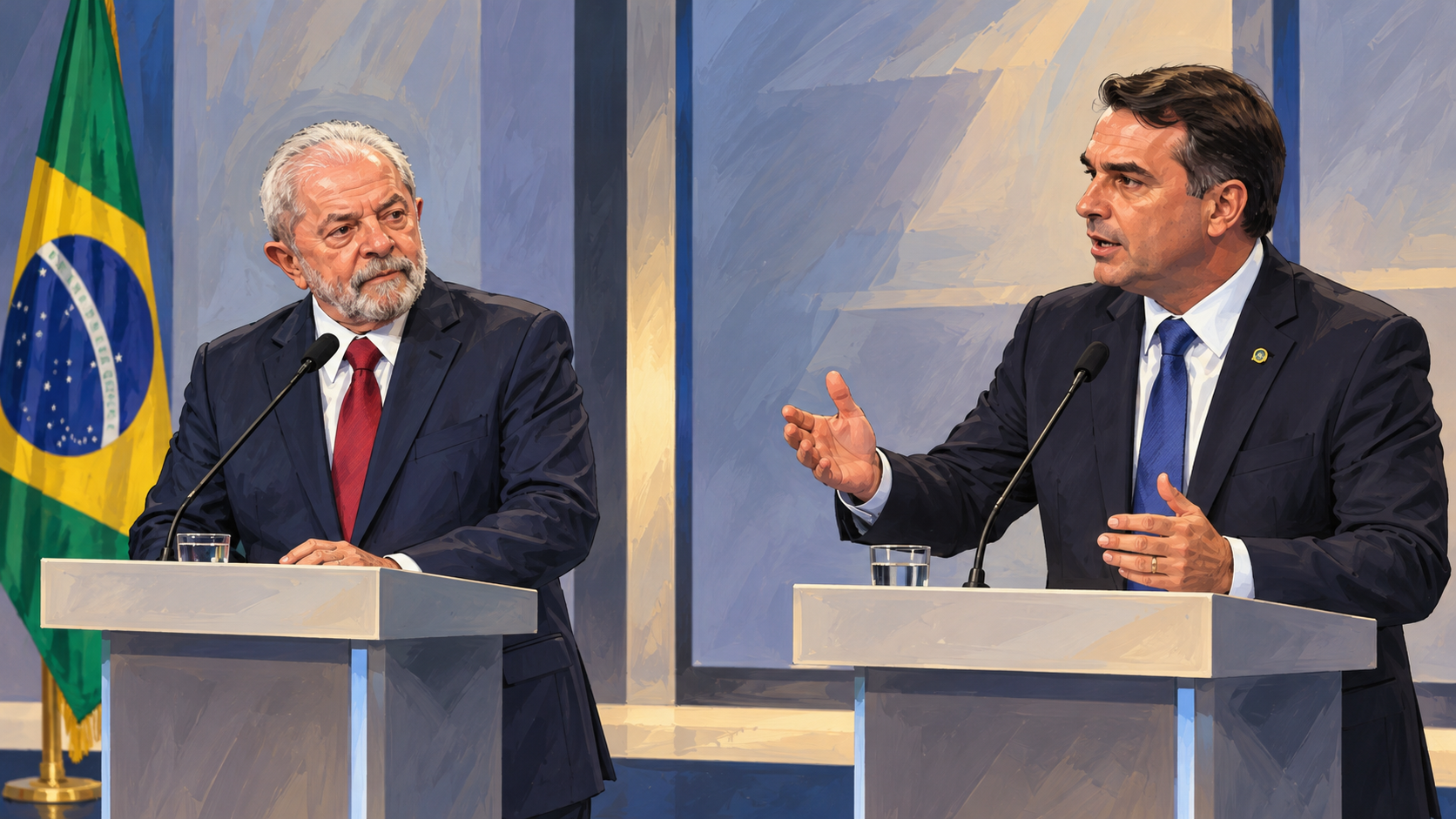
During the first runoff debate between President Lula and Flávio Bolsonaro on Sunday night, Kalshi's contract on a Flávio win traded up to 81 cents while Polymarket's drifted down. By about 5:30 a.m. Monday, Kalshi was at 79 cents and Polymarket at about 77.25.
Brazil's presidential candidates spent Sunday night attacking each other. Traders spent it disagreeing about what it meant.
Polymarket's contract on a Flávio Bolsonaro victory in the Oct. 25 runoff fell from about 80.35 cents on Sunday afternoon to 78.75 cents at about 4:45 a.m. Eastern on Monday and to about 77.25 cents by 5:30 a.m.
Kalshi's equivalent contract moved the other way during the debate. It opened the period at 80 cents, traded at 81 cents in a series of purchases between about 7:45 p.m. and 9:20 p.m. Eastern, during the broadcast window, then slipped back to 80 cents overnight and printed 79 cents at about 5:10 and 5:25 a.m. Monday. All eight of its largest trades in the period were buyers of the Flávio side.
The two venues had converged at about 80 cents on Sunday. They now sit about 1.75 points apart, with Kalshi the more confident.
The debate
The debate, broadcast from São Paulo, was dominated by personal accusations. President Luiz Inácio Lula da Silva called his opponent a "malandro carioca," a Rio hustler, and said he lies. Lula raised an alleged rare-earths concession to the U.S.; Flávio pressed Lula on organized crime.
Estadão Verifica, the fact-checking unit of a newspaper that co-hosted the debate with broadcaster Band, found claims on both sides that held up and claims that did not. Lula's statements on Brazil's investment-grade rating and its debt to the International Monetary Fund were rated true, as was Flávio's statement that interest-rate futures fell 2% after the first round. Other claims by each candidate were rated misleading or exaggerated. A panel of commentators on one Brazilian broadcaster split between calling Flávio the winner and calling it a draw.
Reading the split
The opposite moves on the two venues do not have an obvious cause. Kalshi's rise came in a cluster of large purchases during the broadcast, which may reflect a few traders who thought Flávio performed well. Polymarket's decline was gradual and began before the debate. Neither move is large, and both venues still price Flávio as a strong favorite at close to four-in-five odds. A contract price reflects what traders will pay under its rules, not an objective probability.
The polls describe a closer race. Flávio led in 11 of 13 recent surveys, and one poll had Lula ahead. Most of those leads sit within the margin of error.
Market implications
One reading is that the debate changed little. Both venues remain within a few cents of 80, the split is under two points, and the surveys still show a narrow but consistent Flávio edge.
A second reading is that the venues are beginning to diverge on new information, and that a sharper move awaits the first polls taken after the debate. If those show Lula gaining, Polymarket's earlier drift may prove the better signal.
For investors in Brazilian assets, the winner shapes the fiscal outlook, though Flávio has pledged to keep the inflation-linked minimum wage and pensions, which limits room for restraint whichever candidate wins.
What to watch
The Quaest poll due Wednesday; the Globo debate on Friday, Oct. 23; the runoff on Sunday, Oct. 25; and whether the Kalshi-Polymarket gap widens or closes. A post-debate poll showing a Lula lead would test whether 80 cents can hold on either venue.