
TQ Morning Briefing
Alphabet and Microsoft both spent less than expected. Alphabet, which funded its spending with bonds and stock, was indicated about 10% lower; Microsoft about 3% higher. Software raised guidance and was indicated lower. Ceasefire bets rose as reports of a letter to Tehran spread. GDP and PCE land before the open.
Nasdaq Futures Took the Hit. The Dow Held Its Ground.
Futures split overnight, and the split tracked exposure to AI spending. Nasdaq-100 futures were down about 1% early Thursday and S&P 500 futures 0.3%. Dow futures were slightly higher, after trading as much as 0.9% higher overnight.
Wednesday's cash session gave no warning. The S&P 500 and the Nasdaq each rose 0.3%, and the Dow 0.2%. The VIX ended near 17.
The Fed held at 3.75% to 4% in a 10-2 vote, with Governor Lisa Cook and Cleveland Fed President Beth Hammack voting for a hike. Futures pricing for a December increase rose to about 85% from 78% a day earlier.
Third-quarter GDP and September PCE prices land before the open. Forecasters expect growth of 3.2%, up from 2.2% in the second quarter, and core PCE up 3.1% from a year earlier.
Market Implication
The calm at the index level hides a market that has started charging more for waiting. With a December hike priced near 85%, profit promised years out is worth less today, and the Nasdaq holds most of those promises. The overnight split fits that sorting, with the weakness concentrated where the payback is furthest away while Dow futures hold up. If core PCE runs hot, the hurdle rises for the same stocks already indicated lower.
The 7 Stocks Built to Outlast the Market
Some stocks are built for a quarter… others for a lifetime.
Our 7 Stocks to Buy and Hold Forever report reveals companies with the strength to deliver year after year - through recessions, rate hikes, and even the next crash.
One is a tech leader with a 15% payout ratio - leaving decades of room for dividend growth.
Another is a utility that’s paid every quarter for 96 years straight.
And that’s not all - we’ve included 5 more companies that treat payouts as high priority.
These are the stocks that anchor portfolios and keep paying.
This is your chance to see all 7 names and tickers - from a consumer staples powerhouse with 20 years of outperformance to a healthcare leader with 61 years of payout hikes.
The report is free for a limited time - go here to get it now.
Both Spent Less Than Expected. Only One Paid Its Own Way.
Alphabet (GOOGL) spent $51.4 billion on property and equipment in the third quarter, below the roughly $55.1 billion analysts expected. Microsoft (MSFT) also came in light, at $45.2 billion including finance leases against an average estimate of $50.7 billion.
The results around the spending differed too. Microsoft's revenue rose 19% to $92.3 billion, above the roughly $90.6 billion analysts expected. Alphabet's rose 25% to $127.6 billion, just short of the $128.2 billion consensus.
The stocks went opposite ways. Alphabet was indicated about 10% lower early Thursday and Microsoft about 3% higher.
The gap shows up in cash. Microsoft produced $18.6 billion of free cash flow. Alphabet's was negative $9.1 billion, its second straight negative quarter, and it issued about $28.7 billion of senior notes during the quarter. It also sold $12.4 billion of stock through an at-the-market program, which it says is mainly meant to cover taxes on employee stock awards.
Both businesses grew fast. Google Cloud revenue more than doubled to $30.7 billion, though advertising came in about $1.4 billion short of estimates. Azure grew 48%, above Microsoft's own guidance, and the company expects 49% to 50% in constant currency this quarter.
Microsoft trimmed its calendar 2026 spending view to about $170 billion from about $175 billion. Finance chief Amy Hood tied the shortfall to third-party capacity deliveries that were delayed. Alphabet held its $195 billion to $205 billion plan, and its finance chief said spending will rise significantly in 2027.
Structural Setup
Early trading suggests the market is grading AI spending by its source as well as its size. Both companies undershot their estimates, and the roughly 13-point gap between their indications lines up with how the spending gets paid for: Microsoft out of operating cash, Alphabet increasingly from bond buyers. The reports differed in other ways too, with Microsoft beating on Azure while Alphabet's ad sales fell short, so funding is one explanation rather than the only one. If it holds, the AI trade's pressure point moves from demand to the balance sheet, where a cloud business that doubled does not cover a widening funding need.
Software Raised Its Guidance and Was Indicated Lower.
Oracle Rose 10.6% on Investor Day.
ServiceNow (NOW) guided fourth-quarter subscription growth to 22.5% to 23%, faster than the 21% it just reported, and raised its AI contract target to $1.7 billion. Adjusted earnings of $1.00 a share missed by 2 cents. The stock was indicated about 19% lower.
Fortinet (FTNT) beat on revenue and earnings and raised its billings forecast for the third time this year. Its adjusted gross margin slipped to 79.6% from 81.6%, below the 80.1% analysts expected. It was indicated roughly a quarter lower.
Oracle (ORCL) went the other way on Wednesday, rising 10.6% on 79.1 million shares. Its fiscal 2030 revenue target of more than $225 billion matched what analysts already had. The new pieces were a $20 billion cap on new capital-markets funding through fiscal 2030, excluding refinancing and on top of $20 billion of stock it sold earlier this fiscal year, plus a target for positive free cash flow in the second half of fiscal 2028. The stock was already rising before the release came out, and it was little changed in early indications Thursday.
CoreWeave (CRWV), which leases AI capacity to companies such as Microsoft, was indicated about 6% lower after Microsoft's spending came in light.
Bitcoin fell below $80,000 during Asian trading even as U.S. spot bitcoin funds took in about $137 million on Wednesday, a third straight day of inflows. It had risen after the Fed statement. The drop came later, alongside the slide in tech futures.
Sector Read
A beat-and-raise used to be the safest print in software. ServiceNow and Fortinet both raised forward numbers and were still indicated about a fifth to a quarter lower, so the guide carried little weight against a small miss or a margin slip. Oracle rose on a revenue target that matched the Street, paired with a funding cap and a cash-flow date, and because its shares were rising before the release, the market didn't say which piece it paid for. The bar may be moving from how fast a company grows to when that growth turns into cash, and a raise that skips the second question looks like a weaker defense.
Elon Musk: This Could be 180 Times Bigger than SpaceX IPO

Elon Musk is on record predicting this new opportunity is set to be 180 times bigger than the SpaceX IPO.
That IPO minted 4,400 millionaires overnight.
If this is 180 times bigger…
Just imagine how many more Americans will become millionaires.
Will you be one of them? Click here now.
Ceasefire Bets Rose as Reports of a Letter Spread. The Week After the Vote Got Riskier.
Polymarket's contract on the U.S.-Iran ceasefire holding through Nov. 8 jumped 9 points to 81.5 cents overnight, with volume up about sixfold. The contracts settle "no" only on a qualifying U.S. strike on Iranian territory. Most of the move came Wednesday evening, as reports spread that Vice President JD Vance had written to Iran's security chief, Mohsen Rezaei, about restarting talks.
President Trump said he approved outreach about medical supplies and denied directing peace talks.
The Nov. 15 contract rose only to 58.5 cents from 52.5. That leaves about 23 points of strike risk priced into the week of Nov. 9 to Nov. 15 alone, up from 20 a day earlier and more than the market assigns to the next 10 days combined.
U.S. crude slipped 1.2% to near $101.50.
Watch Signal
The ceasefire market is pricing a calendar, not a negotiation. The biggest jump came in the Nov. 8 contract while the Nov. 15 contract moved less, so the risk priced into the week of Nov. 9 to Nov. 15 grew even as near-term odds improved. Crude's small dip fits the same shape, with relief at the front and the price still above $100. If the Nov. 15 contract starts closing its gap to Nov. 8, traders are treating the diplomacy as real rather than as a pause.
The AI Build-Out Is Heading for the Bond Market
Treasuries split after the Fed. The 2-year yield slipped 0.4 basis point to 4.731% while the 10-year rose 5.2 basis points to 5.044%, its biggest one-day rise since Sept. 28. The 30-year closed near 5.36%. Those closes came before Alphabet reported after the bell.
The front end heard a patient Fed. Chair Kevin Warsh called inflation "too high" but made no December commitment, and the statement swapped its tightening rationale for a promise to gather more information. Oil gained almost 3% on the day, so the long-end move can't be pinned on the Fed alone.
The supply side is growing in the background. Alphabet's long-term debt reached $125.1 billion at the end of September, up from $46.5 billion at the end of 2025, an increase of about $78.6 billion in nine months.
Private money is bidding for the same build-out. TPG (TPG) is in talks to buy Elliott's UK data-center operator Ark at a valuation of about $5 billion, the Financial Times reported. The talks could still fail.
The Treasury sells seven-year notes today.
The Read
AI spending is turning from a line in earnings into a borrower in the capital markets. Alphabet's notes draw on the same pool of long-term money the Treasury needs, and private bids like TPG's chase the same build-out. Wednesday's 10-year move came before Alphabet's numbers were out and on a day oil rose almost 3%, so it isn't evidence of that competition yet. If the biggest spenders keep borrowing at this pace, long yields could carry part of the AI bill.
Free Stock Pick: The Company First in Line
for America’s New Super Fuel
The U.S. Army and Department of Energy are about to flip the switch on a revolutionary new fuel — and one obscure defense contractor has a five-year head start on every competitor.
This joint, high-priority initiative — ordered by President Trump — is called Project Janus.
And the first powerplant to run this new fuel is expected to go live before December 18, 2026…
When it does, this company’s name will be everywhere.
Full details — including the name and ticker symbol — are being revealed for free.
Click HERE to get the stock name, ticker, and the full Project Janus story for free.
Economic Data: Third-quarter GDP, September PCE prices and weekly jobless claims, before the open. ECB decision. Seven-year note sale. Friday: third-quarter employment cost index, Chicago PMI and the Bank of Japan decision.
Fed Speakers: None today; the post-meeting blackout ends after today. Friday: St. Louis Fed President Alberto Musalem.
Earnings: Before the open: Eli Lilly (LLY), Caterpillar (CAT), Mastercard (MA) and Merck (MRK), plus Blue Owl (OWL). After the close: Amazon (AMZN), Intel (INTC), Coinbase (COIN) and Strategy (MSTR). Friday: Exxon Mobil (XOM) and Chevron (CVX).
Overnight: Kospi -1.24% | Nikkei +1.10% | Shanghai -0.82% | FTSE +0.25% | DAX +0.74%
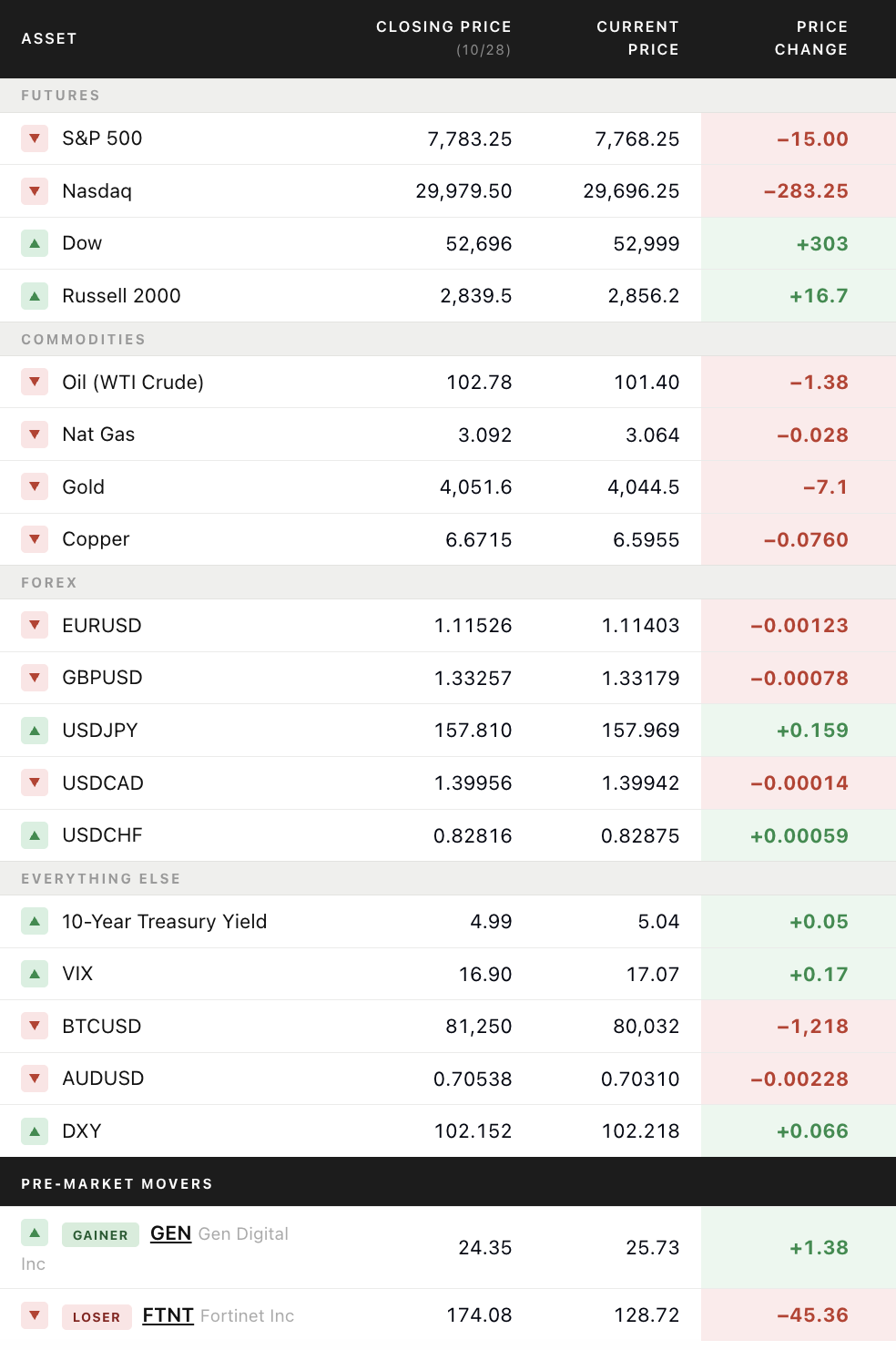
Early quotes drew a line through the AI trade.
Microsoft, paying from its own cash, was indicated higher. Alphabet, which sold $28.7 billion of notes as its cash flow turned negative and fell short on ads, was indicated about 10% lower.
Two tests land today. Core PCE comes out before the open and bears on what that borrowing costs. Amazon reports after the close and will show how much of its own build-out its cash still covers.
A hot print and a thin Amazon cash line would support the view that funding, not demand, now prices AI. A cool print and strong cash would make Alphabet's drop look more like a one-company story.
Rates Just Reset. Who Feels It First?
On January 2, the 10-year Treasury yielded 4.19%. By September 30, it was 5.29%. Most of that move landed in a single quarter.
The bond market repriced and companies are starting to report it.
Some companies earn from higher rates. Some pay for them. And each one runs on a different clock.
We traced three of them, IBKR, WRB and FIS, in a new FREE Special Report:
Rates Just Reset. Who Feels It First?
Who earns it fast. Who earns it slowly. Who pays. One has already reported. The other two report next, and the report tells you the exact line to check.
We'll text the report straight to your phone.