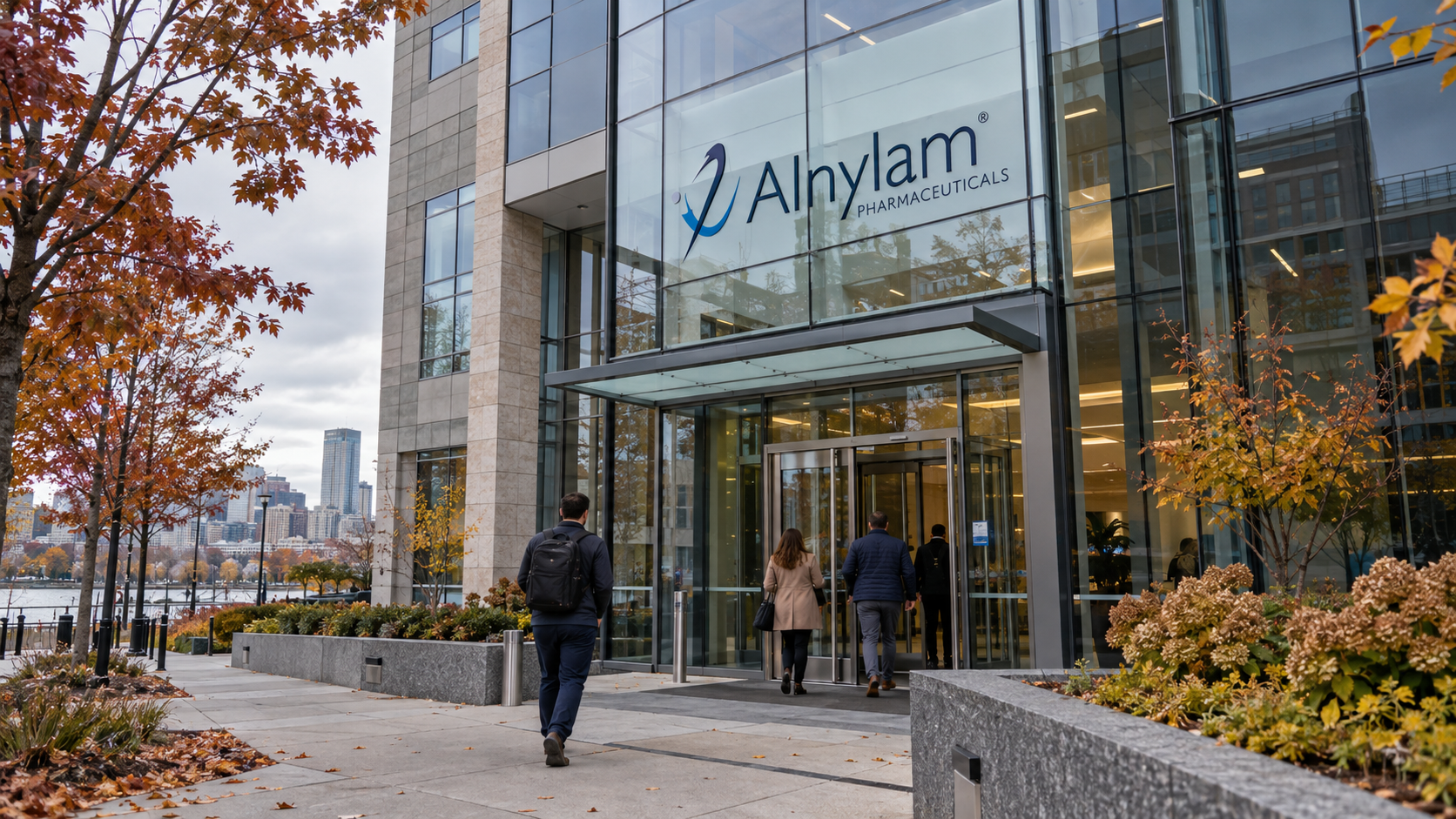
The rare-disease drugmaker's main heart drug grew strongly, but total revenue rose only 17%, operating income fell and its 2026 product forecast came in below expectations. It also enlarged a key trial for the second time this year.
Alnylam Pharmaceuticals reported the kind of drug sales growth most biotech companies would envy. The stock fell by a quarter anyway, and trading was briefly halted.
Net product revenue rose 52% to $1.29 billion in the third quarter. Sales of its transthyretin amyloidosis franchise rose 59% to $1.15 billion, led by Amvuttra at $1.13 billion. Shares fell about 25% to about $173.80 in early afternoon, from $232.40, after a volatility halt at 9:35 a.m. Eastern.
Below the product line
Total revenue grew much more slowly, rising 17% to $1.458 billion. The gap means revenue from collaborations and royalties fell sharply, to about $166 million from roughly $400 million a year earlier, by our arithmetic.
Operating income declined. GAAP income from operations fell 6% to $345.8 million and non-GAAP operating income 11% to $424.9 million, so costs grew faster than revenue.
GAAP net income, by contrast, jumped to $2.17 billion, or $15.72 a share, from $292.7 million. With operating income lower, that increase came from items below the operating line, so the headline earnings figure says little about the business.
What may have moved the stock
Several explanations competed. Alnylam forecast 2026 net product revenue of $4.7 billion to $5.1 billion, below the roughly $5.5 billion analysts expected, according to TheFly. The company said its guidance assumes transthyretin sales at the low end of the range because of uncertainty over drug discount programs and payers. It also pushed some early and mid-stage trial data into 2027.
And it expanded TRITON-CM, the late-stage heart trial for its next-generation drug nucresiran, to 2,250 patients, which TIKR described as the second enlargement this year. Some investors read larger trials as a sign that events are occurring more slowly than expected, which would make a benefit harder to prove. Yvonne Greenstreet, the chief executive, said the company has "a high level of conviction." Alnylam still expects a launch in that indication by 2030.
Overreaction or reset?
The overreaction view: the core drug is growing at nearly 60%, a launch in a large heart indication remains on track, and a guidance range that assumes the low end of transthyretin sales may prove conservative.
The reset view: total revenue and operating income tell a weaker story than product sales, the forecast missed, and enlarging a pivotal trial twice raises the risk and cost of the company's next major product.
What to watch
Fourth-quarter Amvuttra sales against the guidance, detail on the non-operating gain, TRITON-CM enrollment and timing, and any change in discount-program rules.