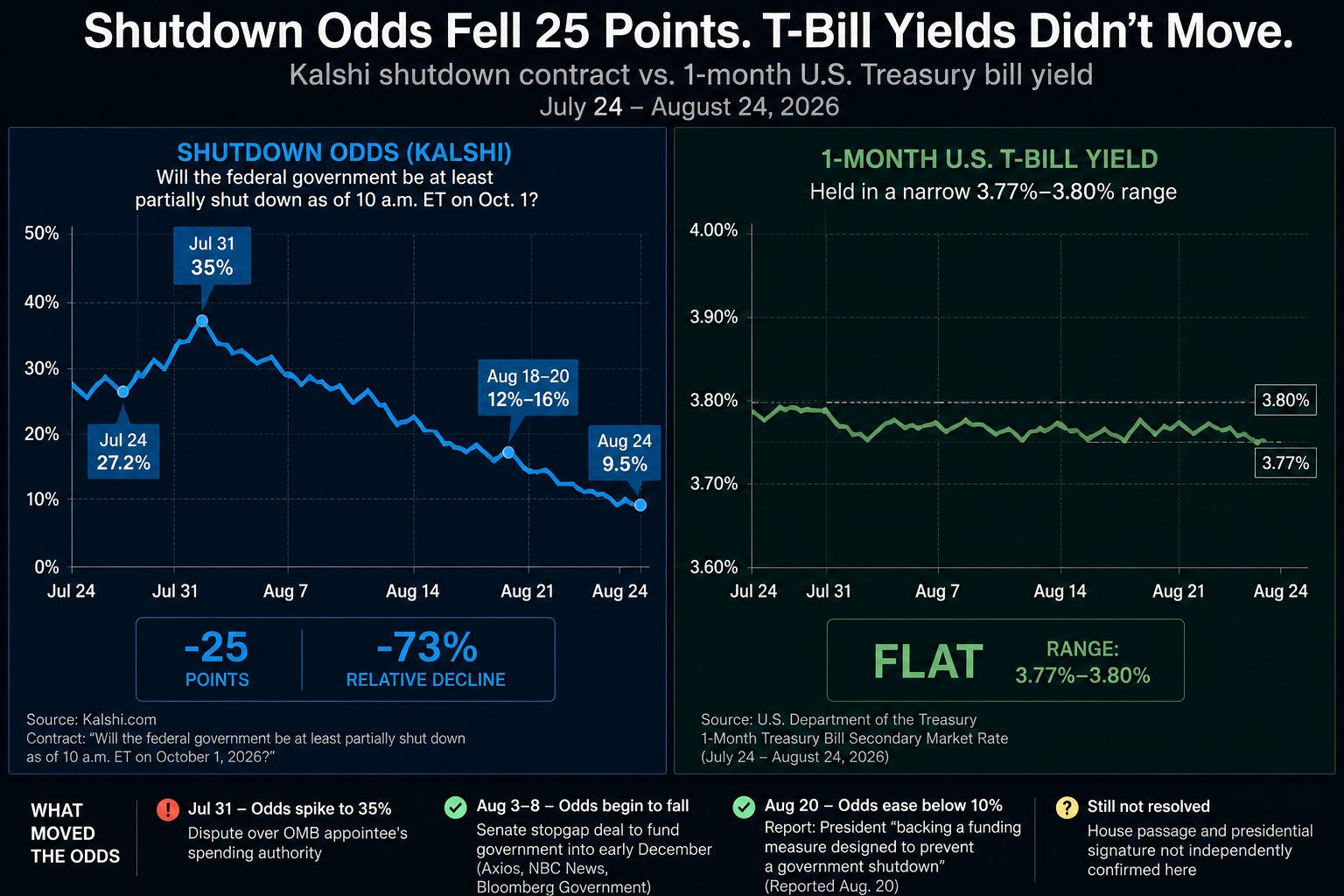
Kalshi traders spent late July pricing in a real chance of a government shutdown. By late August, they weren't. The contract asking whether the federal government will be at least partially shut down as of 10 a.m. ET on October 1 climbed to 35% on July 31, driven by a dispute over an OMB appointee's spending authority. Odds eased to roughly 12%-16% around August 18-20 and now sit near 9.5%, with PredictIt showing a comparable 7.5% on its own contract. That is a 25-point decline, and about 73% in relative terms, in three weeks. The contract had traded as low as 27.2% earlier in the cycle, so the July 31 spike was itself a jump off a calmer baseline.
Short-dated Treasury bill yields did not participate in either direction. Across the same window, one-month bills held in a roughly 3.77%-3.80% range, a band narrow enough to call flat. There was no visible risk premium as odds rose to 35%, and no relief rally as they fell back under 10%.
What actually repriced the odds
The mechanics are traceable. The spike to 35% coincided with a dispute over an OMB appointee's spending authority, the kind of procedural fight that has derailed funding timelines before. The subsequent decline tracks a Senate stopgap deal to fund the government into early December, reported the week of August 3-8 and independently corroborated by Axios, NBC News, and Bloomberg Government. A later report, dated August 20, adds that the President is "backing a funding measure designed to prevent a government shutdown."
That is meaningful legislative progress, not resolution. The corroborated reporting covers Senate-side action; House passage and a presidential signature have not been independently confirmed here. Kalshi and PredictIt traders are pricing a probability under 10% that a shutdown occurs by the October 1 deadline, not certainty that one won't.
Two markets, two different questions
The bill market's silence isn't necessarily a judgment call on the same odds Kalshi is pricing. Kalshi and PredictIt price a binary: shutdown or not, by a specific hour on a specific date. The bill market prices something narrower: whether investors get paid on time and in full. A shutdown can happen and still leave that second question untouched, if the disruption is short enough that it never reaches debt-service mechanics. Treasury bill auctions and coupon payments have historically continued through brief lapses; the instrument that would react to real payment risk is not the one that reacts to a few-week funding gap. So the two markets may never have disagreed about a probability. They may simply be pricing different risks, and a 35% chance of some shutdown was never the same as a 35% chance of the kind that moves bill pricing.
That reading doesn't make the bill market obviously right. It's also possible traders extrapolated from a long run of shutdowns that resolved before touching fixed income, and didn't update in real time as odds climbed. Both explanations are consistent with three flat weeks of yields; only a future move would separate them.
What resolves the question
Shutdown odds will move again as the funding measure works through the House toward a signature that hasn't been separately confirmed. Watch what one-month bill yields do the next time they do. If the Senate deal collapses or House passage stalls and odds jump back toward 35% with yields still pinned near 3.78%, that will support the view that the bill market has already priced this as a short, non-disruptive lapse regardless of how the politics reads. If yields finally widen on the next swing, that would mean the fixed-income market was behind the news, not indifferent to it.