The tariffs it appeared to be tracking took effect anyway. The contract's own wording just asked about the wrong date.
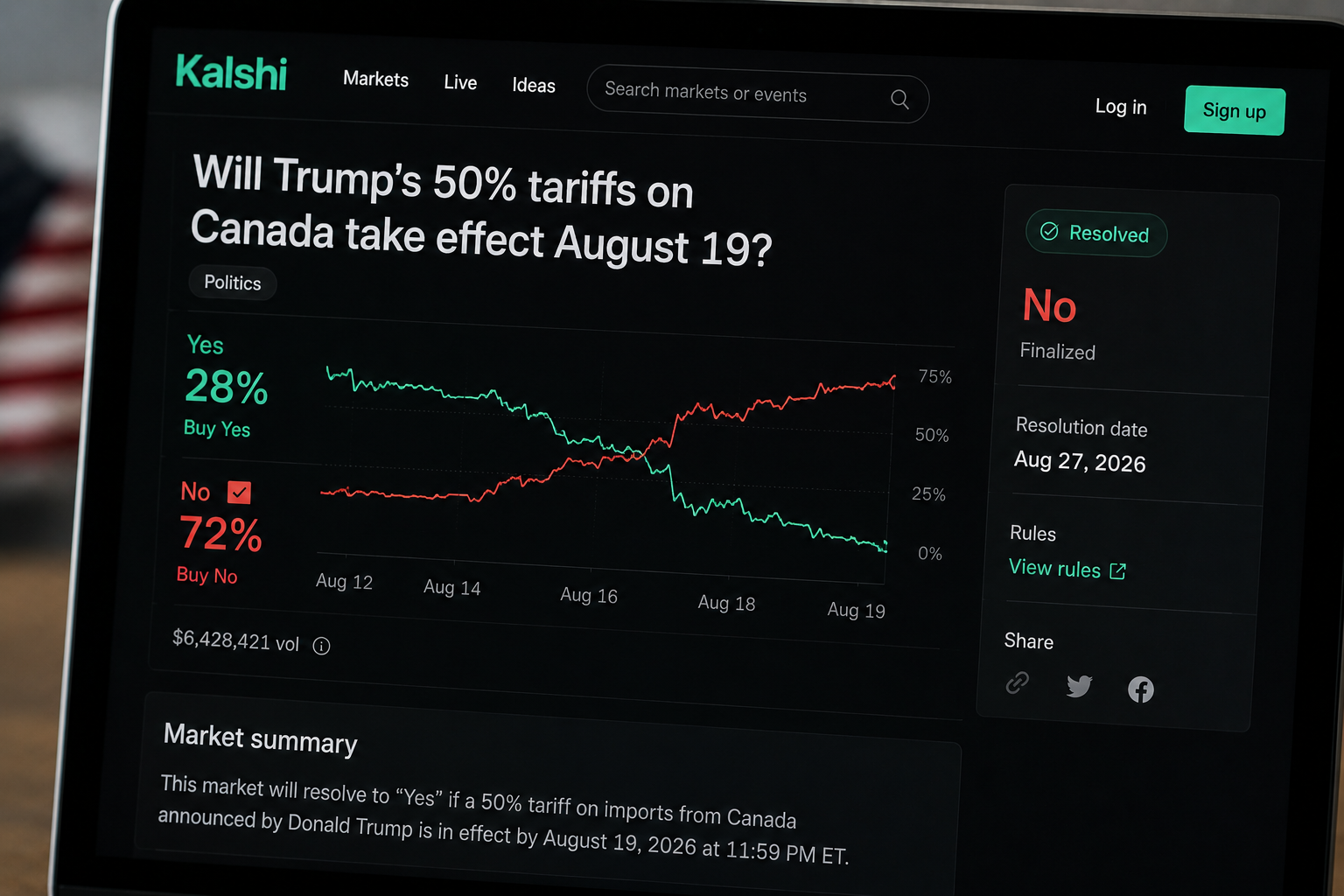
A Kalshi contract titled "Will Trump's 50% tariffs on Canada take effect August 19?" has resolved. A direct check of the contract shows status Resolved, Finalized; outcome No; resolution date August 27, 2026. As worded, the contract asked only whether the tariffs would be in effect by a specific date, August 19, and by that literal measure, they were not.
The tariffs happened anyway, just later. The U.S. imposed 50% tariffs on roughly $20 billion of Canadian goods around August 22, after trade talks between the two countries collapsed. Canadian Prime Minister Mark Carney said Canada is "at war" with the U.S. over the dispute, and Canada is preparing retaliatory tariffs of its own.
Both facts are true at once, and they are not in conflict. The contract's resolution criterion was tied to a specific date; the real-world tariffs simply arrived after that date passed. Someone reading only the contract's No resolution, without checking its exact wording, could reasonably conclude the tariff threat had fizzled. It didn't. It missed its own deadline by roughly three days, a distinction the binary resolution alone does nothing to communicate.
This isn't a data error or a case of the market getting the underlying story wrong. Kalshi's contract measured precisely what it was built to measure: a specific date-bound question, resolved accurately against that question. The gap is between the contract's narrow wording and the broader real-world narrative a casual reader might assume it was tracking. For investors using prediction-market pricing as a proxy for real-world policy outcomes, that gap is worth internalizing: a resolution is only as good as its exact text, and a No on one date-bound question says nothing about whether the underlying event happens later, under a different contract, a few days on.
A separate, still-open Kalshi contract tracking the Canada tariff rate going forward exists; it, not the now-resolved August 19 contract, is the one that reflects where the market currently stands. With Canada's retaliatory tariffs still being prepared, the underlying trade dispute remains active. The resolved contract above is now historical: a record of one narrow question's outcome, not a live signal of where things stand today.