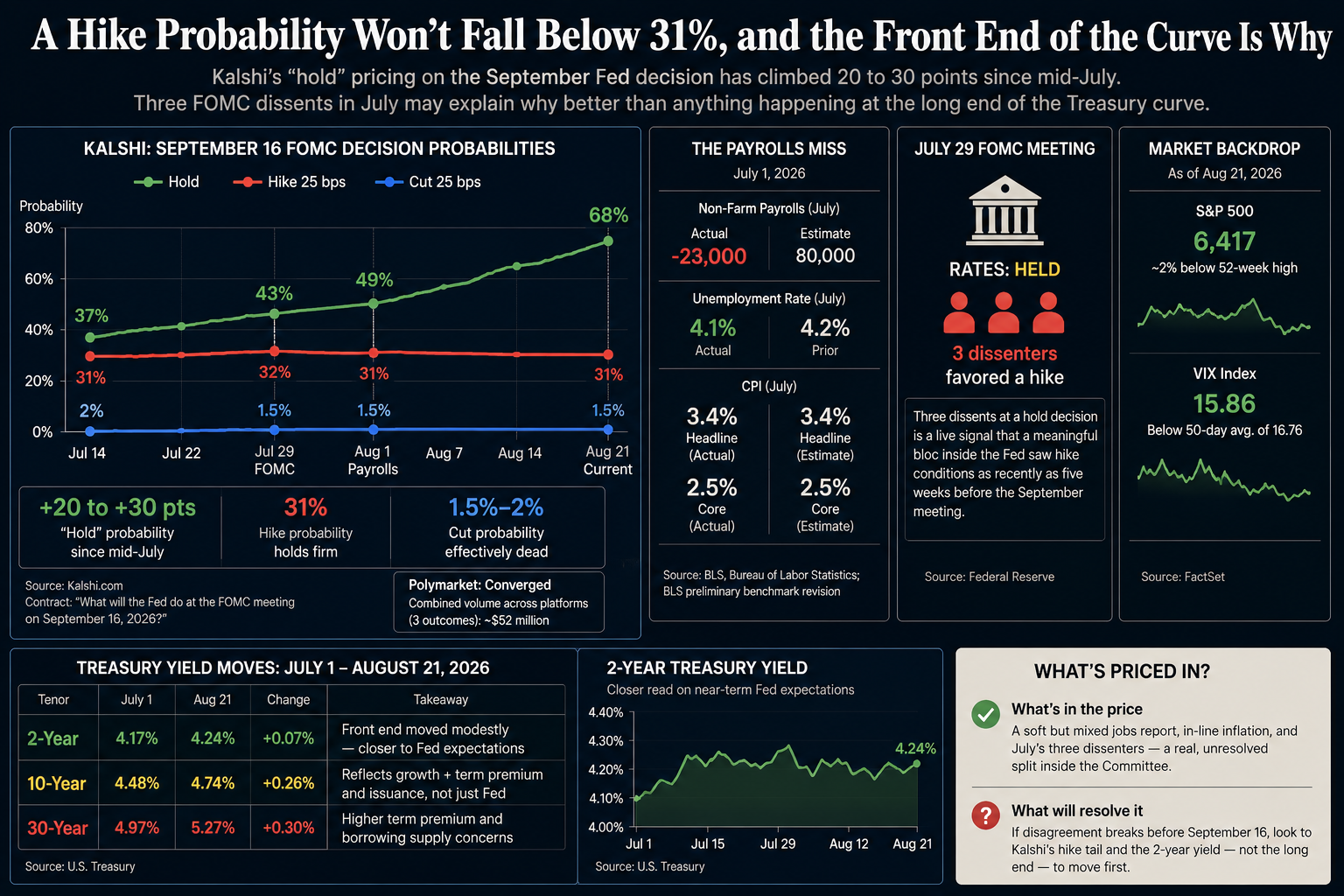
Deck: Kalshi's "hold" pricing on the September Fed decision has climbed 20 to 30 points since mid-July. The hike tail hasn't moved. Three FOMC dissents in July may explain why better than anything happening at the long end of the Treasury curve.
Kalshi's contract on the Federal Reserve's September 16 decision has moved a long way in six weeks. It has not moved the way a clean consensus story would move.
"Hold" pricing on the three-way contract climbed from roughly 37% on July 14, to 43% ahead of the July 29 FOMC meeting, to 49% ahead of the July payrolls report, to roughly 68% now. That is 20 to 30 points delivered in stages, not one jump. Polymarket has converged on essentially the same levels, per a cross-platform tracker, with combined trading volume across the contract family near $52 million.
What hasn't moved is the tail. A 25-basis-point hike is still priced at roughly 31%, barely below where a genuine hold consensus should have pushed it. A cut sits at 1.5% to 2%, effectively dead. Traders have added money to "hold" without pulling a corresponding amount out of "hike." That is not a market converging on an answer. It is a market adding conviction on one side while leaving a stubborn minority position intact on the other.
The Payrolls Miss Everyone Wants to Credit
The obvious catalyst sits in early August. July non-farm payrolls came in at negative 23,000 versus a positive 80,000 estimate, a miss large enough to reset assumptions about labor-market momentum entering the fall. If the market's hold-pricing jump traces to a single data point, this is the one commentators will name.
But the same report cut the unemployment rate to 4.1% from 4.2%, not the reading a purely dovish labor shock produces. July CPI landed exactly in line with estimates, 3.4% headline and 2.5% core, offering no inflation surprise to reinforce a dovish read. The payrolls miss happened. Whether it alone explains a 20-to-30-point repricing spread across six weeks is a harder claim than the data supports.
The Dissents the Payrolls Story Skips
The July 29 FOMC meeting sits inside the same window, and it produced a detail the "payrolls drove it" narrative tends to leave out: the Committee held rates but recorded three dissents favoring a hike. Three dissents at a hold decision is a live signal that a meaningful bloc inside the Fed saw hike conditions as recently as five weeks before the September meeting.
A contract that still can't push hike pricing below 31%, even after a soft payrolls print, looks like it is carrying the weight of that division rather than a stale artifact from before the jobs data. Read against the sequence, hold-with-three-dissents on July 29, a weak but genuinely mixed payrolls report the following Friday, hold pricing rising in stages rather than in one move, the more disciplined read is that Kalshi is pricing real committee disagreement, not an unresolved rounding error left over from mid-July.
Where the Comparison Actually Belongs
The instinct is to check that story against Treasuries, but the long end is the wrong place to look. From July 1 to August 21, the 10-year rose from 4.48% to 4.74% and the 30-year rose from 4.97% to 5.27%. Those moves are real, and they matter for a separate story about term premium and fiscal issuance risk that FinancialMarkets.com has covered on its own terms. But 10s and 30s are priced off growth expectations and the government's borrowing calendar as much as anything the Fed does at a single meeting. Treating a rising 30-year yield as evidence the market has dismissed hike risk conflates two different clocks.
The more meeting-relevant point on the curve is the 2-year Treasury yield, which moved from 4.17% to 4.24% over the same stretch, a modest rise that sits closer to what near-term Fed expectations should show than anything at the long end. That is a small move for a market supposedly settling into a clean hold consensus, and it is more consistent with the front end pricing in the same lingering division Kalshi is pricing than with a resolved outlook. Equities, for what it's worth, aren't signaling stress either way: the S&P 500 sits within about 2% of its 52-week high, and the VIX at 15.86 sits below its own 50-day average of 16.76.
What September 16 Has to Settle
The better-supported read of the last six weeks is that Kalshi's 31% hike tail is doing its job. Three dissents at the last meeting, a payrolls miss that came bundled with a falling unemployment rate, and in-line inflation together look less like noise the market forgot to price out and more like a genuine, unresolved split inside the Committee. The rise in long-dated yields is a real but secondary data point, tied more plausibly to term premium and issuance than to the Fed's next move.
A 31% hike tail that hasn't budged after a soft payrolls print says traders still believe the three July dissenters matter. That is a far less settled Fed than the 68% hold headline suggests, and it may be Kalshi's tail, not the 2-year yield, that moves first if the committee's division breaks before September 16.