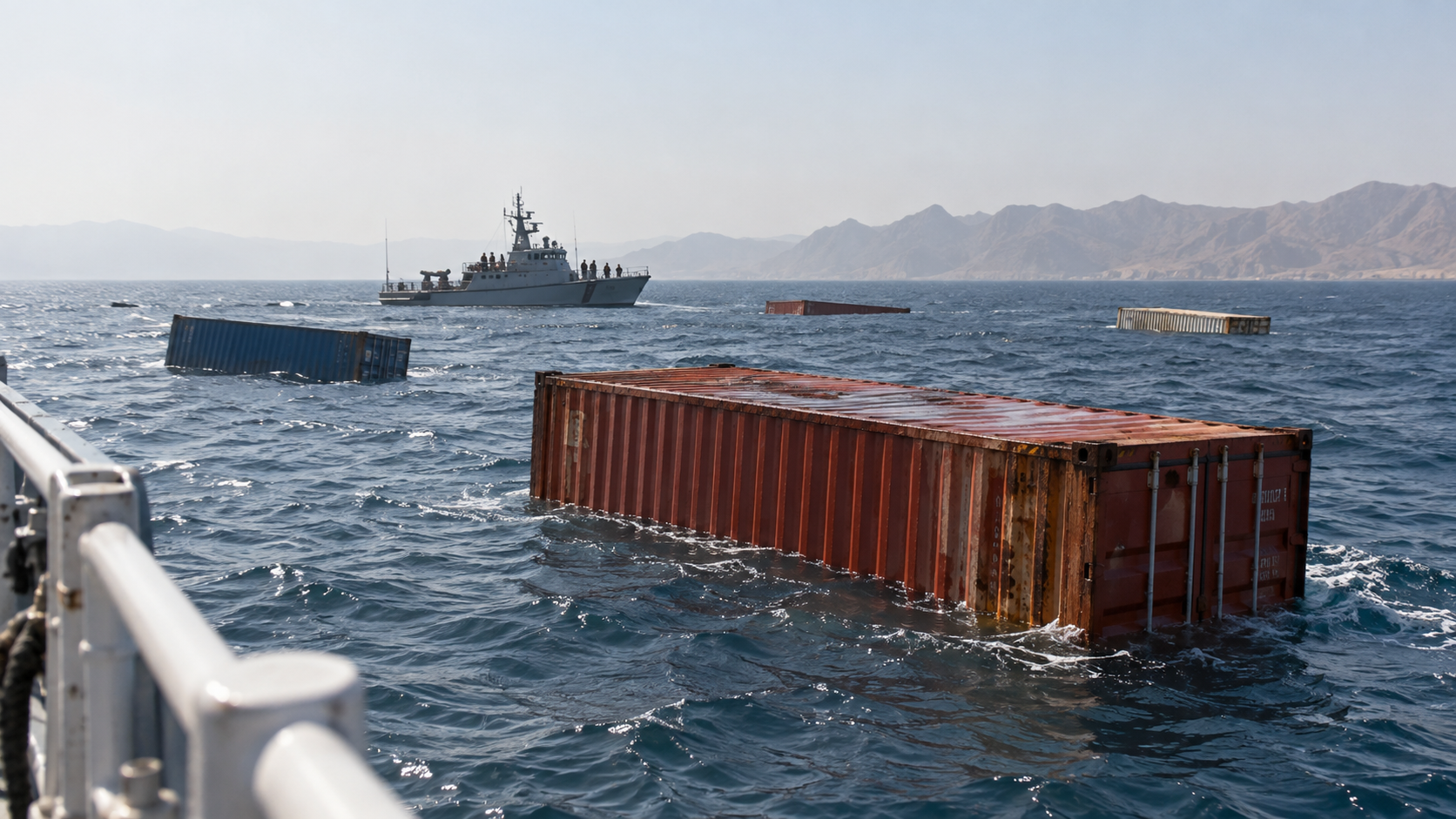
Iran said the GFS Pride hit a mine on an unauthorized route; maritime security sources said a projectile struck it. People familiar with Aramco's Dhahran complex described extensive fire damage. A contract on the blockade ending by Oct. 31 sat at 12.5 cents through the afternoon.
Reports of two of the most serious developments in the Gulf conflict this month arrived on Wednesday morning. A market built to price their consequences barely noticed.
The ship
The Singapore-flagged container ship GFS Pride, with capacity for 2,824 standard containers, sank south of the Strait of Hormuz. Iran's Revolutionary Guards navy said in a statement carried by state media that a vessel, carrying "more than 2,500 containers," struck a naval mine while using an "unauthorized and dangerous route." Maritime security sources identified the ship as the GFS Pride and said it sank after being hit by a projectile. Singapore's port authority later confirmed that the ship had been struck by a projectile and had sunk. A navigational warning from Pakistan's hydrographer described the ship as "reported sunk with floating containers."
Separately, the Cape Dao, struck on Sept. 23, was reported to be sinking. The International Maritime Organization counted 106 confirmed attack incidents in the strait as of Oct. 13, and Britain's maritime trade agency reported two more container ships hit by unknown projectiles on Tuesday, with minor damage.
The headquarters
In Saudi Arabia, three people with direct knowledge of the matter said Aramco's Dhahran headquarters suffered extensive damage in Tuesday evening's strike. A fire spread across floors six through 10 of the south wing and was still burning early Wednesday, they said, and the top three floors, including Chief Executive Amin Nasser's office, were severely damaged, with part of the ceiling collapsing. Operations continue, some staff are working from home and some functions have moved to overseas offices. The complex houses an operations center that oversees rigs, refineries, export terminals and pipelines.
Saudi Arabia's energy ministry has described the incident as a "limited fire." Aramco did not comment. A Houthi spokesman said the group would keep targeting Saudi airports and oil facilities in coming days and told shipping companies and workers to stay away.
The contracts
Polymarket's contract on the Hormuz blockade ending by Oct. 31 traded at 12.5 cents in every hourly reading from 5 a.m. to 1:46 p.m. Eastern. A separate contract that pays out if there is no direct U.S. strike on Yemeni territory through Oct. 31 rose from 87.5 cents to 88.5 cents at 8 a.m. and stayed there. The equivalent contract through Oct. 15 traded near 99.6 cents in early afternoon.
Reading the flat line
A contract that does not move after a sinking is still informative. At 12.5 cents, traders had already assigned only about a one-in-eight chance that the blockade ends this month, so Wednesday's events confirmed rather than changed their view. The Yemen contract, meanwhile, continues to price a high likelihood that Washington stays out of direct strikes despite escalating attacks on its Saudi ally.
Both are market prices, not forecasts, and the Yemen contract trades thinly.
Market implications
One reading is that prediction markets have fully absorbed a prolonged conflict, leaving little room for single incidents to move prices. The other is that they are underpricing escalation. A sinking, a damaged command center for the world's largest oil company and a pledge of more attacks would each be grounds for a higher risk premium elsewhere, and Brent crude was up about 1% by early afternoon.
What to watch
An official account from Aramco or Riyadh on the headquarters damage, any U.S. statement on the cause of the GFS Pride sinking, and whether the Yemen contract moves if Washington announces a response.