

Robinhood was built on two booms: free stock trading and crypto. Last quarter, something else beat them both. Event contracts, which let customers bet on elections, Fed decisions, oil prices and football games, brought in $173 million. Stocks brought in $121 million. Crypto, $120 million. Then, on the call, the company said that by early next year most of that flow will go to an exchange it co-owns and a partner it holds a stake in. The stock was indicated about 7% lower before the open after profit came in below some forecasts. The market is grading last quarter. It may be missing that Robinhood just told you what kind of company it wants to be, at the exact moment 39 states are asking the Supreme Court to let them treat much of its fastest-growing product as gambling.
But before we get to that, a quick look at what moved overnight and what matters today…
3 Movers in 3 Minutes
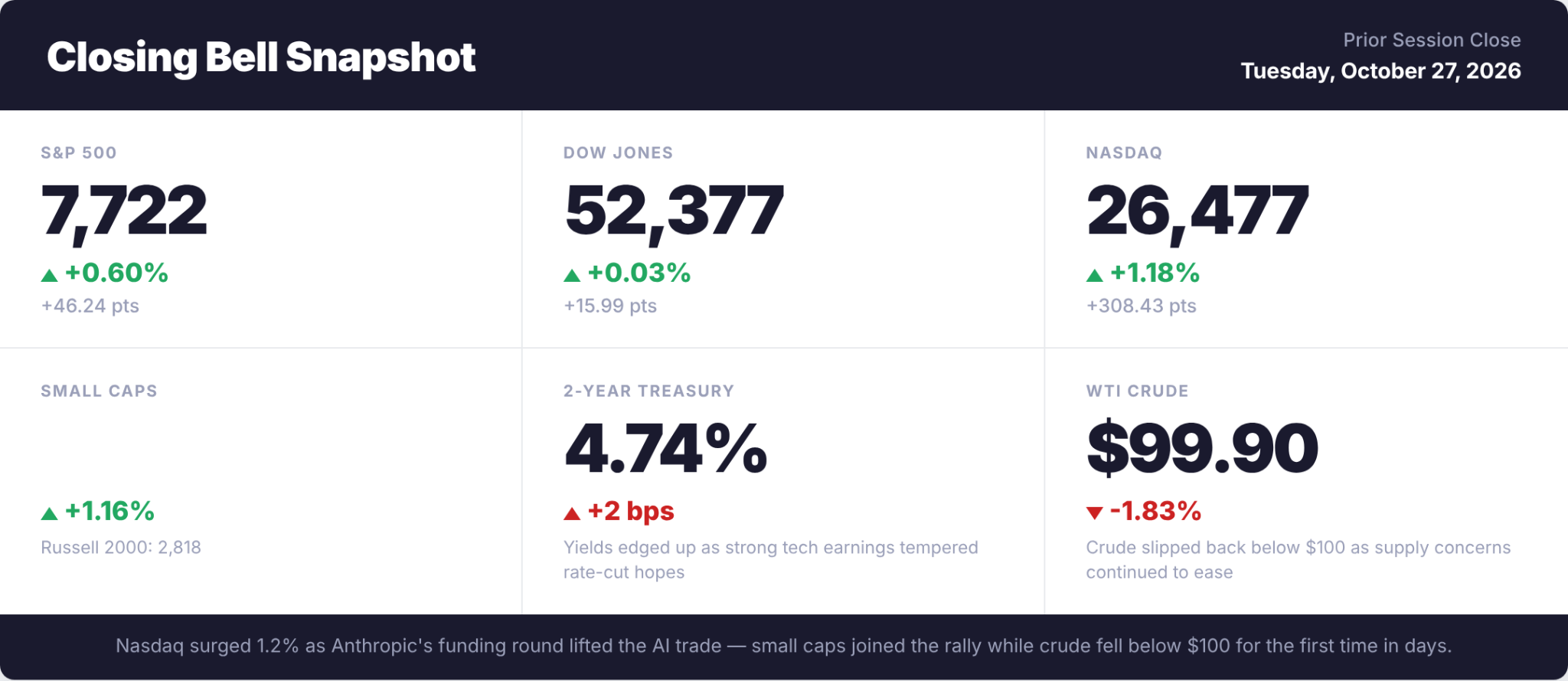
1. Oil is back above $100, and it's pricing a date. U.S. crude was up about 1.6% at around $101.50 a barrel shortly before 7 a.m. ET, with Brent near $115. The new item overnight was a Wall Street Journal report, citing people briefed, that Washington told Gulf states to prepare for a possible short, intense campaign against Iran after the Nov. 3 midterms. No final decision has been made, according to accounts of the report. A Houthi claim of a missile strike on Saudi Arabia's Ras Tanura refinery, which Saudi Arabia has not confirmed, came Tuesday, a day Brent still fell 1.7%. Polymarket's ceasefire contracts split by date: Oct. 31 held near 95 cents while Nov. 15 fell about 4 points from Tuesday to around 51.5 cents, which puts close to even odds on a qualifying U.S. strike by mid-November. Yesterday we said the risk sat on the calendar, not in the terminal. Overnight, a newspaper printed the calendar. That premium is unlikely to leak out before Nov. 3 unless diplomacy produces a date of its own.
2. Israel voted for a deadlock. Two prediction markets read it differently. With about 77% of ballots counted, partial results gave Netanyahu's bloc 54 seats, the opposition 47 and Arab-led parties 19, leaving both blocs short of the 61 needed to govern. On Polymarket, Benjamin Netanyahu's contract to be the next prime minister was at about 45 cents shortly before 7 a.m. ET, up from 31.5 cents after the exit polls but off a 52.5-cent high at 4 a.m. Gadi Eisenkot's was near 28 cents, from about 63 cents just before polls closed. On Kalshi, whose contract settles on government formation, the biggest price late Tuesday was on "No one," at 60 cents. Tel Aviv's TA-90 fell 3%, insurers 3.6%, and the shekel weakened about 1% to around 3.08 per dollar. The venues aren't arguing about the count. They're arguing about the rules. Neither counts a caretaker prime minister, but the two contracts run to different deadlines, and on Kalshi the single highest price is on nobody.
3. KKR found a new exit for a 2017 loan fund. KKR (KKR) closed its first private credit continuation vehicle, with more than $460 million of commitments led by Allianz Global Investors, PitchBook reported, citing market sources. It holds the loans of KKR Lending Partners III, a $1.5 billion direct lending fund that finished raising money in 2017. Investors could cash out or roll into the new vehicle on substantially the same terms. The price wasn't disclosed. Yesterday a listed private-credit fund agreed to sell at about 85 cents on the dollar of its stated value. Private credit is building exits for its oldest funds faster than it's publishing what those exits pay. Until terms like KKR's are disclosed, deals like Ares' remain the clearest public marks investors have.
3 Signals for Today
Three central banks, one question: timing or direction. New Zealand held at 2.75% overnight by a 4-3 vote when markets had priced a hike, yet all seven members agreed tighter policy is "likely to be required". The Bank of Canada decides at 9:45 a.m. ET, with 19 of 34 economists in a Reuters poll expecting a hike. The Fed follows at 2 p.m. Kalshi's hike contract sits at 5 cents, while traders there price a December hike near 79%. If Chair Warsh frames December the way New Zealand framed its hold, as a question of when rather than whether, the 10-year near 5% stays where it is. If he leans against December, that's the first real dovish surprise of this oil shock, and the dollar, near a two-week high, is the trade that moves first.
Microsoft and Alphabet put numbers on the AI bill tonight. Microsoft (MSFT) is expected to earn $4.72 a share on $90.6 billion of revenue, and Alphabet (GOOGL) $3.02 on about $128 billion, according to FMP data. On Monday, Microsoft offered voluntary buyouts to about 60,000 employees, roughly a quarter of its workforce, as it spends on AI. Meta (META) closed Tuesday at $620.19, below the $625 price of its new $25 billion stock sale. Read capital spending next to operating cash flow. Alphabet raised $84.75 billion of stock in June, and Meta followed this week. Any hint that Microsoft needs outside money would make it three of the biggest spenders, and the AI trade starts competing with everyone else for capital.
Strategy votes on dividends that accrue every day, including Christmas. At 10 a.m. ET, holders of Strategy (MSTR) vote on moving its four listed preferred stocks to daily dividends without changing total payouts. Strategy pitches the change as a way to improve liquidity and price stability. For Stretch, its variable-rate preferred, stability means staying near its $100 stated value. It closed at $99.49. That price matters because preferred stock has become one of Strategy's main ways to fund bitcoin buying. The other end of the treasury trade showed up Tuesday: Datavault AI (DVLT) said it has been unable since June to withdraw bitcoin credited to its account at exchange Biconomy, and that past financial statements can no longer be relied upon. The stock halved to under 7 cents. With Strategy and Coinbase reporting Thursday, bitcoin treasury companies are being judged on funding and custody, not just on bitcoin at $81,400.
Elon Musk's $2.1 Trillion Hit List

The SpaceX IPO made Elon Musk the wealthiest man who has ever lived.
Now he's spending it to complete his dynasty...
He's already acquired a $40 billion AI firm and a $1 billion turbine company.
But a handful of companies still stand between him and total control of the space economy.
Click here to see why early investors could walk away with a fortune.
And with that out of the way, let's get to today's big story: how Robinhood quietly became a prediction-market company, and why it now wants to own the exchange.
The Sip
Three numbers in a row
Here are three revenue lines from the third quarter at Robinhood (HOOD).
Stocks: $121 million. Crypto: $120 million. Event contracts: $173 million.
The company that became a household name on meme stocks and Dogecoin now makes more money from people betting on events than from either. Among its trading lines, only options, at $399 million, earned more. Event contract revenue rose more than sixfold from a year ago, and customers traded a record 16.4 billion contracts. It is the second straight quarter that bets have outearned both stocks and crypto.
Total revenue hit a record $1.42 billion, up 12%. The stock was still indicated about 7% lower before the open, near $87.70, after closing at $94.56 on Tuesday. It had already lost 17% in October through Monday.
The selloff appears to be about last quarter's profit. The more important news was about next year's plumbing.
The broker wants to be the exchange
Until this summer, Robinhood was a storefront for prediction markets. Customers traded in its app. The contracts lived on other exchanges. Robinhood collected its fee and sent the trade elsewhere.
In June, a joint venture between Robinhood and trading firm Susquehanna International Group launched its own exchange, Rothera. In its first full quarter, Rothera passed $100 million in annualized revenue. It contributed $28 million of the $173 million.
Then came the line on Tuesday's call that matters most. "Rothera will be our primary exchange," CFO Shiv Verma said, with Crypto.com and OG.com as the main second venue, "and we'll be getting off most of our competitors." By the end of the year into early next year, he said, the vast majority of Robinhood's flow should run through those two. Robinhood took an initial 1% stake in Crypto.com and OG.com and can earn up to 10%.
Verma explained the logic plainly: "Before we were sending our flow to other exchanges and we weren't getting any financial incentives because of that."
Translate that. Robinhood owns the customers. Since Robinhood launched prediction markets in late 2024, someone else owned the venue and kept the venue's economics. By early next year, Robinhood plans to send the vast majority of its flow to an exchange it co-owns and to a partner it holds equity in. Distribution is turning into ownership.
Where the crypto money went
The crypto line tells you what the customers left behind. Crypto revenue fell 55% from a year earlier, when it was $268 million. A year ago crypto was about 21% of Robinhood's revenue. Now it's 8.4%.
There's a footnote inside the footnote. Crypto revenue did rise 20% from the second quarter, but $26 million of it came from Robinhood Chain, the company's new blockchain, in its first quarter. Strip that out, and crypto revenue fell about 6% from the second quarter.
Yesterday morning we said the October numbers would tell you whether retail was stepping back. Here is the answer. On the call, Verma said average daily volumes in stocks, options and crypto are running about 5% below a very strong third quarter. Event contracts are up about 10%.
Retail didn't leave. It moved.
Why the stock fell anyway
The market appeared to grade the quarter on profit, and profit was soft. Diluted earnings fell 16% to 51 cents a share, including a 7-cent mark-to-market loss on investments the company holds. Adjusted earnings, a new measure, were 60 cents, below the 64 cents analysts polled by S&P Global expected but above other forecasts of about 55 to 56 cents. On Tuesday morning, Polymarket traders had given roughly two-in-three odds that GAAP earnings would top 56 cents. They came in at 51.
Free Stock Pick: The Company First in Line
for America’s New Super Fuel
The U.S. Army and Department of Energy are about to flip the switch on a revolutionary new fuel — and one obscure defense contractor has a five-year head start on every competitor.
This joint, high-priority initiative — ordered by President Trump — is called Project Janus.
And the first powerplant to run this new fuel is expected to go live beforeDecember 18, 2026…
When it does, this company’s name will be everywhere.
Full details — including the name and ticker symbol — are being revealed for free.

Click HERE to get the stock name, ticker, and the full Project Janus story for free.
Net interest revenue fell 9% to $415 million. Expenses rose as credit-loss provisions nearly tripled and Robinhood spent on Trump Accounts. Crypto take rates slipped because more customers are parking money in a stablecoin product that Robinhood monetizes less.
None of that is a thesis killer. October net deposits topped $13 billion in a few weeks, including $6 billion from the Dell family's contribution to Trump Accounts. But it explains the reaction. The market is pricing a broker whose crypto engine stalled. It isn't yet pricing a broker turning into an exchange operator.
The fine print is mostly sports
Here's the uncomfortable number. In the third quarter, about 30% of Robinhood's event contract activity was non-sports, the CFO said, up from 15% the quarter before. The other 70% was sports.
That matters because sports contracts are exactly what the courts are fighting over. New Jersey has asked the Supreme Court to decide whether states can regulate sports contracts on federally licensed exchanges like Kalshi. Ohio, 38 other states and Washington, D.C. filed a brief backing New Jersey, and Kalshi's response is due Nov. 9. In August, a federal appeals court ruled that Kalshi's sports contracts are not swaps under federal law, which lets Nevada enforce its gambling rules. In September, the same circuit said two California tribes were likely to win claims over sports contracts on tribal lands, in a case where Robinhood is a named defendant. The NFL has told the Supreme Court that on the season's first Sunday, $1.8 billion of $3.3 billion in prediction-market volume was tied to the league.
Vlad Tenev seems to see the clock. On the call, he said sports is "rapidly going to get commoditized" and that Robinhood wants to "own the financial category": crypto and commodity contracts, and contracts on company metrics that are waiting on final approvals. The strategy is a race. Shift the mix toward financial contracts before the courts decide what sports contracts are.
What the market keeps missing
The obvious read is that Robinhood is a crypto stock having a bad crypto year. The better read is that Robinhood is becoming a different kind of company, and the comparison set is changing.
Look at Thursday. Coinbase (COIN), the largest U.S. crypto exchange, is expected to report a loss of about 23 cents a share on $1.21 billion of revenue, according to FMP data. That's less revenue than Robinhood just reported. Coinbase also sells prediction markets, and its help pages say they are operated by Kalshi. Coinbase is renting the venue. Robinhood is leaving the rental.
Bernstein expects Robinhood's prediction-market revenue to reach $1.7 billion in 2028, from about $650 million this year, edging past the $1.6 billion it expects from crypto. If Rothera becomes the main venue, more of that money stays inside the joint venture instead of going to someone else's exchange.
For a decade, critics said Robinhood turned investing into a game. Now it wants to own the scoreboard.
Buffett, Gates and Bezos Quietly Dumping Stocks—Here's Why
The world's wealthiest individuals are making huge moves with their money.
Warren Buffett just liquidated billions of shares. Bill Gates sold 500,000 shares of Microsoft. Jeff Bezos filed to sell Amazon shares worth $4.8 billion.
What is going on? One multi-millionaire believes they are preparing for a catastrophic event. But not a crash, bank run, or recession. It’s something we haven’t seen in America for more than a century.
The MarketSipsTakeaway
Robinhood's quarter looked like a profit miss with a crypto hangover. Underneath, it showed a broker turning its distribution into an exchange business, built on a product whose legal status is still being argued. Three things will tell you whether that bet is working. First, Rothera's share of event contract revenue: $28 million of $173 million this quarter, and the company says the vast majority of its flow will run through Rothera and Crypto.com/OG.com by early next year. Second, the non-sports share, which doubled to 30%; if it keeps climbing, the court fight matters less. Third, the Supreme Court: whether it takes New Jersey's case after Kalshi responds on Nov. 9. A ruling for the states would hit the 70% that is still sports, wherever it trades. Watch Coinbase on Thursday for the contrast. If its retail crypto line is as weak as Robinhood's, the market will have to decide which company it thinks found the next engine.
Until then, sip slowly!
The Market Sips Desk
Reply prompt: Would you rather own the app where people place the bets, or the exchange where the bets clear? Hit reply and tell us why.
Rates Just Reset. Who Feels It First?
On January 2, the 10-year Treasury yielded 4.19%. By September 30, it was 5.29%. Most of that move landed in a single quarter.
The bond market repriced and companies are starting to report it.
Some companies earn from higher rates. Some pay for them. And each one runs on a different clock.
We traced three of them, IBKR, WRB and FIS, in a new FREE Special Report:
Rates Just Reset. Who Feels It First?
Who earns it fast. Who earns it slowly. Who pays. One has already reported. The other two report next, and the report tells you the exact line to check.
We'll text the report straight to your phone.