

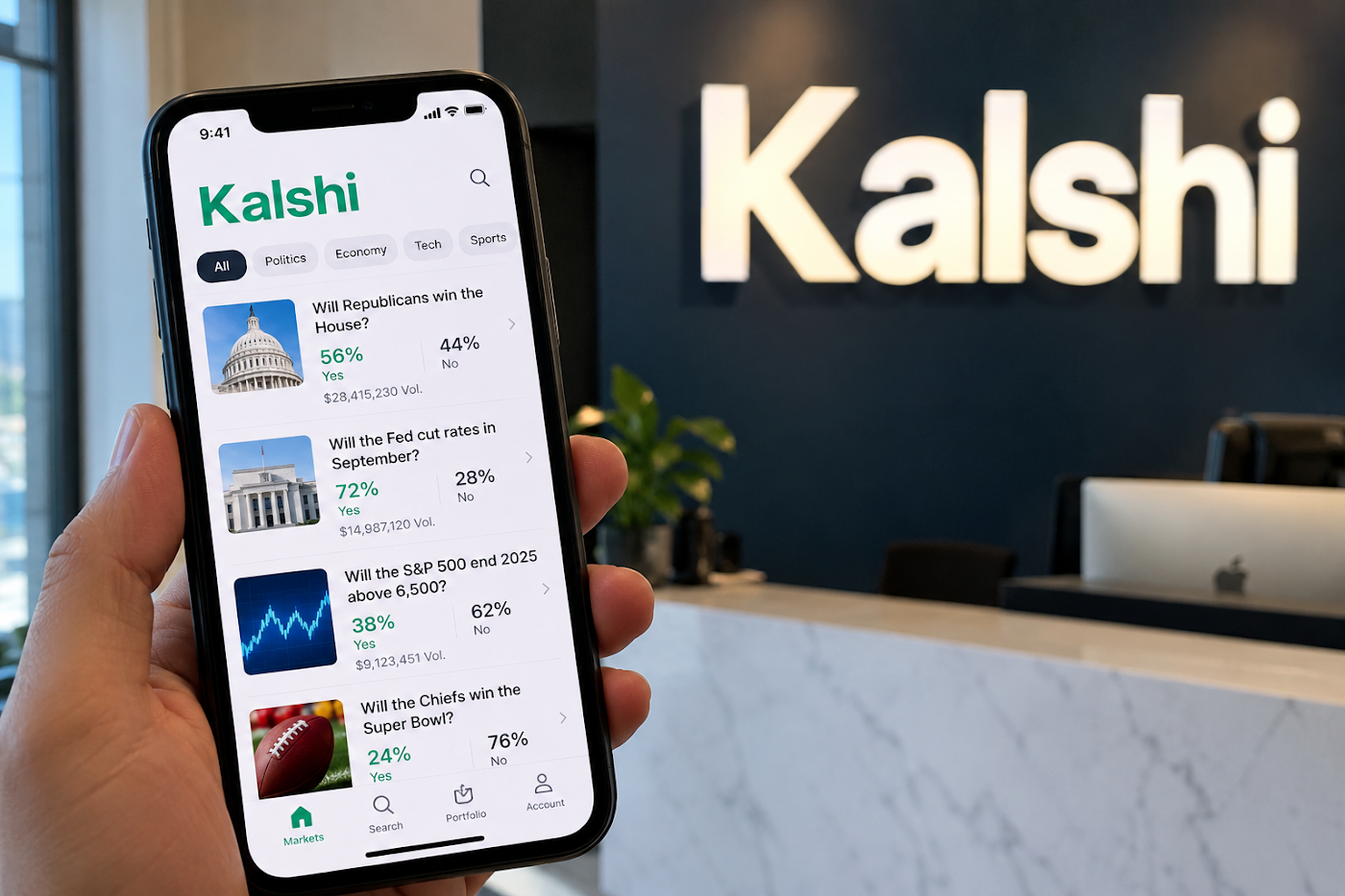
Yesterday, it was reported that Kalshi, a prediction markets platform most people have never heard of, is closing a funding round at a $40 billion valuation. A year ago, it was worth $5 billion. The company lets you bet on whether the Fed will hike rates, whether oil will hit $100, or whether it will rain in Miami on Saturday. Regulators once tried to shut it down. The U.S. Senate banned its own members from using it. And yet, somehow, Kalshi is now worth more than Nasdaq Inc., the company that runs the stock exchange.
How does a company that sells yes-or-no contracts become one of the most valuable private companies in America?
But before we get to that, let's take a quick look at the markets and what matters…
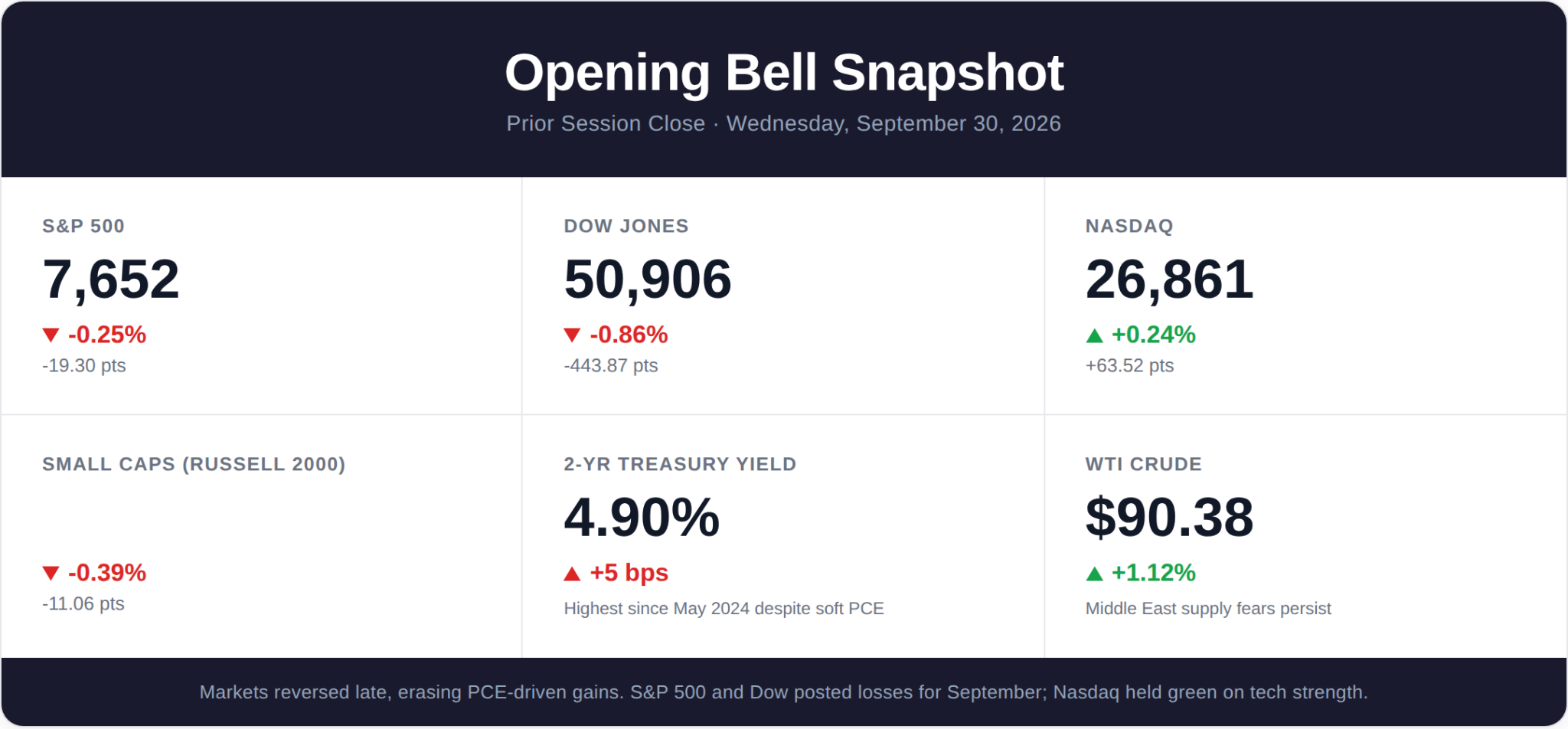
3 Movers in 3 Minutes
1. Micron crushes it, AI memory trade reignites. Micron Technology (MU) reported fiscal Q4 earnings after the bell on Tuesday, beating Wall Street estimates with adjusted EPS of $3.03. CEO Sanjay Mehrotra called memory "the defining silicon of the AI era." The stock rose roughly 2% in premarket, inching toward its all-time high.
2. Inflation cools, but the market didn't care. The August PCE price index, the Fed's preferred inflation gauge, came in below expectations, pulling October rate hike bets down to 37% on CME FedWatch. Stocks initially rallied on the data, with the S&P 500 up as much as 0.7% intraday, before reversing sharply into the close. The Dow and S&P both posted losses for September.
3. Prediction markets enter the big leagues.Bloomberg reported that Kalshi is finalizing a roughly $1 billion funding round at a $40 billion valuation, led by Sequoia Capital and Wellington Management. The valuation has grown 8x in twelve months and positions Kalshi as the most valuable private fintech company in the U.S. More on this below.
3 Signals for Today
September ISM Manufacturing PMI drops at 10:00 AM ET. After months of contraction readings, any surprise above 50 could shift the narrative on the U.S. industrial economy.
Nike (NKE) reports earnings before the open. The stock is down sharply this year and investors want clarity on Elliott Hill's turnaround timeline.
Nonfarm payrolls loom Friday. The September jobs report lands October 2 and will be the single most important data point for the October FOMC meeting. Consensus sits around 140,000.

The $16 Trillion Rare Earth Discovery
The Guardian calls it "the beginning of the biggest gold rush in history"... and one stock under $5 owns exclusive rights to harvest these rare earths.
Elon Musk and his companies need these minerals before a January 1 Pentagon deadline.
And with that out of the way, let's get to today's big story: the prediction market startup that Wall Street cannot stop funding.
The Sip
A $5 Billion Idea, Twelve Months Ago
In October 2025, a company called Kalshi was worth $5 billion. That number, by venture capital standards, was already remarkable. Kalshi runs a federally regulated exchange where users buy and sell contracts on the outcome of real-world events. Will the Fed raise rates in December? Will oil close above $90? Will it snow more than three inches in New York on January 14?
Each question is a binary contract. You buy "yes" or "no" at a price that reflects the market's implied probability. If you're right, you collect. If you're wrong, you lose your stake. Simple.
But the trajectory since October has been anything but simple.
By December 2025, Kalshi was worth $11 billion. By May 2026, it closed a $1 billion Series F at $22 billion, led by Coatue Management. And yesterday, Bloomberg reported that Kalshi is finalizing another $1 billion round, this time at roughly $40 billion, with Sequoia Capital, Wellington Management, Tiger Global, and Dragoneer circling the deal.
That is an eightfold increase in twelve months.
What the Numbers Actually Say
Kalshi is not growing on narrative alone. It now generates an estimated $4 billion in annualized revenue, compared to roughly $1.1 billion for its closest competitor, Polymarket. Its annualized trading volume has surged from $52 billion to $178 billion in just six months. In July alone, prediction markets hit an all-time monthly volume of $50.6 billion, and Kalshi contributed $37.7 billion of that.
To put that in context, the New York Stock Exchange processes roughly $25 to $30 billion in equity trading on an average day. Kalshi is not that big yet, but the velocity of its growth is unlike anything the exchange world has seen.
And unlike Polymarket, which operates in a regulatory grey zone, Kalshi is a CFTC-designated contract market. It is, in regulatory terms, a proper exchange. It reports to the Commodity Futures Trading Commission the same way the CME Group or ICE does. That distinction matters enormously because it means Kalshi can serve institutional capital, not just retail speculators.
The Uncomfortable Question
Here is where it gets interesting.
Prediction markets were nearly killed before they could grow. For years, regulators argued that event contracts, which effectively let users wager on outcomes, were just gambling wrapped in financial language. State gaming regulators have repeatedly pushed back, arguing these platforms should pay gaming taxes and follow gambling laws.
The U.S. Senate went further. In May 2026, it banned senators and their staff from trading on prediction markets like Kalshi, citing conflicts of interest. If a senator has inside knowledge of a policy decision, should they be allowed to profit from a contract priced on that decision? The Senate clearly thought not.
Landmark Executive Order 14241 Unleashes
TRUMP’S NEW DOLLAR
Republican or Democrat – whether you support or oppose Trump’s New Dollar – every American could soon be forced to use it

Discover three critical moves to help you prepare, before it’s too late
And yet, at almost the exact same time, a February 2026 study published by the Federal Reserve found that prediction market pricing was "a useful method for measuring macroeconomic expectations." In other words, the same government that bans its employees from using prediction markets acknowledges that these markets are, in many cases, more accurate than its own models.
That tension is the crux of the entire sector.
Why the Money Keeps Coming
The investor thesis for prediction markets runs deeper than trading volume. It rests on a structural shift in how information is priced.
Traditional financial markets are excellent at pricing companies and commodities. But they are terrible at pricing events. What is the probability of a government shutdown? What is the likelihood of a rate hike in October? What are the odds of a major hurricane making landfall in Florida before November? These questions have enormous economic implications, and until recently, there was no liquid, transparent market to price them.
Kalshi fills that gap. And every major investor backing the company, from Sequoia to Wellington, is making a bet that event pricing is not a niche product. It is a new asset class.
The 2024 U.S. presidential election proved it. Prediction markets outperformed polls, pundits, and models in calling both the direction and the margin of the outcome. That single event converted a generation of skeptics and drove an explosion of retail and institutional interest.
The IPO Yardstick
Kalshi CEO Tarek Mansour told CNBC in June that an IPO is under consideration but would not happen before 2027. That timeline makes this $40 billion round the company's final private fundraise.
And that detail matters. Because a big late-stage round right before an IPO does not just fill the bank account. It also anchors expectations. If Sequoia and Wellington are underwriting a $40 billion number, that is the yardstick every IPO investor will benchmark Kalshi against when it lists.
Polymarket, meanwhile, is raising its own $1 billion round at a $21 billion valuation, backed by Intercontinental Exchange, the parent company of the NYSE. So the two largest prediction market operators are now raising capital simultaneously, from two of the most credible institutional backers in global finance.
This is no longer a fringe experiment. It is a two-horse race for a market that may not have a ceiling.
Is Elon About to Create a New Generation of Millionaires?

When Elon took SpaceX public, an estimated 4,400 employees became millionaires – with top executives, welders, and even cafeteria workers getting rich overnight. Sources close to Elon indicate that he's about to hatch a new opportunity to create generational wealth – and you don't have to work for Elon to see massive potential profits. Click here for the full details.
This ad is sent on behalf of InvestorPlace Media at 1125 N. Charles Street, Baltimore, Maryland 21201. If you're not interested in this opportunity, please click here.
The MarketSipsTakeaway
The reason Kalshi matters is not the valuation headline. It is what the valuation tells you about how financial infrastructure is changing. For 200 years, exchanges existed to price two things: stocks and derivatives. Kalshi is building a third category, a market for pricing real-world events, and the speed at which capital is flowing in suggests that institutional finance has already decided this category is permanent. If Kalshi lists in 2027 at anywhere near the $40 billion mark, it will be the first IPO of a genuinely new asset class in decades. That is the signal beneath the noise.
Until then, sip slowly!
The Market Sip Desk
Reply prompt: Which side are you on? Are prediction markets a revolutionary new financial tool or gambling in a Bloomberg terminal? Hit reply and tell us.
3 Stocks at a Major Turning Point
Something unusual is happening beneath the surface of three widely followed stocks.
In each case, the fundamentals are saying one thing... while institutional activity, management signals or the options market are saying something else.
That kind of disagreement can matter.
Because when the evidence stops lining up, the next move in the story often comes down to a handful of signals most investors never think to watch.
Our new FREE Market Tell Special Report breaks down three of these situations, and shows you exactly what we’re watching next.
Tickers: UI MS MU EPS PCE CME ISM PMI ET NKE FOMC CFTC ICE TRUMP CNBC POLL