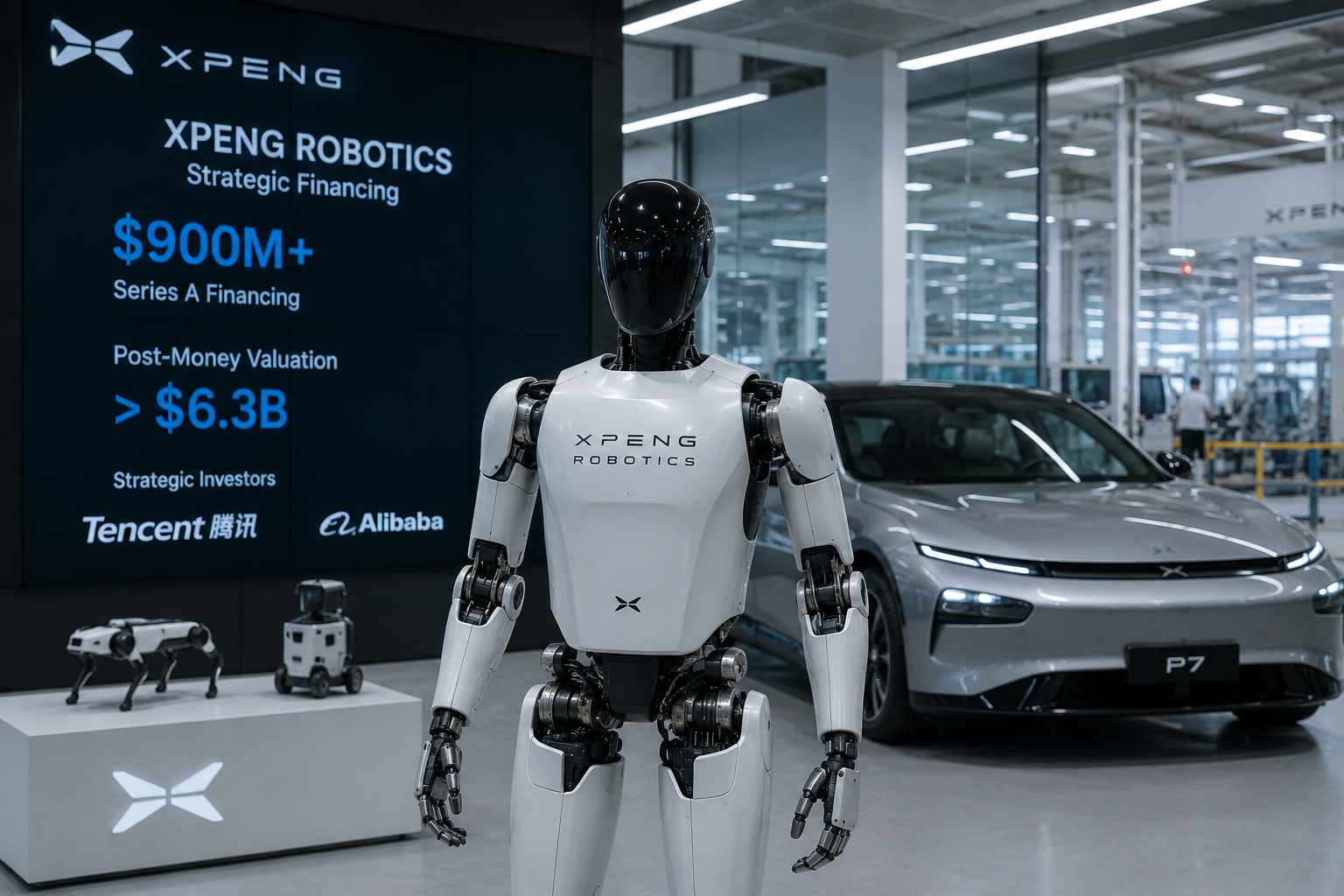
XPeng's most consequential number this quarter didn't come from the car business. It came from a subsidiary financing round. The company's robotics unit disclosed the same day as earnings that it had raised more than $900 million in its first funding round, at a post-money valuation exceeding $6.3 billion, with Tencent and Alibaba as strategic backers. That figure is worth more than half of XPeng's own $11.6 billion market capitalization, assigned to a division that does not yet generate meaningful outside revenue. XPEV shares traded up 1.6% to $12.195 intraday following the release.
The vehicle numbers explain why that bet matters as much as it does. XPeng delivered 103,295 vehicles in the second quarter versus 103,181 a year earlier, growth of essentially zero. Revenue still rose 51.5% sequentially to RMB 19.74 billion, missing Wall Street consensus, and the gain came almost entirely from pricing and mix rather than more cars sold. Gross margin rose 3.4 percentage points year over year to 20.7%, and vehicle margin held roughly stable quarter over quarter near 12.1%. XPeng is extracting more value from each vehicle it sells. It is not yet expanding how many buyers it sells to. The net loss widened year over year, with the company attributing the increase to heavy investment in AI and robotics.
Put those two facts next to each other and the robotics raise stops looking like a side story. A core delivery business stuck at flat unit growth is exactly the position that makes a $6.3 billion outside valuation, for an unproven division, the more important disclosure of the week.
A Subsidiary Priced Richer Than the Parent's Growth Justifies
The size of the valuation is the more striking fact here, not the parent's quarterly print. $6.3 billion for a division with no material outside revenue, backed by two of China's largest technology companies, is a number that would be notable on its own in a quarter with strong delivery growth. In a quarter with flat deliveries, it is the headline: outside investors just priced the robotics unit alone at more than half of what public markets assign the entire parent company, at the same moment the parent's core vehicle business stopped growing in unit terms.
Tencent and Alibaba's participation is the strongest evidence available that XPeng's "Physical AI" strategy, the extension from cars into robotics, has real strategic value independent of the auto business; two sophisticated strategic investors do not write nine-figure checks into a subsidiary they view as a bookkeeping trick. That reading carries the most weight here. It is also true, as a secondary consequence rather than a competing explanation, that the raise mechanically moves robotics losses off XPeng's own income statement and onto a separately capitalized entity funded by outside money, at the exact moment the parent's net loss is widening. The financing relief is real, but it is a byproduct of the validation, not an equally weighted alternative to it.
Where the Money Comes From, and Why the Stock Barely Moved
The Wall Street Journal characterized XPeng's posture as prioritizing heavy investment in new models and AI-related technology over near-term profitability — the outlet's characterization, not a direct quote from the company, but one that matches the numbers: vehicle margins improving while the consolidated loss widens, with the gap explained by spending outside the core auto business.
The stock's reaction was modest rather than negative. Shares rose 1.6% to $12.195 intraday on the day of the release, a mild positive move given a headline built around a widening net loss. At least one other outlet described the stock as falling on the news, which appears to reflect either a different intraday snapshot or the following trading session rather than a contradiction of the move recorded here. XPeng's RMB 40.48 billion cash position (roughly $5.97 billion) as of June 30 gives it room to keep funding the vehicle business and the robotics bet regardless of which reading of the raise proves more accurate over time.
This quarter's revenue line, flattered by pricing rather than demand, isn't what will settle this. Vehicle delivery growth breaking out of its flat pattern, and Tencent and Alibaba's money showing up as independent robotics revenue and product traction rather than a valuation resting on strategic-backer confidence alone, would.