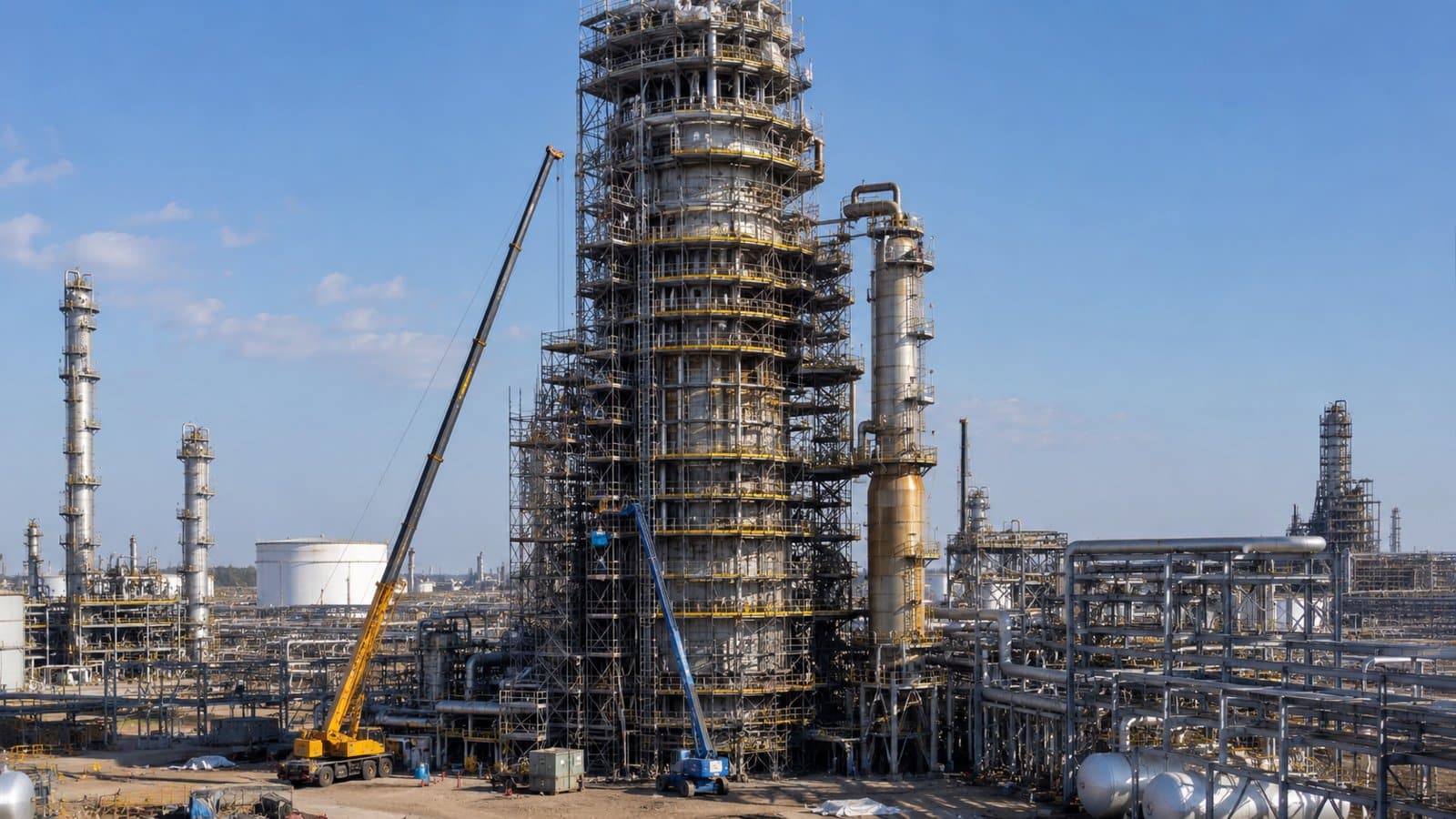
Exxon made its biggest profit in four years. Its refining arm still missed by more than a billion dollars. Chevron and Shell ran their plants flat out. Exxon had its in the shop.
Exxon just earned $14.5 billion and the stock fell.
The absolute numbers were strong. Adjusted earnings rose 67% from the first quarter and more than doubled from a year ago. It was the largest quarterly profit in four years. But the war that lifted oil prices and fuel margins arrived while Exxon had refineries down for planned work. Rivals captured that windfall. Exxon captured part of it.
The debate is no longer whether Exxon's assets are improving. It is whether Exxon can out-earn peers when conditions are close to ideal.
The miss was small at the top and large in refining
Exxon reported GAAP earnings of $14.53 billion, or $3.48 a share. Adjusted earnings were $14.68 billion, or $3.52.
The size of the shortfall depends entirely on whose estimate you use. LSEG had $3.60. Bloomberg's survey worked out near $3.54. Other providers sat at $3.56 and $3.63. One published figure of $3.76 conflicts with Bloomberg's own reporting and should be set aside. So the honest range is a miss of roughly two to eleven cents, not a single agreed number.
A few cents would normally mean little. It mattered here because of where the gap sat.
Refining is the answer. Energy Products adjusted earnings came in at $4.10 billion against roughly $5.36 billion that analysts expected. That is a shortfall of more than a billion dollars in one segment. It was still a four-year high for the business in absolute terms. It was well short of what the margin environment allowed.
Exxon named the cause plainly. Scheduled maintenance limited how much it could run. Management expects less downtime in the second half.
Everyone else's plants were running
This was not a sector problem. That is what makes it awkward.
Chevron posted adjusted earnings of $6.06 a share against consensus near $5.50, its best quarterly profit in at least six years. It set a record for US upstream output at about 2.07 million barrels a day and record refinery throughput above 1 million barrels a day. Downstream earnings jumped to $4.9 billion from $737 million a year earlier.
Shell earned $9.8 billion on an adjusted basis, more than double last year, and beat a consensus near $8.7 billion. Its refinery utilization hit a record 102%, up from 99% in the first quarter. Shell credited fewer maintenance outages.
So two of Exxon's closest peers ran near capacity through the best fuel margins in years. Exxon did not.
That deserves a fair reading. Turnarounds are scheduled far in advance, often more than a year out. No one times them against a war. This is calendar luck rather than a broken refining system, and Exxon's integrated network did shift products to where they were needed. Darren Woods said the quarter was shaped by disruption but defined by execution.
The cost is still real. Margins may normalize before the maintenance ends, and some of that opportunity will not come back.
The segment numbers mislead in both directions
Here is a trap worth flagging. Total adjusting items were only $155 million, which makes the GAAP and adjusted results look nearly identical. Inside the segments they were not.
Upstream earned $7.93 billion under GAAP but $9.19 billion adjusted, a difference of about $1.26 billion. Energy Products showed $5.47 billion under GAAP against $4.10 billion adjusted, a gap of roughly $1.37 billion the other way. The two nearly cancel at the company level.
So anyone quoting $5.5 billion of refining profit is using the flattered figure in the quarter Exxon says maintenance hurt refining.
The mechanism is timing. Exxon marks unsettled derivatives to period-end prices before the physical cargo reaches earnings. Those effects are expected to unwind later.
The first quarter was the mirror image. Adjusting items then totaled negative $4.59 billion, and Energy Products showed a GAAP loss of $1.26 billion against adjusted earnings of $2.80 billion. That matters for the comparison everyone will make. The move from $4.2 billion of first-quarter GAAP earnings to $14.5 billion is not a clean measure of how much the business improved. Year to date, GAAP earnings are up about 26% while adjusted earnings are up about 61%.
The war paid on price and charged on volume
Brent averaged $96.68 a barrel in the quarter, up 23% from the first three months of the year. That lifted upstream realizations and fuel margins across the industry.
Exxon paid for it elsewhere. About 450,000 barrels a day of Qatari LNG output remains largely shut in after attacks on energy facilities, though roughly 150,000 barrels of equivalent domestic gas production there kept flowing. An oilfield in the United Arab Emirates is partly offline, with reported figures differing across outlets. Another 250,000 barrels a day was produced but cannot be booked as revenue until shipping routes reopen. If the Strait of Hormuz stays shut through the third quarter, Middle East output would run about 750,000 barrels of oil equivalent a day below last year.
Total production fell to 4.51 million barrels of oil equivalent a day from 4.59 million. Exxon's claim of its highest upstream production in more than two decades excludes Middle East volumes from every period. That exclusion has to travel with the claim.
Strip the disruption and the underlying portfolio does look better. Permian output set a record above 1.8 million barrels of oil equivalent a day. Guyana's fifth production vessel starts up in the fourth quarter, adding 250,000 barrels a day of capacity.
Reuters noted the scale of the profit could draw further criticism from President Trump, who last month called for an investigation into oil companies he accused of price gouging.
What Exxon still has to prove
Cash generation was not the problem. Operating cash flow reached $23.6 billion, and Exxon's own free cash flow measure came to $17.2 billion. The company returned $9.4 billion, split between $4.3 billion of dividends and $5.1 billion of buybacks, keeping it on pace for a $20 billion annual repurchase target. It declared a third-quarter dividend of $1.03 and did not describe that as an increase.
Management's tone was notably careful for a peak-margin quarter. CFO Neil Hansen said Exxon reduced net debt by $7 billion and wanted to strengthen the balance sheet further before lifting dividends or buybacks. That is not what a management team says when it believes current earnings are repeatable.
The cost program keeps helping. Cumulative structural savings reached $16.3 billion against 2019, including $1.2 billion in the first half. Chemicals and specialties both improved on feedstock advantage and margins rather than demand, with chemical volumes down about 17% sequentially.
Shares sold off by as much as 3% before the open and traded down about 2% through the morning. The session was not complete at last check. Exxon is up 28% this year against 29% for the energy index, so expectations were not low going in.
The structural case is intact. The Permian is delivering, Guyana is close, and the cost base is lower. What this quarter did not show is that those gains translate into peer-leading results when the macro backdrop hands the industry a gift. Chevron and Shell converted it. Exxon converted part of it and explained the rest.
So the burden of proof has moved. Exxon no longer needs to prove the Pioneer integration and the cost program are working. It needs to show that refining can capture the next favorable window, that Middle East volumes come back rather than becoming permanent, and that earnings hold when Brent is not near $97.