
TQ Morning Briefing
No inflation data prints this week. Trump hosts Xi on Thursday with a trade truce that expires November 10. Diesel topped $6.50 over the weekend while crude fell, because the cost is now in the shipping.
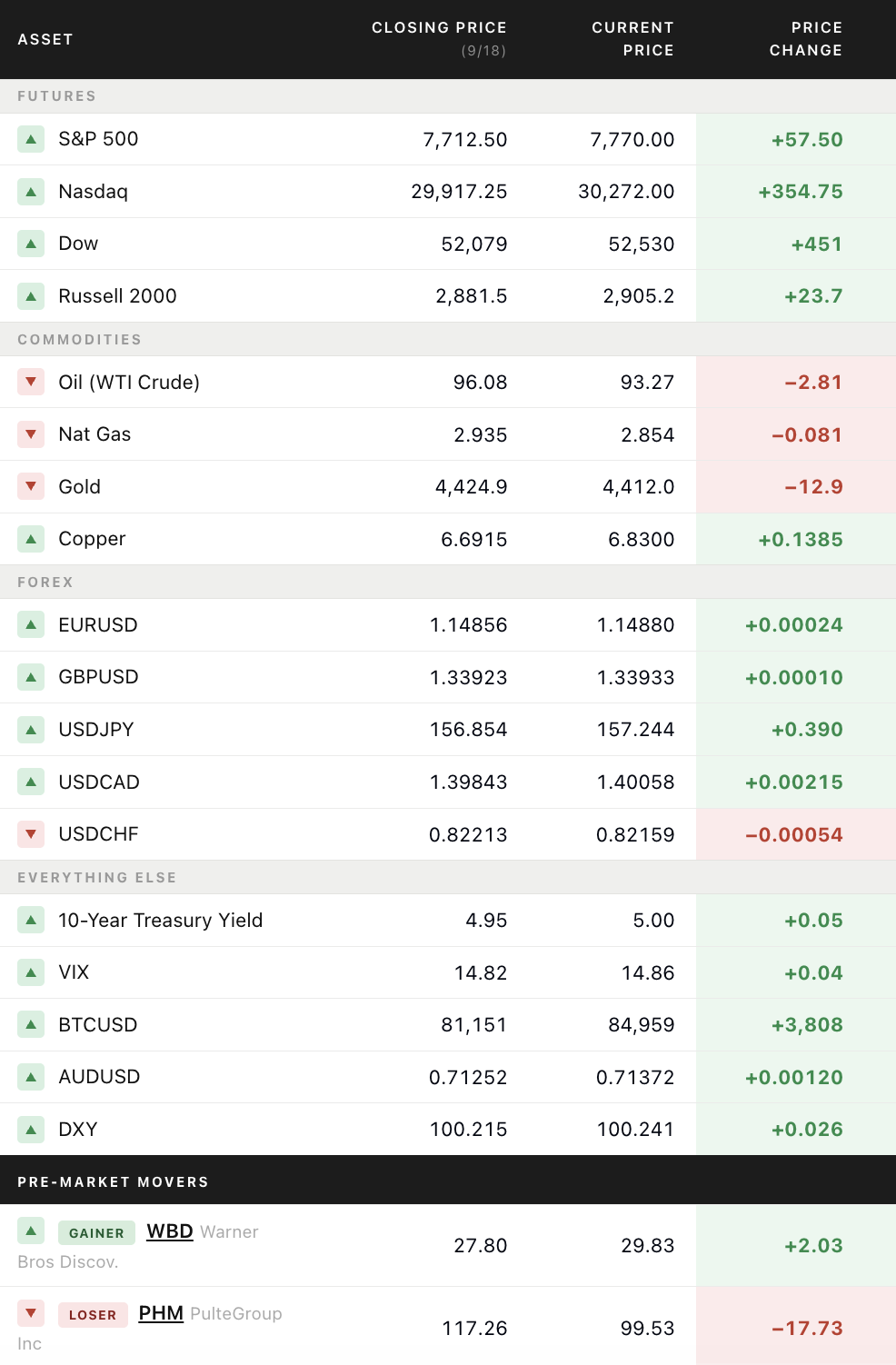
Futures are higher, and the Nasdaq leads.
Chipmakers are out front after weekend talks in New York between Bessent and China's He Lifeng.
Crude is down about 3% in early trading. WTI trades near $97, Brent near $101. Iran's president arrives in New York this week for the UN, and traders are pricing a path to talks.
The ten year Treasury yield is easing to 4.96% from Friday's 4.997%. Bitcoin touched $85,000, its highest since January.
Asia closed higher with Tokyo shut for a holiday. Europe opened higher.
Market Implication
Two meetings are carrying the tape, one at the UN and one at the White House. With no inflation data until the 30th, headlines are the only thing setting prices. Neither meeting lands before Thursday. Until then, this rally is a bet on talks, not on numbers.
Wall Street Is Positioning Before the Fed Cuts
Billions of dollars are quietly flowing into a small group of stocks ahead of the next rate-cut rally.
Our analysts tracked the institutional money and uncovered 10 companies positioned to surge when the Fed pivots.
Some are AI leaders.
Others are dividend powerhouses built for income and upside.
Miss them now and you may be chasing the rally later.
See the Top 10 Stocks to Own in the Second Half of 2026 — free today.
The Case for Hikes Just Moved Off the War
The Fed has treated this inflation as a supply problem. Oil, tariffs, commodities. Supply shocks fade on their own, so a central bank can wait them out.
Chicago Fed President Austan Goolsbee said Sunday the waiting has run out. Forecasters have spent more than a year pushing back the date inflation was supposed to peak. "That's not a comforting pattern," he said.
Then he added demand. AI investment could be "spilling out of its own lane and raising aggregate output beyond what the economy can absorb." If demand overheats, "there is no ambiguity about how the Fed needs to respond." He does not vote this year.
The Factory Data Shows Where a Hike Lands
Manufacturing output fell 0.3% in August against a forecast gain of 0.3%, the first drop in eight months. Data center equipment is holding up the rest.
That is the problem with Goolsbee's fix. The demand he's worried about sits in one lane. A rate hike doesn't. It lands on every factory that borrows short and is already slowing.
Structural Setup
The Fed's patience rested on one idea: supply shocks fade. Goolsbee says these aren't fading, and AI spending is adding demand on top. That turns an oil problem into a rate problem, and rates hit the whole economy, not just the hot lane. A supply shock gets patience. A demand problem gets a hike.
The Transports Are in a Correction. The Nasdaq Isn't.
The Dow fell 1.7% last week, its worst week since March. The Nasdaq rose 0.7%. The Dow Jones Transportation Average closed Friday 16.1% below its April record, in a correction.
Airlines, railroads and truckers run on diesel. J.B. Hunt (JBHT) fell 13% last Wednesday after its CFO called the fuel swings the most abnormal the company has seen. United Airlines (UAL) is cutting routes that stop paying at these prices.
The Nasdaq's biggest names don't fill tanks. Their input is chips, and South Korea's chip exports rose 259% in the first 20 days of September. Citigroup (C) CEO Jane Fraser said Sunday: "The bottleneck has moved from chips into energy."
Sector Read
The tape is sorting by fuel bill, not by AI exposure. Firms that burn diesel pay the higher cost now and pass it on later, if they can. The market stopped asking who builds AI. It is asking who pays for fuel.
Louis: The "Strawberry Problem" Is Stalling the AI Revolution

Billion-dollar tech investor Louis Navellier calls it "AI's darkest secret." Until AI models solve the "Strawberry Problem," they'll never create new breakthroughs in medicine, energy, or quantum computing. The good news? One company is about to solve the crisis… unleashing a new $100 trillion opportunity.
This ad is sent on behalf of InvestorPlace Media at 1125 N. Charles Street, Baltimore, Maryland 21201. If you're not interested in this opportunity, pleaseclick here.
Xi Arrives With the Stronger Hand
Trump hosts Xi on Thursday. Bessent and Vice Premier He Lifeng spent Sunday setting it up at JPMorgan Chase (JPM) headquarters in New York. AI guardrails, rare earths and tariffs were on the table.
The deadline under all of it is November 10, when the trade truce expires. In August we flagged that two suspensions lapse that same morning: the US rule on affiliates of blacklisted Chinese firms, and China's pause on rare earth exports. Only an extension takes signatures.
China has the leverage. Its trade surplus is on pace to top $1 trillion again. A US official said Friday that its rare earth deliveries "have not been up to par." Secondary sanctions over Iran have not touched Beijing.
Watch Signal
The best case Thursday is an extension, and an extension only moves the date. Chips are leading premarket on hopes for the talks. That rally is pricing a delay, not a deal. If Thursday ends without extension language, November 10 lands a week after the midterms with nothing signed.
The Barrel Got Cheaper. Moving It Did Not.
Brent is headed for a fourth straight loss. Diesel hit a record $6.505 a gallon Saturday, up 87 cents in September alone. What split them is the ship.
Drone strikes shut Saudi Arabia's pipeline to the Red Sea earlier this month. Crude that went west by pipe now goes out through Hormuz by ship, onto a fleet already running short.
About 15% of the world's supertankers now sit off Oman running shuttle trips. Hiring one through Hormuz topped $1 million a day this month. That is about $26 a barrel, roughly a quarter of what the crude is worth. The global average rate nearly doubled in a week.
Refiners pay for delivered crude, not the screen price. Home Depot (HD) shows where that lands. Its CFO said energy and raw material costs will fully offset $730 million in tariff refunds.
The Read
On August 31 we wrote that this war sells distance. It still does. On the Hormuz run, freight is now a quarter of the barrel, and a falling crude price doesn't touch it. Fuel stays expensive as long as the ships stay tied up. The war is taxing the trip now, not just the oil.
Buffett, Gates and Bezos Quietly Dumping Stocks—Here's Why
The world's wealthiest individuals are making huge moves with their money.
Warren Buffett just liquidated billions of shares. Bill Gates sold 500,000 shares of Microsoft. Jeff Bezos filed to sell Amazon shares worth $4.8 billion.
What is going on? One multi-millionaire believes they are preparing for a catastrophic event. But not a crash, bank run, or recession. It’s something we haven’t seen in America for more than a century.
Economic Data: Chicago Fed National Activity Index
Fed Speakers: Goolsbee
Earnings: No notable reports
Overnight: Nikkei closed, Kospi 1.65%, Shanghai +0.97%, DAX +1.15%, FTSE +0.93%
The inflation data goes quiet until PCE on the 30th. The costs keep moving.
Goolsbee moved the case for hikes from the war to the economy. A war can end. Demand doesn't fade on its own.
Two companies test it this week. General Mills (GIS) reports Wednesday. It buys grain, ships food and prices a box. Costco (COST) reports Thursday and sees what shoppers actually pay.
If both say costs are passing through, the PCE print lands with the input already built in. If both say they're absorbing it, the squeeze shows up in margins.
Xi lands the same day as Costco. The best outcome there moves a date, not a cost.
Nobody at the Fed gets a new inflation number this week. General Mills and Costco do.
THE MARKET WON’T WAIT FOR YOUR INBOX
Get the Alerts That Could Move Your Money
Breaking market news, actionable trade ideas, analyst signals, and major catalysts—sent straight to your phone when they matter.
Join FinancialMarkets.comFREE market alert list today.
SEND ME THE NEXT ALERT →(free)