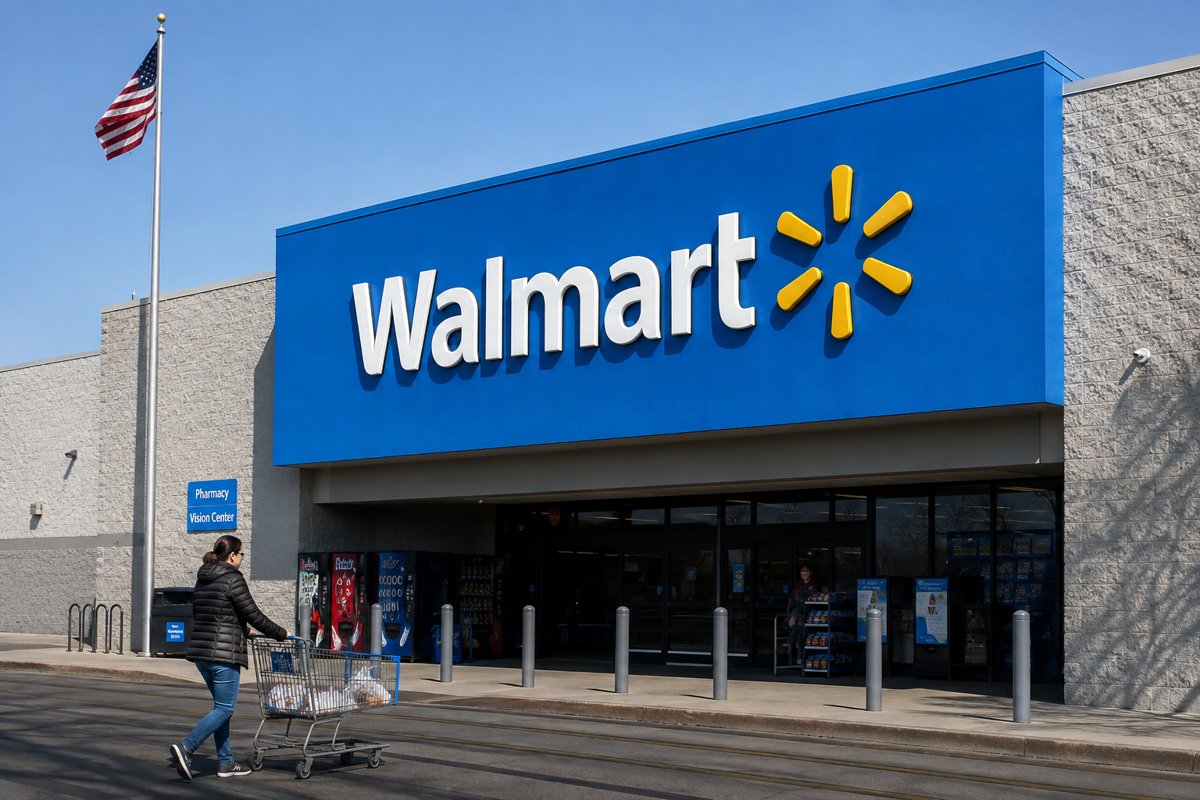
Walmart's stock fell roughly 9% on August 20, its steepest single-day drop in years, even though the company beat profit and sales estimates and raised its full-year forecast for a third straight quarter. The decline continued into the next session. The trigger was not the headline numbers. It was a U.S. comparable-sales slowdown to its weakest pace since 2020, paired with a third-quarter outlook that landed below what analysts had modeled. Investors now have to decide whether that slowdown is a temporary side effect of a new drug-pricing rule, as management argues, or an early sign that a price war Walmart is funding with disputed tariff money is buying growth it cannot yet prove will last.
The Slowdown Splits Into a Regulatory Story and a Consumer Story
Walmart U.S. comparable sales rose 2.6%, excluding fuel, below the roughly 3.6% analysts expected and the slowest growth in six years.
Management has a specific explanation. CEO John Furner said a new federal rule setting maximum fair prices on certain drugs cut comparable sales by 125 basis points this quarter, up from an original 100-basis-point estimate. Excluding health and wellness, he said, core merchandise comps have held in a consistent 3% to 4% range for two and a half years. That argument, if taken at face value, means the headline slowdown is mostly a pricing-policy artifact, not a demand problem.
But the same executives volunteered a second, less convenient point. CFO John David Rainey told analysts the company is seeing "incremental pressure on the consumer relative to the beginning of the year with higher fuel prices," and that customers were "making trade-offs" as the quarter progressed. At Sam's Club, comparable transactions rose 7.0% while average ticket fell 2.5%, more shopping trips, smaller baskets, a pattern consistent with value-seeking behavior rather than confident spending. Neither side of this argument was resolved on the call. Both were stated directly by the people running the company.
The Money Behind the Rollbacks Has Two Different Accounts
Walmart is eligible for about $2.9 billion in tariff refunds, and that money is doing real work in this quarter's results. Rainey said the refunds added roughly 750 basis points to adjusted operating income growth; strip that out, and underlying growth was still at the top of the company's 7% to 10% guided range, a genuine result on its own terms. The company is plowing much of that refund into price. Rollback items reached more than 11,000 by quarter-end, up from 7,200 at the end of the prior quarter and well above what Furner called a normal baseline of about 5,000.
How much of that $2.9 billion has actually been collected in cash is unclear, and Walmart's own chief financial officer gave two different answers on the same day. Earlier on August 20, Rainey told CNBC in an interview that the company had received less than $100 million of the refund. Later, on the earnings call, he told analysts the company had "received substantially all" of it. Neither statement has been corrected. Until one is, how much of that benefit is actual cash in hand, rather than an accrued accounting entry, remains an open question.
Deutsche Bank analyst Krisztina Katai asked management directly how it will judge whether the rollbacks are paying off. Rainey's answer: "It's probably a bit too early to call how many of these will be permanent." That is a fair statement of where things stand, and it is also an admission that the payoff has not yet been measured.
The Raised Guide Still Undercuts Analyst Models
Walmart raised its full-year adjusted EPS guidance to $2.80 to $2.87, up from $2.75 to $2.85. Even the top of that new range sits below the roughly $2.90 analysts had modeled heading into the print. The pattern repeats for the third quarter: Walmart guided adjusted EPS to $0.62 to $0.64, versus an analyst estimate of about $0.67, below the Street's number at both ends of the range.
Some of that gap has a specific, disclosed cause. Rainey said a large share of the tariff-refund-funded price cuts hit late in the second quarter, so their full cost shows up in the third quarter's numbers instead. He asked analysts to judge the two quarters together, noting that combined operating income growth would average close to 10% per quarter across both periods. That is a reasonable framing of a real timing effect. It does not, on its own, explain why the raise still trails what analysts had already built into their models before the quarter was reported.
Free cash flow adds another wrinkle to the guidance story. It fell $1.4 billion in the first half of the fiscal year, to $5.5 billion, even as operating cash flow rose. The company raised its capital-spending plan to about 4% of sales, up from 3.5%, and still expects double-digit free cash flow growth for the full year, a forward claim that has not yet been tested. Raising guidance while cutting prices and spending more on capital projects is not a costless combination.
Not everything in the quarter supports a cautious read. Global e-commerce sales grew 23%, advertising grew 38%, and membership income hit an all-time high, up 17%. Those businesses carry higher margins and are becoming a larger share of Walmart's profit engine, a genuine offset to the softness in core U.S. comparable sales.
The Burden Falls on Q3 to Settle What Q2 Left Open
Three sell-side firms, BTIG, Baird, and RBC Capital, all kept bullish ratings on the stock after the report while cutting their price targets, a signal that the long-term thesis survived the quarter even as near-term confidence took a hit.
What investors need to watch next is straightforward, even if the answer is not. If comparable sales in the U.S. reaccelerate once the pharmacy-pricing headwind laps, that supports management's regulatory framing. If they do not, the consumer-pressure explanation gains weight. If the price rollbacks show up as sustained traffic and share gains once the third quarter reports, the tariff-refund spending will look like smart reinvestment. If they do not, this quarter's operating-income growth will look like it was borrowed from the next one. And Rainey himself flagged a further complication for next year: lapping this year's 19% adjusted EPS growth "will be a challenge," a risk management raised before any analyst asked about it.
None of that makes this a weak quarter or a strong one in isolation. It makes it a quarter that raised the number of things Walmart now has to prove, at the same time it raised its guidance.