

The world's two largest economies sat down at JPMorgan's Manhattan headquarters this weekend to negotiate the future of global trade. But the real question isn't what they'll agree to. It's why they have to keep meeting every 90 days to avoid blowing the whole thing up. US-China trade has quietly become the world's most expensive subscription service. And the next billing cycle is seven weeks away.
But before we get to that, let's take a quick look at the markets and what matters...
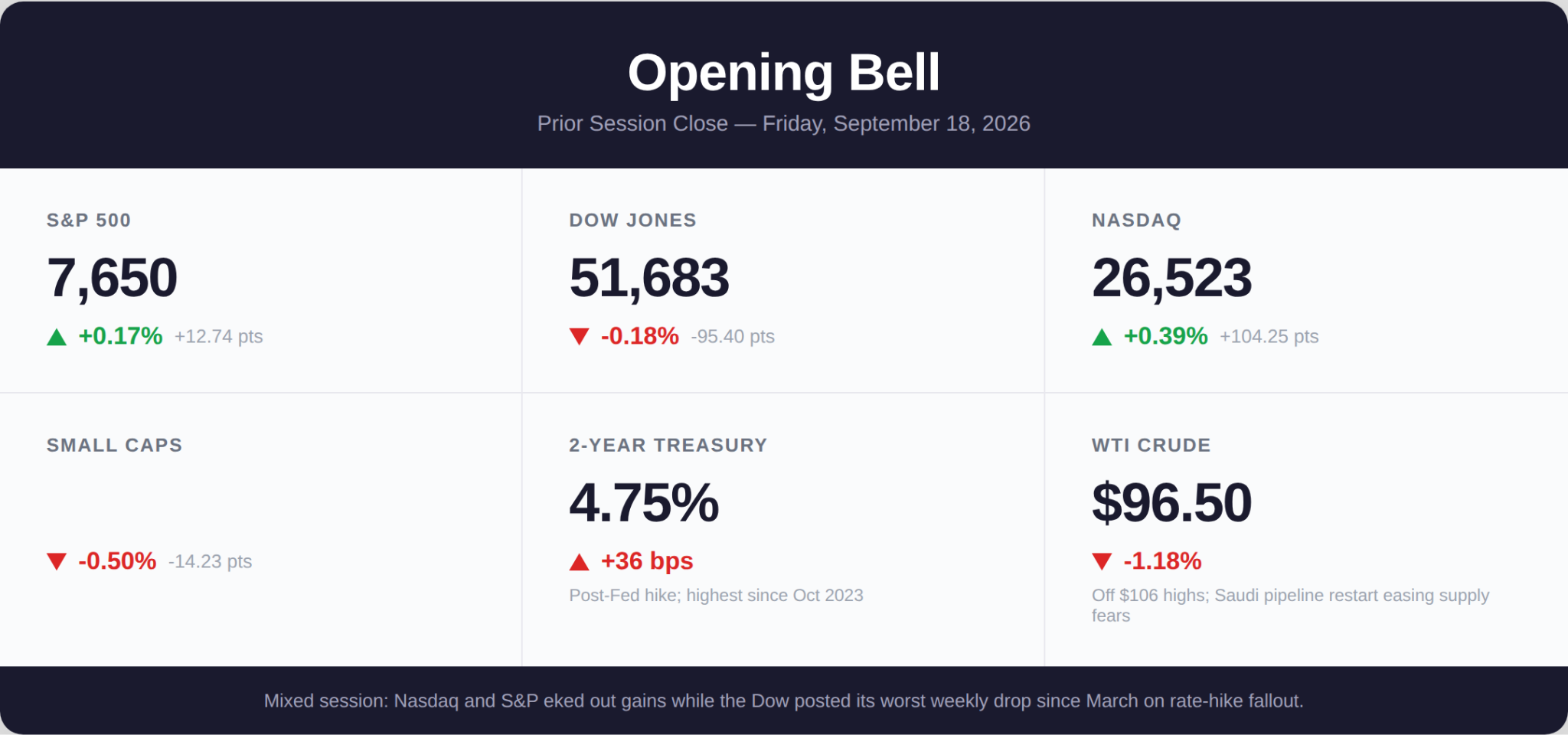
3 Movers in 3 Minutes
- Buffett's final goodbye. Warren Buffett stepped down as chairman of Berkshire Hathaway (BRK.A) on Friday, eight months after handing the CEO role to Greg Abel. His son Howard takes the chairman title. Shares barely moved, which tells you the succession plan worked exactly as designed. The 96-year-old's 19.7% compounded annual return over six decades roughly doubled the S&P 500's performance, a record that may never be matched.
- The Dow's worst week since March. The 30-stock index shed more than 3% over the week as the Fed's first rate hike since 2023 collided with oil still hovering near $100 and the 10-year Treasury yield punching back to 5%. IBM (IBM), Walt Disney (DIS), and Nike (NKE) led the index lower. The S&P and Nasdaq held up better, buoyed by tech strength, but the divergence between the Dow's old-economy tilt and the Nasdaq's growth bias is widening.
- Bessent and He Lifeng shake hands in Manhattan. Treasury Secretary Scott Bessent and Chinese Vice Premier He Lifeng wrapped talks at JPMorgan Chase headquarters on Sunday, laying the groundwork for the Trump-Xi summit on Wednesday. The headline: a proposed AI safety notification mechanism, essentially a red phone between the world's two AI superpowers. The subtext: the tariff truce expires November 10, and neither side has locked in what comes next.
3 Signals for Today
Chicago Fed National Activity Index (8:30 AM ET) for August will offer a read on whether the economy's post-hike momentum is holding or cracking beneath the surface.
Fed speaker parade begins. At least 10 Fed officials are scheduled to speak this week, the heaviest stretch since March, and markets will parse every syllable for clues on whether September's hike was one-and-done or the start of a series.
Costco Wholesale (COST) reports earnings Thursday after the close. The stock is a real-time barometer of consumer resilience, and with the personal savings rate dropping and gas prices near $4, Wall Street wants to know if the trade-down shopper is still showing up.
I've Read a Lot of Mining Filings. They All Sound the Same.
This one stopped me cold.
Sitting in the filings of one small American gold company is a phrase I have never seen on a gold project: substantial support and partnership from the Department of War.
The Department of War does not partner with gold miners. Except it's partnering with this one.
Here's why. The deposit carries a second metal — one China formally banned from export to the United States. The only domestic reserve of it in the country.
Gold for the dollar war. The banned metal for the shooting war. Both from the same pit.
Washington didn't stop at words. On May 21, 2026, a federal bank voted unanimously to lend nearly $3 billion to build it. Congress got 25 days notice. Nobody objected.
When final papers are signed, funding risk goes to zero — and Wall Street re-rates the stock from speculative developer to federally backed strategic asset.
The company is about one fiftieth the size of Newmont.
And with that out of the way, let's get to today's big story: the strange economics of US-China trade diplomacy.
The Sip
The Most Expensive Phone Call in the World
On Sunday morning, Scott Bessent walked into JPMorgan Chase's midtown Manhattan headquarters for a meeting that has become oddly familiar. Across the table sat He Lifeng, China's Vice Premier and the country's top trade negotiator. Between them, a stack of unresolved issues worth roughly $30 billion in bilateral goods that each side has been trying to unstick through a mechanism called the Board of Trade.
This was not the first time the two men had sat across from each other. They met in London in June 2025. In Seoul four months later. In Stockholm after that. Then Madrid. Then Beijing. And now, Manhattan.
Each meeting follows the same rhythm. The two sides agree on small concessions, issue carefully worded statements, and schedule the next conversation. Think of it as a quarterly earnings call, except the company is the entire global trading system.
And the product under review is a tariff truce that expires on November 10, 2026.
The Subscription Model
Here is the part most coverage of the Trump-Xi summit misses.
US-China trade does not operate on a permanent agreement anymore. It runs on rolling extensions. Since the first Geneva Agreement in May 2025, the two countries have essentially been renewing a 90-day ceasefire every quarter. Each renewal suspends the worst of the reciprocal tariffs. And each expiration threatens to snap them back to triple-digit levels.
The structure looks remarkably like a subscription. Both sides pay a cost to maintain it, the tariffs that remain in place average roughly 33% on Chinese goods entering the US. Both sides lose something when it lapses. And both sides keep renewing it, not because the relationship is working brilliantly, but because the alternative is worse.
In February 2026, the US Supreme Court struck down the IEEPA-based tariffs that had been the legal backbone of Trump's trade war. That should have ended the tariff regime entirely. Instead, the administration rebuilt tariffs under Section 301 and Section 122 of the Trade Act. Different legal authority, similar economic effect. The subscription auto-renewed under new terms.
And this is the counterintuitive truth about US-China trade in 2026: neither country wants permanent terms. Permanent terms would mean making real concessions. The rolling truce lets both sides maintain leverage, claim progress, and defer the hardest questions indefinitely.
What Wednesday Actually Decides
The Trump-Xi summit on September 24 will be Xi Jinping's first visit to the White House in 11 years. He is expected to bring a large business delegation that could include BYD founder Wang Chuanfu, Xiaomi executives, and CATL leadership. Trump has reportedly said he might allow a Chinese automaker to build factories in America if it employs American workers. That would be a seismic shift.
Why are companies flying spy planes over Elon's closely-guarded AI lab?
Elon did the seemingly impossible – far faster than anyone expected...
And it's sent the tech industry into PANIC MODE.
ChatGPT, Claude, Google Gemini, and DeepSeek could soon become obsolete.
And three little-known firms could soar 10X or higher as a result.
But markets should watch three things more closely than the photo ops.
First, the November 10 deadline. The current tariff suspension expires in seven weeks. If no extension is announced during the summit, markets will start pricing escalation risk immediately. That means pressure on companies with deep China supply chains, from Apple (AAPL) to Nvidia (NVDA).
Second, AI guardrails. Bessent's proposed AI safety notification mechanism is the most significant attempt yet to create a framework between the two AI superpowers. Think of it as a nuclear hotline for artificial intelligence. Whether Xi agrees will signal how seriously Beijing wants to cooperate on frontier technology, or whether it intends to keep building its own parallel AI governance framework, launched in July.
Third, rare earths. China expanded export curbs on rare-earth minerals earlier this year, and US officials say the current flow of critical minerals is insufficient. These materials are essential for defense systems, EV batteries, and semiconductors. If Beijing offers meaningful concessions here, the summit becomes more than theater.
Why Neither Side Can Cancel
The deepest irony of this subscription is that both sides know it is suboptimal, and neither side can quit.
For the US, China still accounts for a massive share of electronics imports. Chinese exports to America rebounded in 2026 despite tariffs, partly because demand for AI-related electronics made in China remains overwhelming. Trade diversion to Vietnam, Mexico, and India has absorbed some volume, but not enough.
For China, the US market remains irreplaceable for its highest-margin manufactured goods. And the diplomatic choreography, the state dinners, the business delegations, the handshakes at JPMorgan's headquarters, provides a veneer of stability that Beijing's export-dependent economy desperately needs.
So the subscription renews. Every quarter. Every summit. Every carefully staged pre-meeting in a neutral city.
The question for investors is whether this rolling truce is a feature or a bug. In the short term, it keeps things stable. In the long term, it means neither country is building toward a permanent framework. And every 90 days, markets hold their breath and wait to see if the auto-renewal goes through.
Wednesday's summit will produce headlines. Maybe a soybean purchase agreement. Maybe an AI framework announcement. Maybe even a BYD factory pledge.
But the structure will remain the same. Ninety days of certainty, followed by another negotiation, followed by another renewal.
The world's most important economic relationship is running on a month-to-month lease. And neither landlord nor tenant seems interested in signing a long-term contract.
Middle East Conflict Lights Fuse on US Debt Bomb
America was already drowning in $38 trillion of debt, but the recent conflict in the Middle East just accelerated the timeline.
As oil spikes, a 100-year-old stock market signal that accurately predicted the 2008 and 2020 crashes is flashing a massive "Sell" on dozens of popular U.S. equities.
If you hold the wrong stocks when this debt crisis hits, it could wipe out years of gains.
Click here to see the 10 popular stocks to dump immediately
11780 US Highway 1, Palm Beach Gardens, FL 33408-3080 Would you like to edit your e-mail notification preferences or unsubscribe from our mailing list? Copyright © 2026 Weiss Ratings. All rights reserved.
The MarketSipsTakeaway
The Trump-Xi summit on Wednesday is the single biggest macro catalyst of the week, but the real signal is not what they announce. It is whether they extend the November 10 tariff truce. If they do, risk assets breathe. If they don't, every company with a China supply chain re-enters pricing uncertainty within weeks. Watch for the AI framework language, the rare-earth concession, and whether BYD actually shows up in Washington. The subscription model of trade diplomacy works until the moment one side decides it doesn't. That moment hasn't arrived yet. But every renewal gets harder.
Until then, sip slowly!
The Market Sip Desk
FREE MARKET ALERTS
Know What’s Moving the Market Before You Miss the Move
Get market-moving news, analyst trade ideas, and key catalysts delivered directly to your phone so you can spot opportunities faster.
Tickers: UI MS BRK IBM DIS NKE ET COST IEEPA BYD CATL PANIC MODE AAPL NVDA EV FL POLL