

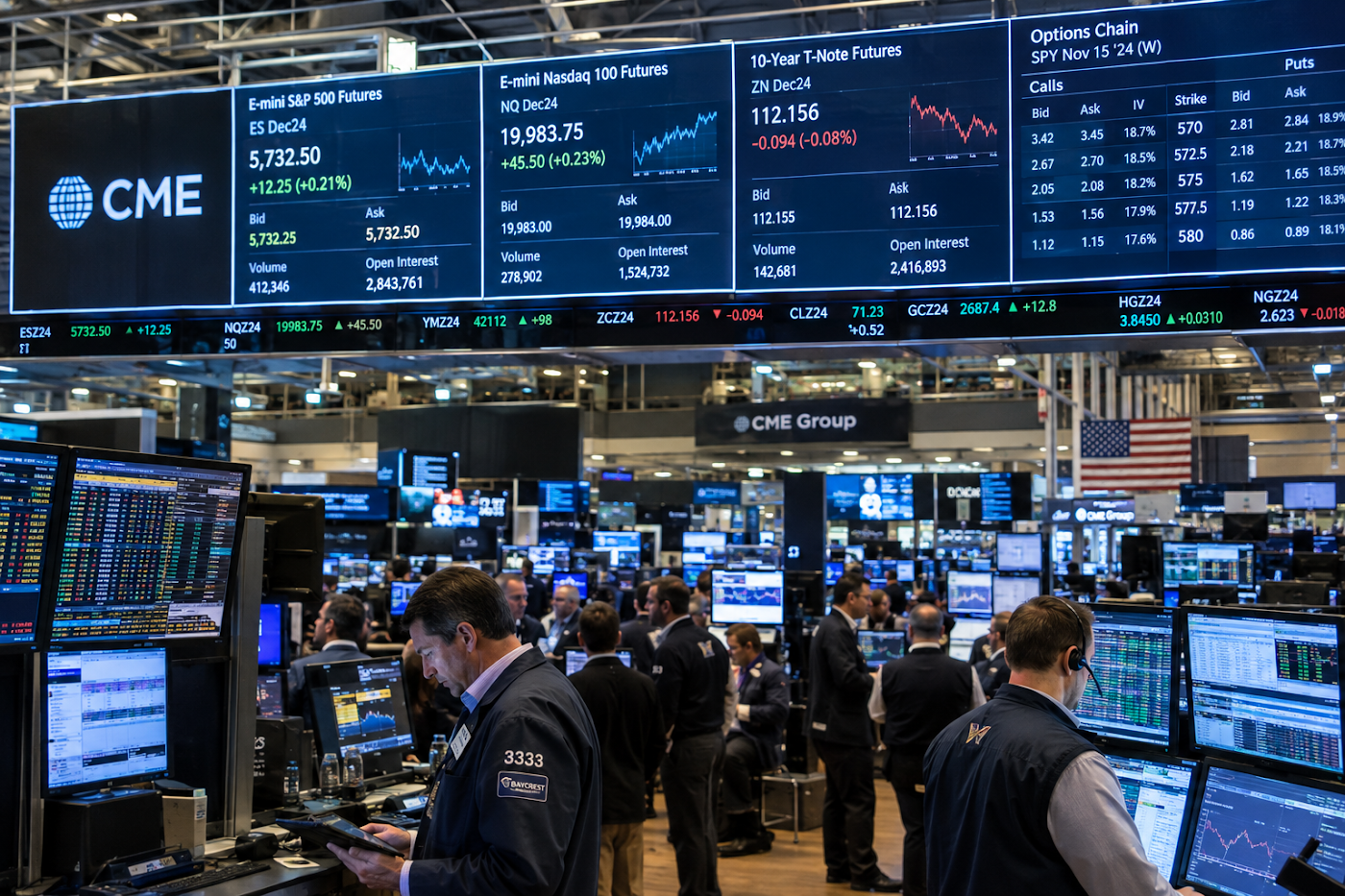
Every quarter, Wall Street gets its own version of a horror movie. Three types of derivatives contracts expire simultaneously, trillions in notional value roll off the books, and the financial press reaches for the word "witching." The name alone sounds like it should cause a crash. And yet, the days that follow triple witching are consistently among the calmest of the quarter. Today, with $6.2 trillion expiring just 48 hours after the Fed hiked rates, the real question isn't whether markets will be volatile. It's whether anyone should care.
But before we get to that, let's take a quick look at the markets and what matters...
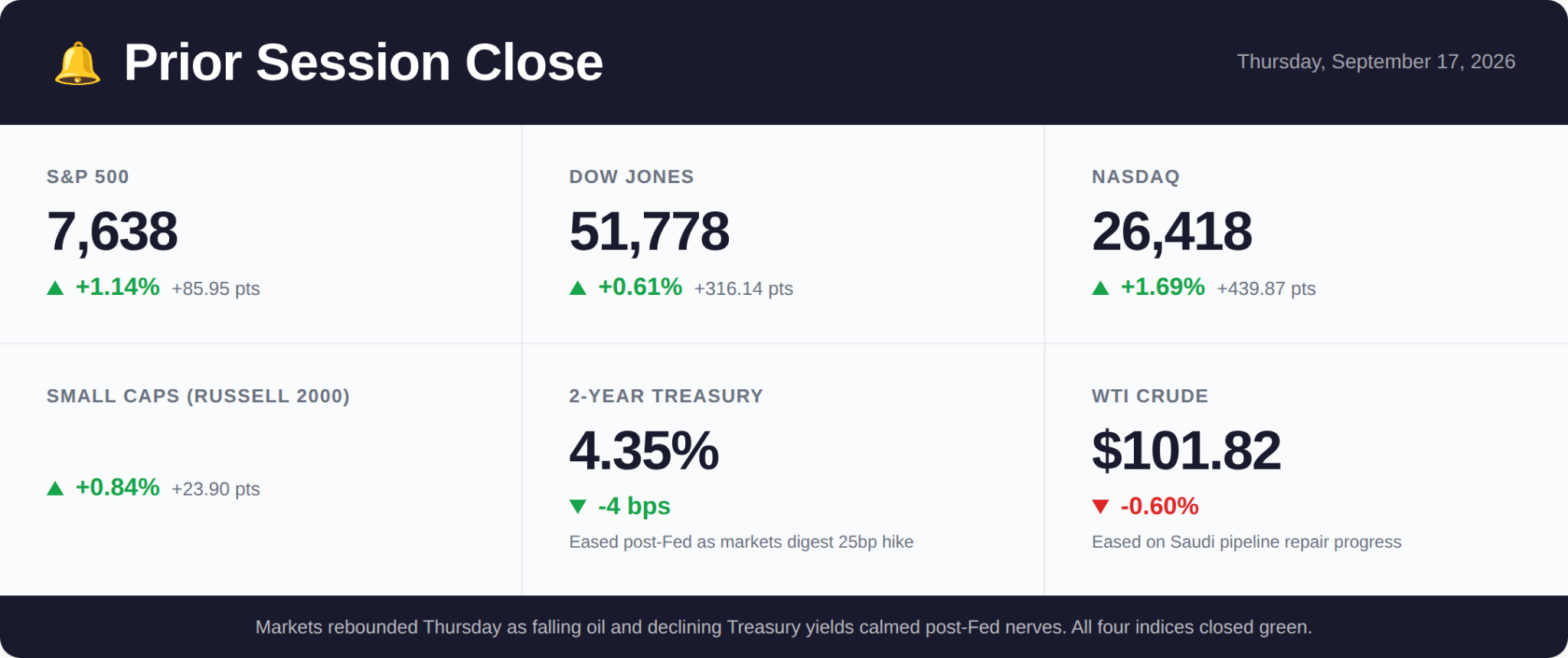
3 Movers in 3 Minutes
1. Workday's take-private whispers get louder. Shares of Workday (WDAY) rose 5% Thursday after it was reported that financing efforts for a bid to take the cloud HR platform private are continuing. The move fits a broader pattern: private equity has been circling enterprise software companies trading at multi-year valuation lows, treating post-hike SaaS names as turnaround targets rather than growth bets.
2. Intel's CEO just handed Micron a gift. Micron Technology (MU) climbed 5% after Intel (INTC) CEO Lip-Bu Tan said at an industry event that memory chip demand isn't slowing down and that prices would continue to rise. His exact framing: next year will be "even worse" than the bottleneck he flagged in early 2025. That's a forward guidance gift for MU shareholders from a competitor's CEO, which almost never happens.
3. Oil quietly retreats below $102 as Saudi pipeline fears ease. WTI crude fell to around $101 after Saudi Arabia signaled it could restore half of its damaged East-West pipeline capacity within days and full operations within six weeks. Riyadh is also offering crude cargoes to Asian refiners through ship-to-ship transfers near Oman, an alternative export route that has reduced immediate supply-shock fears. Brent dropped to $102, its lowest in over a week.
3 Signals for Today
Triple witching arrives, with an estimated $6.2 trillion in U.S. options and futures exposure set to expire. September is tracking toward the largest quarterly expiry of 2026. Expect volume spikes, especially in the final hour.
Industrial Production and Capacity Utilization (9:15 AM ET) will give the first hard read on factory output since the Fed hiked. August's print will signal whether the manufacturing sector can absorb tighter financial conditions or if oil-driven input costs are already compressing margins.
Bank of Japan aftermath. The BOJ hiked 25 basis points overnight to 1.25%, its highest rate since April 1995. The move narrows the U.S.-Japan rate differential for the first time in this cycle with both central banks hiking in the same week. Watch yen-funded carry trades and any spillover into U.S. Treasury positioning as the session digests the double-hike week.
The 7 Stocks Built to Outlast the Market
Some stocks are built for a quarter… others for a lifetime.
Our 7 Stocks to Buy and Hold Forever report reveals companies with the strength to deliver year after year - through recessions, rate hikes, and even the next crash.
One is a tech leader with a 15% payout ratio - leaving decades of room for dividend growth.
Another is a utility that’s paid every quarter for 96 years straight.
And that’s not all - we’ve included 5 more companies that treat payouts as high priority.
These are the stocks that anchor portfolios and keep paying.
This is your chance to see all 7 names and tickers - from a consumer staples powerhouse with 20 years of outperformance to a healthcare leader with 61 years of payout hikes.
The report is free for a limited time - go here to get it now.
And with that out of the way, let's get to today's big story: the $6.2 trillion triple witching, and why the scariest day on Wall Street's calendar might be the most predictable.
The Sip
The Witching Hour
Approximately $6.2 trillion in U.S. options and futures contracts will expire in today’s trading session. That figure, estimated by Citadel Securities as of late August, represents roughly 23% of all outstanding U.S. options exposure. The actual number is almost certainly higher now, because positions have continued rolling toward the September 18 expiry date for weeks.
It's called triple witching. It happens four times a year, on the third Friday of March, June, September, and December. Stock index futures, stock index options, and individual stock options all expire on the same day. When that happens, traders who hold positions in any of those contracts must decide in a matter of hours: close the trade, exercise the contract, or roll it into the next quarter.
The name itself is vintage Wall Street theatre. It dates back decades, a nod to the idea that something ominous happens when three different expirations collide. And the numbers certainly suggest drama. Trading volume on triple witching days routinely doubles. The S&P 500's intraday range expands by nearly 7% compared to a normal session. Price swings are sharper. Headlines get louder.
But here is the part that almost nobody talks about.
The Gravity Well
The scariest day on Wall Street's calendar is also, paradoxically, one of the most mechanically controlled.
To understand why, you need to think about who is actually on the other side of most options trades. It's not other retail investors. It's options dealers, usually at the large banks and market-making firms, who sell the contracts and then manage their risk in real time.
When a dealer sells a call option, they are exposed if the price of the underlying stock goes up. To neutralize that risk, they buy shares of the stock. If the stock moves down, they sell some back. This process is called delta hedging, and it happens continuously, adjusting with every tick of the market.
As expiration approaches, something strange happens. The sensitivity of these hedging positions increases dramatically. Small price movements force dealers to buy or sell larger and larger quantities of the underlying stock. In options-market jargon, this is called gamma, and on a triple witching day, gamma exposure is enormous.
This creates an effect that traders call "pinning." Stock prices on expiration day don't move freely. They gravitate toward the most heavily populated strike prices. Imagine 50,000 call option contracts sitting at a particular strike. If the index is trading just below that level, the dealers who sold those contracts have a massive incentive to keep it there. If it drifts above, they have to buy stock to hedge. If it stays below, those contracts expire worthless and the hedging pressure vanishes. The result is a gravitational pull, a kind of invisible floor and ceiling around certain price levels that holds for hours.
It's like watching a planet orbit. The price doesn't crash or spike. It circles.
$6 Trillion of Muscle Memory
Now zoom out and consider what this means in aggregate.
Buffett, Gates and Bezos Quietly Dumping Stocks—Here's Why
The world's wealthiest individuals are making huge moves with their money.
Warren Buffett just liquidated billions of shares. Bill Gates sold 500,000 shares of Microsoft. Jeff Bezos filed to sell Amazon shares worth $4.8 billion.
What is going on? One multi-millionaire believes they are preparing for a catastrophic event. But not a crash, bank run, or recession. It’s something we haven’t seen in America for more than a century.
In June 2026, the previous triple witching saw $7.7 trillion in gross notional exposure expire. March's session was also in the trillions. Each time, trading volume surged, volatility spiked intraday, and then something quieter happened in the days after: realized volatility fell. The mechanical hedging pressure that drove all that intraday action simply disappeared. Contracts settled. Dealers rebalanced. And the market exhaled.
This pattern has repeated so reliably that some quantitative strategists now use the post-witching volatility drop as a systematic trade.
But today's session is not ordinary, even by triple witching standards.
Forty-eight hours ago, the Federal Reserve raised its benchmark rate by 25 basis points to 3.75%–4.00%, its first hike in over two years. Fed Chairman Kevin Warsh called it a "sober" decision, and the dot plot signaled one or two more hikes before year-end. Stocks sold off on Wednesday, then rebounded sharply on Thursday as oil prices eased and Treasury yields pulled back from 19-year highs.
Now, the day after that rebound, over $6 trillion in contracts need to be settled, rolled, or abandoned. And the Bank of Japan has already added a second catalyst, hiking its own rate to 1.25% overnight, the highest level since 1995. Two central banks tightening in the same week, layered onto the largest quarterly options expiry of the year.
Citadel Securities noted that dealers were net short gamma across a wide range of strikes near current index levels heading into today. That means their hedging activity will amplify moves in both directions, making intraday swings look larger and more dramatic than they might otherwise be.
Signal vs. Noise
Here is what matters for anyone watching the tape today.
Not all volatility is created equal. On a normal trading day, a 1% move in the S&P 500 might reflect a genuine shift in how investors view earnings, policy, or risk. On a triple witching day, that same 1% move could be entirely mechanical, driven by dealers rebalancing their hedge books as $6 trillion in contracts expire, with no change in anyone's fundamental view of the world.
The derivatives market has grown so large that it no longer merely reflects the stock market. On days like today, it drives it. The tail wags the dog. Prices move not because someone has a new opinion about the economy, but because a mathematical formula requires a bank's trading desk to buy 50,000 shares of an index ETF at 3:47 PM.
That distinction matters. Not just for traders watching the screen, but for anyone who sees a sharp move on the 6 o'clock news tonight and wonders whether the sky is falling.
It probably isn't. The contracts just expired.
The real test comes Monday. Once the witching clears and the gamma resets, whatever direction the market takes next will be driven by fundamentals, not formulas. And after a Fed hike, an oil shock, and a summer of 19-year-high Treasury yields, those fundamentals have plenty to say.
Is Elon About to Create a New Generation of Millionaires?

When Elon took SpaceX public, an estimated 4,400 employees became millionaires – with top executives, welders, and even cafeteria workers getting rich overnight. Sources close to Elon indicate that he's about to hatch a new opportunity to create generational wealth – and you don't have to work for Elon to see massive potential profits. Click here for the full details.
This ad is sent on behalf of InvestorPlace Media at 1125 N. Charles Street, Baltimore, Maryland 21201. If you're not interested in this opportunity, please click here.
The MarketSipsTakeaway
Triple witching is Wall Street's quarterly reminder that the derivatives market has become the market. Over $6 trillion in contracts expiring in a single session creates forces that look like panic or euphoria but are actually just mechanical hedging. The move to watch isn't today's. It's Monday's. Once the contracts settle and the gamma resets, the market will tell you whether the post-Fed rebound has legs, or whether it was just another kind of pinning.
Until then, sip slowly!
The Market Sip Desk
FREE FINANCIALMARKETS.COM ALERTS
The Next Market Move Could Start With One Alert
Get breaking market developments, trade ideas, analyst signals and upcoming catalysts sent directly to your phone.
Markets move quickly. Now your information can too.