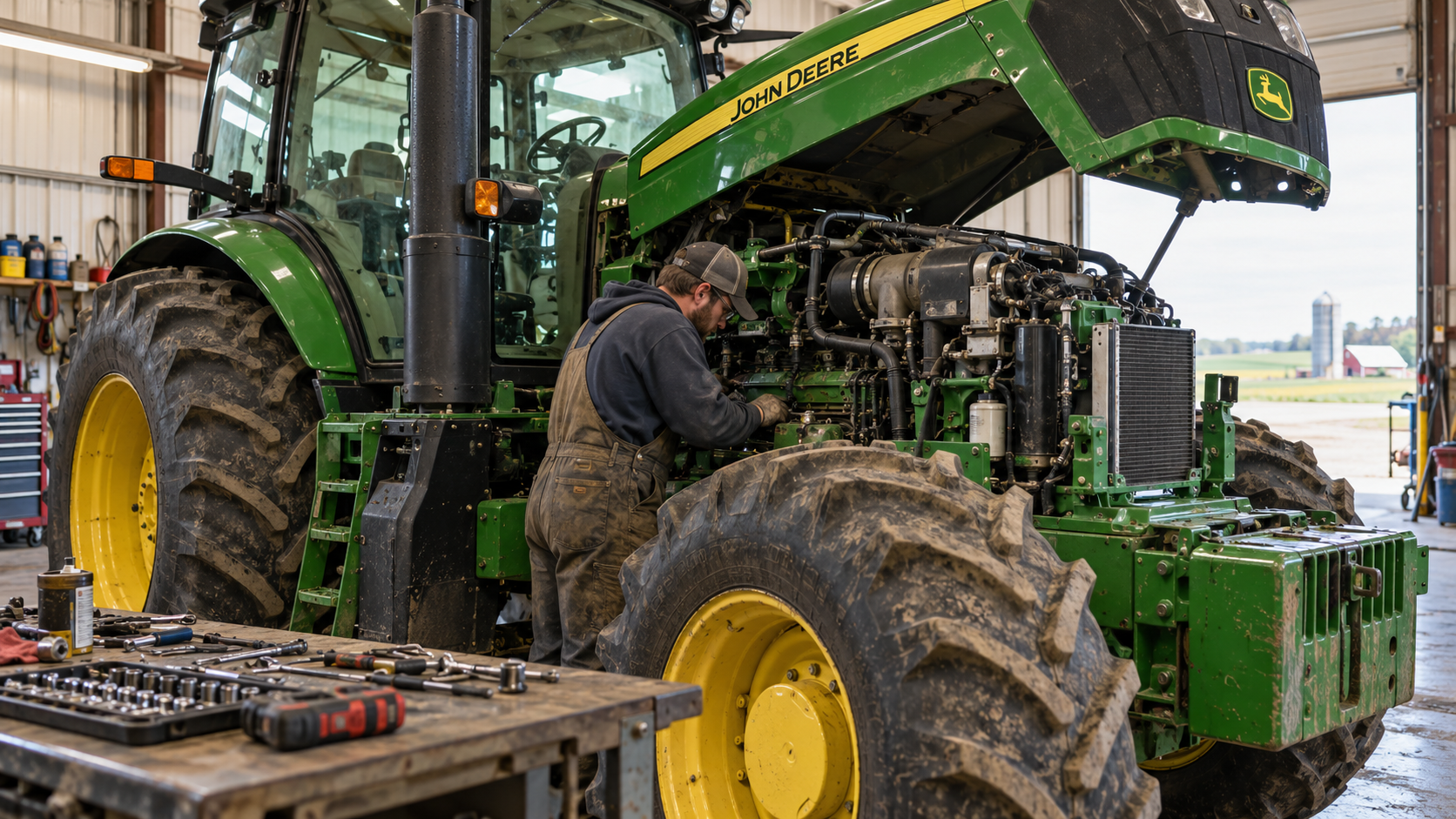
The FTC and USDA asked farmers, dealers and repair shops to describe how equipment is sold and serviced, with comments due . No company is named as a target, and the morning's industrial selloff began earlier.
Two federal agencies asked the farm economy to describe how it buys and repairs tractors on Wednesday. Deere's stock reacted within minutes. For two listed rivals, most of the damage had been done before anyone in Washington spoke.
The Federal Trade Commission and the Agriculture Department "launched a joint public inquiry regarding issues affecting agricultural equipment manufacturing and distribution markets, including potential anticompetitive conduct." The agencies said the request for information responds to "the growing number of complaints received by USDA" that farmers face barriers to acquiring equipment and the services needed to keep it running.
What the agencies asked
The request invites comments from farmers, independent repair providers, and current and former employees of manufacturers and dealers. It asks about business models and contract terms, firsthand accounts of restrictions or penalties, and effects on pricing, market entry, innovation and rural economies. Comments are due by , and the agencies said the information will be used "to inform enforcement and regulatory priorities and future actions."
The request does not name any company as a subject. Its only reference to a manufacturer is the FTC's earlier settlement, joined by five states, of an antitrust action over repair restrictions imposed by Deere. It also cites a September settlement with Corteva.
FTC Chairman Andrew Ferguson wrote on social media that farmers "shouldn't have to overcome artificial service barriers" or "pay inflated prices for critical equipment." No statement from Deere, CNH Industrial or AGCO had been located by midafternoon.
The minute-by-minute tape
The earliest headline on the inquiry appeared on a financial news wire at 10:45 a.m. Eastern. The FTC's release does not carry a time. Deere's shares started to fall in the 10:43 minute, slid from $670.14 to a low of $644.08 by 10:49, and then recovered to about $660 by early afternoon. That was a nine-minute drop of about 3.9%, followed by a rebound of about 2.5%.
CNH and AGCO fell in the same window, by about 3.4% and 2.8% from their 10:35 a.m. levels to their lows. Caterpillar, which makes heavy equipment mostly outside agriculture, fell about 0.6% over the same stretch.
The full-day numbers tell a different story. By early afternoon CNH was down about 6.0% and AGCO about 6.4%. But by 10:35 a.m., before the release window, CNH was already down about 4.0% and AGCO about 5.5%. Deere was down only about 1.9% at that point and stood about 3.3% lower by early afternoon.
The industrial selloff
The broader market was moving at the same time. The Industrial Select Sector SPDR fund fell about 2%. Caterpillar dropped about 6%, Terex about 4.4% and Oshkosh about 2.6%, with the 10-year Treasury yield near its highest since 2002. Titan Machinery, an equipment dealer, fell about 4.9%.
At about 2:12 p.m., the three manufacturers had lost a combined $7.6 billion of market value on the day, about $6.1 billion of it at Deere. Not all of that can be tied to the inquiry, because much of the decline at CNH and AGCO came first.
Two views
One reading is that the inquiry opens a second front after the repair settlement, aimed at dealer contracts, parts and service, which this reading treats as some of the manufacturers' steadiest sources of revenue. The agencies' language points at distribution as well as manufacturing, and the gap between the farm-equipment makers and Caterpillar in the release window suggests investors treated it as specific to agriculture.
Another reading is that a request for public comment is an information-gathering step with no named target and no enforcement action, arriving on a day when long-term yields were already pulling industrial stocks lower. Deere's recovery of much of its nine-minute drop is consistent with that view.
What would move it forward
Responses from the companies or dealer associations would be the first test. Any civil investigative demand or formal FTC matter, before or after the deadline, would change the nature of the inquiry. AGCO reports third-quarter results on , the first scheduled chance for management to address it.