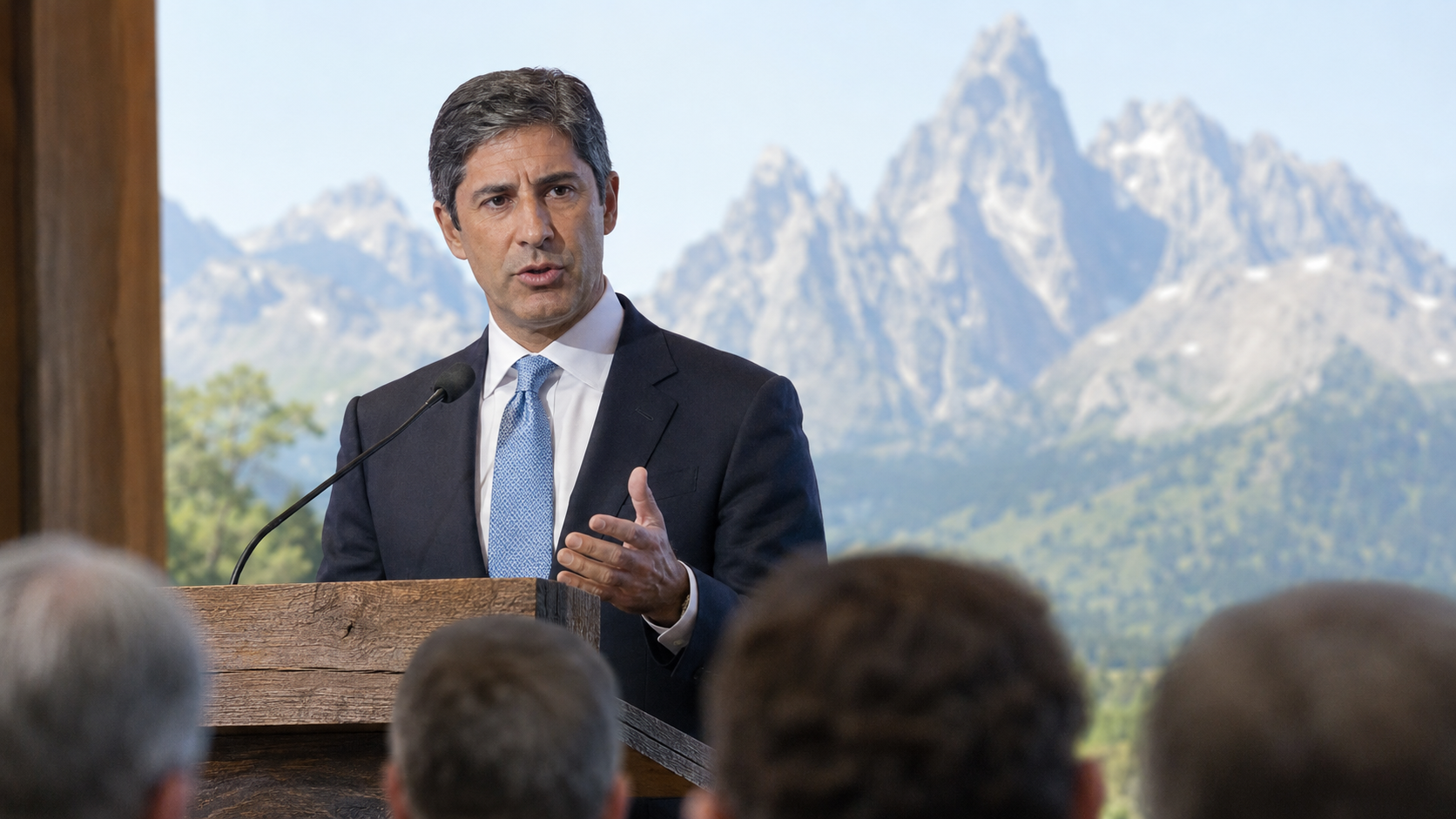
The Fed chair's first Jackson Hole speech paired a pointed inflation warning with an explicit rejection of forward guidance, and the market's hawkish repricing arrived anyway, before the day was out.
Federal Reserve Chair Kevin Warsh used his first Jackson Hole keynote to say the Fed's "predominant focus right now should be on prices," warning in prepared remarks that "we must be confident that underlying inflation is moving to our objective, clearly and at sufficient speed. Otherwise, we have work to do." He went further than a routine inflation warning: in an unusually direct institutional self-assessment, he said "the responsibility for 65 months of sustained, elevated inflation sits squarely with the central bank."
That was one thread of the speech. The other, delivered in the same remarks, was about how the Fed talks rather than what it plans to do next. Warsh criticized forward guidance as a regular Fed practice, saying it "has overstayed its welcome" and that "oversharing policy deliberations and overcommitting to future decisions can lead markets, businesses, and households astray." He argued that "a quieter Fed, more purposeful in its communications, is better able to meet its objectives," and said the Fed's credibility should rest on "delivering on our remit," not on promises about a future rate path. His own words for that approach: "I stand here today committed to a discipline, not to a decision."
Within hours, the market had done something closer to what his first thread implied than his second. Fed funds futures pricing showed the odds of a rate increase at the Fed's September meeting jumping from 35 percent the day before the speech to 46 percent afterward, an eleven-point move inside a single trading session. The dollar strengthened by roughly half a percent. Gold, which had been supported partly as a hedge against currency debasement, fell close to 3 percent. Short-term Treasury yields moved higher. Broader stock indexes were little changed to modestly lower, a muted reaction next to the size of the move in rate expectations.
That gap is the real tension in the day's trading. A chair who explicitly told the room he was moving away from trying to signal the future produced one of the sharper single-day swings in market-implied rate expectations of the summer. Treating the two threads of his speech as a single undifferentiated "hawkish" message misses what actually happened: the inflation language is a policy-stance signal, and the forward-guidance rejection is a meta-statement about how the Fed intends to communicate going forward. They point in different directions for how much weight today's repricing should carry.
One read treats the size of the move as decisive evidence in its own right. A Fed chair assigning his own institution responsibility for more than five years of elevated inflation, declining to offer any dovish reassurance on the path ahead, and watching the market reprice hike odds by eleven points in a single session together suggest the balance of near-term risk has genuinely shifted toward more hikes, not fewer.
The competing read leans on exactly the parts of the day that didn't move as much. If investors had genuinely absorbed a decisive hawkish signal, a broader, more forceful equity reaction would be the more typical result, not one described as muted. And a chair who spent as much of his remarks arguing against pre-committing to future decisions as he did warning about inflation may simply be getting a same-day market reaction that proves as short-lived as the kind of guidance he says the Fed should move away from.
Neither reading resolves this week. What does resolve it, one way or another, is the Fed's next meeting on September 16, when investors will find out whether today's odds move was the start of a durable repricing or a single session's overreaction to a speech that, by its own author's telling, was designed to give the market less to extract, not more.