

The American consumer keeps shopping. Just not where you'd expect.
Walmart, the closest thing the equity market has to a consumer proxy, reported Q2 numbers yesterday morning that missed on the one line that matters: U.S. comparable sales grew 2.6%, well short of the 3.8% Wall Street had penciled in. The stock fell nearly 6%.
Then in the evening, Ross Stores reported. Comps up 10%. Revenue up 13% to $6.3 billion. EPS of $2.66 against guidance of $1.85 to $1.93. Stock jumped 8% after hours.
Both companies sell to the same country. Both serve households squeezed by tariffs, gas prices, and inflation that refuses to come down. One is losing the trade. The other is winning it in double digits.
The shift underneath is the story worth paying for. And with Jackson Hole starting Wednesday and Nvidia reporting Tuesday evening, next week is only going to sharpen it.
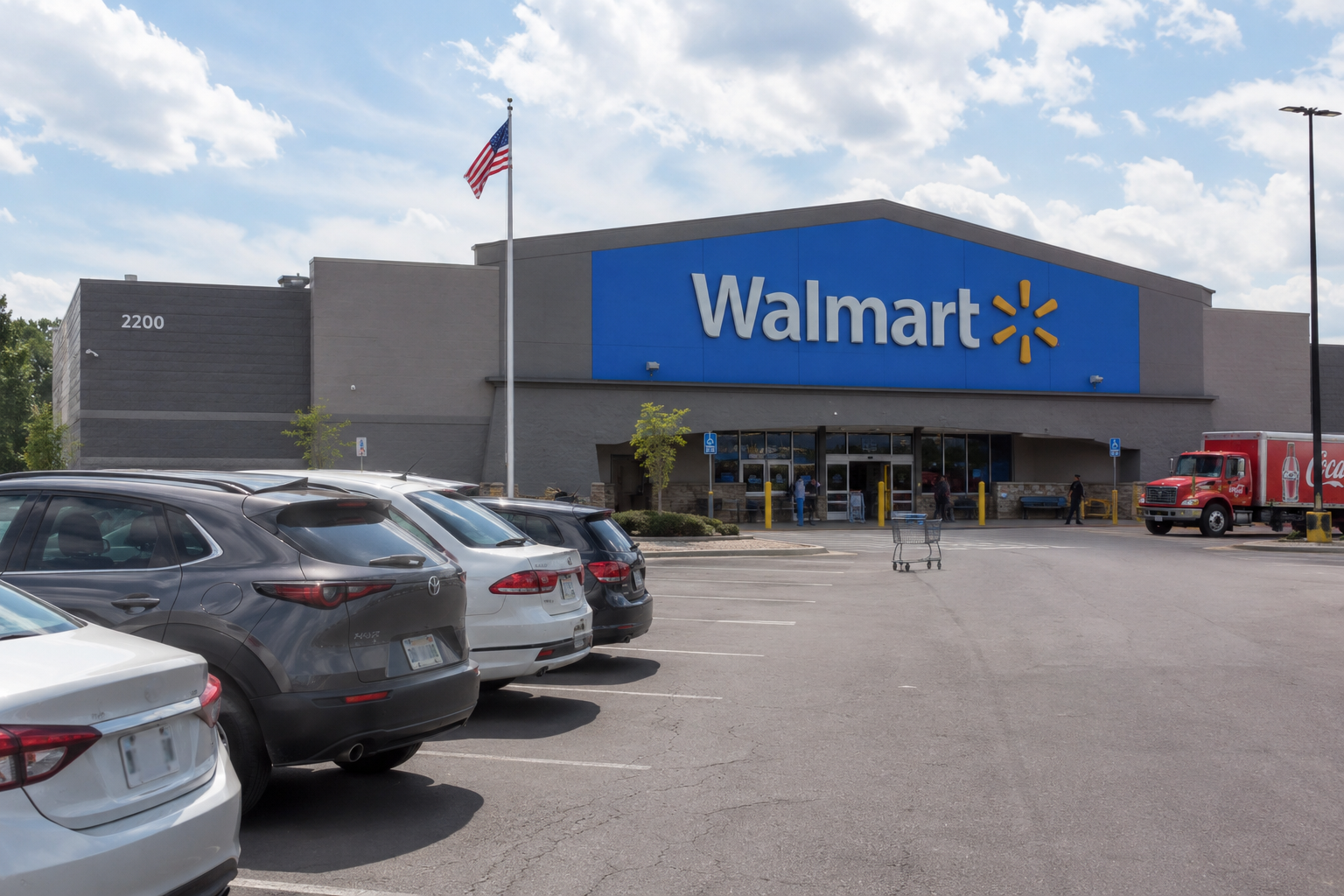
Ross Stores just took Walmart's lunch. And its dinner.
Stack the two numbers. Walmart (WMT) reported U.S. comps up 2.6% for fiscal Q2, missing the 3.8% consensus. Average ticket rose just 1.1%, well below 3.1% a year ago. Walmart still beat on earnings and raised its full-year guide, but the comp line is the tell. The biggest consumer story of the past two years, Walmart absorbing trade-down traffic from every income bracket, may be losing altitude.
Ross Stores (ROST) delivered the counter-narrative the same day. Comps up 10%, the second consecutive double-digit quarter, driven almost entirely by traffic. New customers from every income bracket. Operating profits of $1.1 billion, including $253 million from IEEPA tariff refunds that flowed straight to the bottom line. CEO Jim Conroy raised guidance for both Q3 and Q4.
TJX (TJX) reported Tuesday and pocketed $331 million in tariff refunds, raised guidance, and lifted its long-term global store target to 7,500 locations. Placer.ai data shows Ross Dress for Less visits up 17.7% year-over-year in Q1 while traditional apparel store visits fell 4.8%.
Three off-price retailers. Three raised guides. Three tariff-refund windfalls funneled straight into even lower prices, further widening the value gap against Walmart, Target, and mainstream apparel.
The market signal?
When Walmart misses comps and Ross exceeds them by nearly four times, the trade-down trade has migrated one level further down the price stack. Watch off-price as the cleanest read on where the wallet has settled, and watch Walmart's Q3 comp number as the tell for whether this is a blip or a durable rotation.
Unicorn in the making?
Some companies you only hear about after they IPO.
And some…
Eventual unicorns like Uber, Airbnb and OpenAI…
Forced the world to pay attention long before that.
Mode Mobilecould be a new member to that second group.

Uber turned cars into taxis, Airbnb turned homes into hotels, and Mode Mobile is turning smartphones into EarnPhones.
With $115M+ in revenue, 3-year growth of 32,481%, and an ecosystem with more than 490M+ users, it’s what investors call a “category disruptor.”
The kind that could turn early capital into generational wealth.
They’re raising privately.
For now.
But investors can invest at $0.55/share before the round closes.
With a Nasdaq ticker ($MODE) secured, and early backers like Kevin Harrington from Shark Tank, the company has its eyes on potentially going public.
Their previous two raises sold out, and this one is on track to do the same.
⏰ Invest at $0.55/share before the round closes.
Disclosures *Please read the offering circular and related risks at invest.modemobile.com. *Mode cumulative revenue includes full year revenue of businesses acquired in 2025. Mode Mobile recently received their ticker reservation with Nasdaq ($MODE), indicating an intent to IPO in the next 24 months. An intent to IPO is no guarantee that an actual IPO will occur. The Deloitte rankings are based on submitted applications and public company database research, with winners selected based on their fiscal-year revenue growth percentage over a three-year period.
The Fed minutes bit. The market bled.
The July FOMC minutes landed hawkish. "Many participants assessed that policy tightening would likely be necessary if inflation did not decline," the summary read. Three regional Fed presidents had already dissented in favor of a 25 basis point hike in July. The minutes made clear the hawks were not alone.
Thursday's tape delivered the reaction. The S&P 500 closed down 0.9%. The Nasdaq shed 1%. The Russell 2000 dropped 1.3%. Small caps, most sensitive to a "rate hike back on the table" story, took the hardest hit. The VIX popped to 15.84.
Rate pricing has recalibrated. Where markets were roughly 50/50 on a September action two weeks ago, they now sit near 65% for a hold at 3.50%-3.75%, with modest odds of a hike creeping into December. The 10-year yield sits near 4.70%. The 30-year, which touched 5.34% earlier this week, has cooled slightly after the Treasury's mid-quarter buyback expansion.
This is not a crash setup. It is a repricing. The July minutes did what Warsh's press conference tried to avoid: they told the market how many voters actually want to hike. That read is now in the curve.
The market signal?
Every equity valuation done since June assumed the next Fed move was a cut. The base case has flipped to a hold at best, a hike at worst, with the terminal call landing at Jackson Hole next Friday. Watch the 2-year yield: a close above 4.35% confirms the hawks won the summer.
Jim Conroy said the quiet part loud
Ross Stores CEO Jim Conroy has spent most of his tenure being restrained on earnings calls. Last night, he stepped out of that pattern.
Asked how long the off-price boom can last, Conroy told analysts: "There is plenty of product to continue to fuel the fire. There's a lot of goods being canceled … we expect that to continue. Off-price at the end of the day will probably continue to be a winning sector."
Two things in that quote deserve unpacking.
First, "a lot of goods being canceled." That is Conroy telling the market that full-price retailers are canceling orders they placed months ago because they can no longer move the inventory at target margins. Canceled orders create surplus. Surplus finds its way to the off-price channel at deeply discounted vendor prices. Ross, TJX, and Burlington now have first pick on merchandise their competitors thought they were going to sell at full markup. That is the mechanical engine, and it is accelerating.
Second, "off-price will probably continue to be a winning sector." That is a $50 billion retail CEO telling analysts, on the record, that the structural setup favors his category. Conroy could have hedged. He did not.
The counter-risk sits in the same transcript: inventory rose 18%, fuel costs are pushing freight higher, and roughly $0.60 of the full-year EPS forecast comes from tariff refunds unlikely to recur at the same size next year.
The market signal?
When the CEO of the best-performing off-price retailer publicly names the mechanism driving his tailwind, he is naming the source of pain at every mainstream retailer that reports next. Watch Kohl's (KSS) and Macy's (M) next week. If either misses on comps, Conroy's thesis goes from opinion to consensus.
Is Elon About to Create a New Generation of Millionaires?

When Elon took SpaceX public, an estimated 4,400 employees became millionaires – with top executives, welders, and even cafeteria workers getting rich overnight. Sources close to Elon indicate that he's about to hatch a new opportunity to create generational wealth – and you don't have to work for Elon to see massive potential profits. Click here for the full details.
This ad is sent on behalf of InvestorPlace Media at 1125 N. Charles Street, Baltimore, Maryland 21201. If you're not interested in this opportunity, please click here.
The IEA finally said the quiet oil part out loud
The IEA put out a statement this week that shipping analysts, energy traders, and CFOs at every industrial company have been circling for months: reopening the Strait of Hormuz is "becoming more pressing" as the world burns through oil stockpiles at a rate that cannot be sustained into winter.
The numbers underneath are stark. Between eight and 15 vessels crossed the Strait on August 4, 5, and 6 combined, per MarineTraffic. Pre-war baseline was roughly 130 tankers daily. That is a 90%-plus collapse in the route that carries one-fifth of the world's crude and LNG. Global inventories built before February have absorbed the shock. Those inventories are now running down.
The diplomacy sits in an ugly place. Iranian Foreign Minister Araghchi said Iran will not reopen the Strait without sanctions relief and war reparations. The UAE severed all trade with Iran this week. France expelled two Iranian diplomats. The market believes none of the president's "the strait is open" language at face value.
The market signal?
Brent sits near $86. Every week Hormuz stays closed adds another notch to the second-half inflation setup, the exact setup the Fed just cited when it dropped forward guidance. If Brent closes above $90 in the next fortnight, the "one-time price shock" framing loses credibility, and the hike case gets a real fundamental basis.
Nvidia reports Tuesday. The whole market is holding its breath.
Nvidia (NVDA) reports fiscal Q2 2027 after Tuesday's close. Consensus sits near $28.5 billion in revenue, data center in the $31-33 billion range, EPS around $0.65-0.68. The options market is pricing an implied move of roughly 6% in either direction.
Two things make this quarter different.
First, the setup. Nvidia now represents 7-8% of S&P 500 index weight. A 6% Nvidia move is a 45-50 basis point S&P move all by itself. Options positioning ahead of the print is unusually heavy, suggesting institutional accounts are hedged rather than long.
Second, the read-through. The $105 billion Nvidia-Ohio disclosure earlier this week put a spotlight on the circularity of AI capex. If the Q3 guide comes in below the whisper number, or if data center growth decelerates in a way that suggests hyperscaler digestion, the entire AI infrastructure trade rerates lower in sympathy.
The market signal?
Nvidia is now the single most consequential earnings print of any calendar quarter, more than any Fed decision. Position accordingly, and remember the market's Wednesday reaction happens 24 hours before Warsh takes the Jackson Hole stage.
$40 trillion. And $15 billion added every day.
The U.S. federal debt hit $40 trillion this week. In a prior decade, that would have been front-page news. This week, it barely rated a segment.
The pace tells the story better than the milestone. The debt has added $450 billion just since July 1, a run rate of over $15 billion a day. Over the past 13 months, it has grown by $3.6 trillion. Interest costs now run over $1 trillion annually, more than the entire defense budget.
Here is what makes the dynamic strange rather than merely large. Every CBO model over the past decade assumed debt this large would produce a bond-market revolt: yields spiking, foreign buyers pulling back, refinancing costs consuming an ever-larger share of tax receipts. Some of that is happening, quietly. The 30-year touched a 19-year high this week. But the "cliff event" the models predicted has not arrived. Foreign investors bought $1.43 trillion of U.S. stocks and bonds last year, up from $1.2 trillion the year before. Capital keeps showing up.
What the market is doing instead is repricing gradually. Every basis point of extra long-end yield costs the Treasury real money on the roughly $3 trillion it refinances annually. Bessent's expanded buyback program is a direct acknowledgment: the Treasury is now an active manager of its own yield curve, not a passive issuer. That structural shift most equity investors have not yet processed.
The market signal?
At $40 trillion, the yield curve is the most important price in the economy. Every allocation decision now runs through what happens at the long end. Warsh knows this. That is why next Friday's speech matters more than any single data print for the rest of the year.
AI CEO Issues Code Red: Prepare for Meltdown
The CEO of this AI company (click here to get the name, 100% free) just issued a CODE RED in an internal memo…
Warning his employees that they’re dealing with a critical situation.
Another company executive even implied they might need a government bailout.
And now Jim Rickards is predicting this company is about to go bust, in a full-blown AI meltdown that could be 10 times bigger than Lehman Brothers.
- Jackson Hole runs Wednesday to Friday next week, August 27-29. Fed Chair Kevin Warsh delivers his first symposium keynote on the morning of August 28. Because Warsh has abandoned forward guidance, this is the first genuinely unscripted keynote in years. Every syllable will be parsed.
- Nvidia earnings drop after Tuesday's close, less than 36 hours before Warsh speaks. The market has to digest the largest single-stock print of the year and the most watched Fed speech of the year inside 48 hours. Position sizing is the story of the week.
- Federal Reserve Governor Lisa Cook's August 26 deadline to respond to the White House's "for cause" removal notice lands the same day as Nvidia earnings. If the process moves forward, Fed independence becomes a live legal fight ahead of the September FOMC. That is a tail-risk story most desks are underpricing.
- The market signal across all three? The next seven trading days condense more market-moving catalysts than any equivalent stretch of 2026. If you were planning to be at your desk any Friday this month, make it next Friday.
That's it for today's Slate.
Have a great weekend, and rest up. Next week is the biggest calendar week of the year.
Today's reply prompt:Between Ross Stores, Nvidia, and Warsh's Jackson Hole speech, which one is going to matter most six months from now?
Tickers: MS EPS WMT ROST IEEPA TJX MODE FOMC VIX KSS IEA LNG UAE NVDA CBO CODE RED POLL