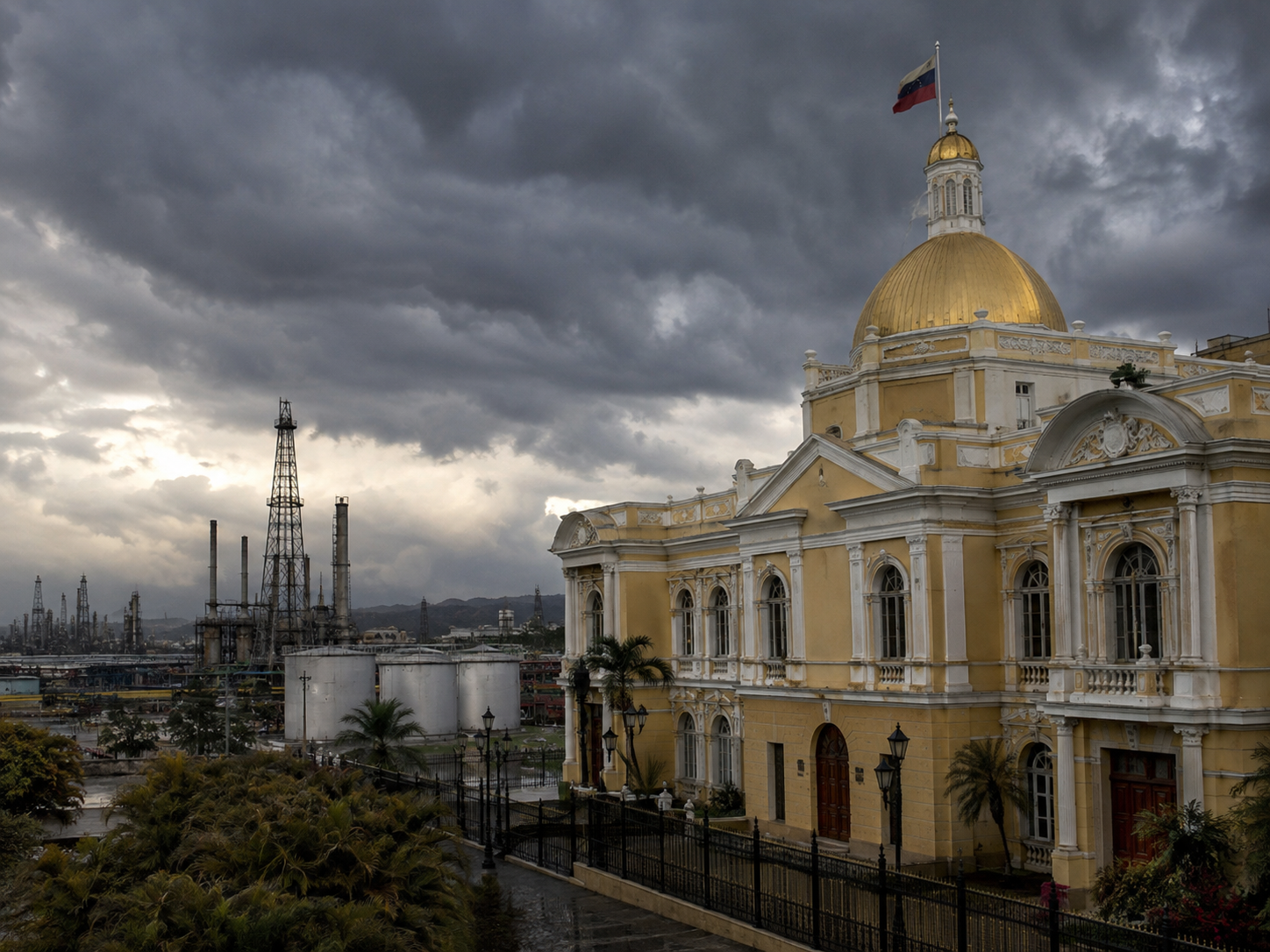
Caracas has put specific numbers on the U.S. energy agreement for the first time. Neither government has addressed whether transferring the oil fields requires a constitutional step neither has mentioned.
When President Trump announced an agreement covering roughly 65 billion barrels of Venezuela's oil reserves, calling it "the biggest oil deal in world history," the announcement stood alone without confirmation from the government it directly concerned. That gap has since closed. Venezuela's Acting President Delcy Rodriguez has publicly confirmed the arrangement, calling it a "historic milestone" in relations between the two countries, and the country's governing party issued its own statement of support.
Rodriguez has since put concrete figures on the arrangement: a 25-year term, a production target of 1.5 million barrels per day, and a projection of more than $209 billion in state tax revenue. A U.S. commercial counterparty has also surfaced, North American Blue Energy Partners, controlled by a Venezuelan businessman, in which the U.S. government is set to take a 35 percent passive stake. The arrangement is described as administered on the American side through the Pentagon's Office of Strategic Capital.
That is a more concrete picture than existed a week ago. It is also not the picture that first circulated. Earlier figures citing a 100-year development-rights framework and a 55 percent U.S. output stake have been superseded by the more recent 25-year term and 35 percent stake.
Neither government has released the legal instrument that would make the arrangement enforceable. No U.S. executive order, Treasury notice, or State Department release has yet confirmed the terms, and no primary text of Rodriguez's statement has been made public in the materials supporting this article.
That gap matters because Venezuela's constitution reportedly treats hydrocarbon resources as inalienable public domain. An actual transfer of ownership rights could therefore require a constitutional reform. Whether such a reform has taken place, or is even underway, has not been confirmed.
The political confirmation now on record answers a different question from the one that determines whether the arrangement can actually be implemented as described. For investors weighing the deal's relevance to Western Hemisphere oil supply, the critical issue is no longer whether both governments say a deal exists. It is whether Venezuela's legal framework permits the transfer being announced.