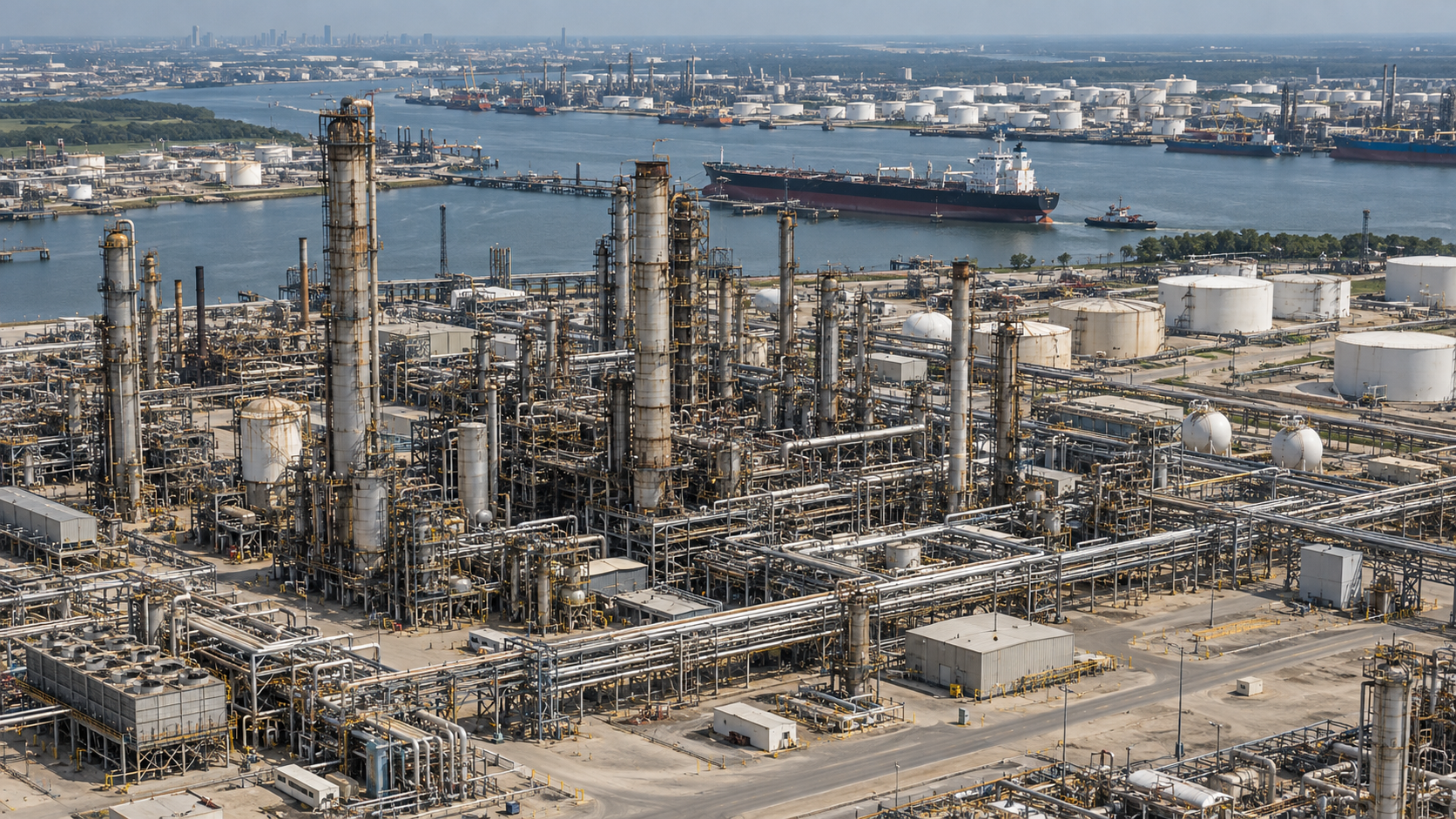
Valero expects to bring 165,000 barrels a day back online in Houston by the end of 2027, close to the 145,000 barrels a day its Benicia, Calif., refinery no longer processes. The restart cost and the liabilities it is taking on were not disclosed.
LyondellBasell stopped refining in Houston in March 2025 to get out of the business. Nineteen months later, Valero is buying the site to start it up again.
Valero said Friday it agreed to buy the former LyondellBasell refinery, a roughly 700-acre site next to Valero's own Houston refinery on the Houston Ship Channel, for $320.5 million, subject to closing adjustments. Valero "currently expects to initially restart 165,000 BPD of light sweet crude processing capacity by year-end 2027," with the option to invest later in more complex processing of heavy, sour crude. The deal needs antitrust clearance and is expected to close by the end of 2026.
"This acquisition is a unique opportunity to strategically expand Valero's U.S. Gulf Coast footprint at a fraction of replacement value," Chief Executive Lane Riggs said. He said it is expected to provide "a compelling financial return."
What Valero is taking on
The price is small. At $320.5 million, it is about 0.3% of Valero's market value and works out to roughly $1,940 for each barrel a day of planned restart capacity, before any restart spending. Valero earned $6.8 billion in the third quarter alone.
The obligations are larger and unquantified. LyondellBasell said Valero is assuming "ongoing site operations, environmental liabilities, pension costs and related employee obligations," and the site's workforce will keep their jobs. Neither company put a figure on those liabilities or on what the restart will cost.
A capacity map, not just a deal
The plant had capacity of 263,776 barrels per calendar day before it closed, according to the Energy Information Administration. Valero plans to bring back about 63% of that.
The restart also needs to be read against Valero's own footprint. The EIA says Valero's 145,000-barrel-a-day Benicia refinery in California has stopped refining. If Houston restarts on schedule, Valero's total capacity ends up about 20,000 barrels a day above where it was before Benicia closed, with the capacity moved from the West Coast, where supply is tight, to the Gulf Coast, a region the EIA describes as producing more fuel than it consumes.
U.S. refining capacity fell by more than 250,000 barrels a day to 18.2 million barrels a day at the start of 2026, the EIA said. The restart would reverse part of that decline. Valero operates 14 refineries with about 3.0 million barrels a day of capacity, so the addition is about 5.5% of its system.
Cheap capacity or late capacity?
The bull case is a low entry price for an adjacent site at a time of strong refining margins. The bear case is that the costs that matter are undisclosed and first output is more than a year away, when today's margins may have faded.
The market did not separate the deal from the sector. Valero was up about 2.6% at $394.59 in early afternoon, in line with Phillips 66, up about 2.5%, and Marathon Petroleum, up about 1.9%. Valero was already higher before the announcement. LyondellBasell rose about 3.2%, on a day it also reported quarterly results.
What to watch
Antitrust clearance and closing by year-end, any disclosure of restart spending on Valero's fourth-quarter call, and progress toward the 2027 restart.