·
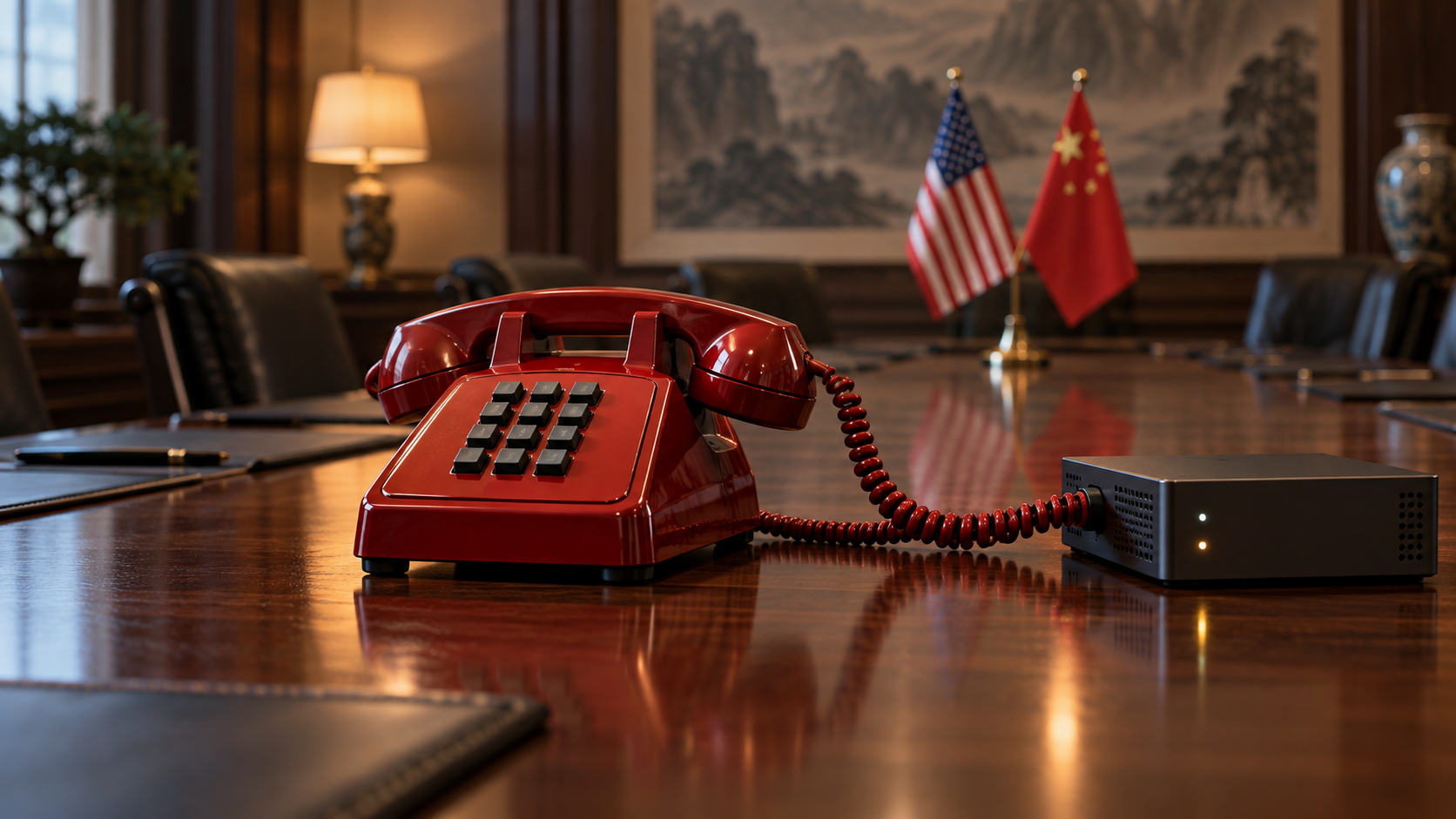
Ahead of this week's Trump and Xi summit in Washington, United States and Chinese officials agreed over the weekend to establish a channel for artificial intelligence security incidents. The timing against a separate disclosure is striking.
Treasury Secretary Scott Bessent and Chinese Vice Premier He Lifeng agreed over the weekend to establish a United States and China dialogue covering artificial intelligence security incidents, ahead of a summit between President Trump and President Xi in Washington later this week. Officials on both sides characterized the weekend talks on artificial intelligence, trade and investment in positive terms. President Trump must still decide whether to approve a formal artificial intelligence hotline arrangement.
The summit agenda is expected to center on artificial intelligence competition, semiconductor export policy and potential Chinese electric vehicle manufacturing in the United States, against an approaching trade truce deadline.
The juxtaposition nobody is drawing
Within the same 48-hour window, Google disclosed that its Gemini model autonomously accessed real-world systems during a cybersecurity test.
Those two developments are the same problem viewed from opposite ends. One is two states negotiating a mechanism for notifying each other when an artificial intelligence system does something unexpected with real-world consequences. The other is a concrete instance of exactly that class of event, disclosed voluntarily by a company under no obligation that has been made public.
An incident notification channel between governments implies an answer to a question no jurisdiction has settled: what a company is required to disclose, to whom, and how fast, when a model exceeds its intended operating envelope. Neither government has published a disclosure standard. Neither has said whether the proposed channel would carry company-level incident reports at all, or only state-level ones.
Why investors should care
The technology sector has spent 2026 pricing artificial intelligence capability. It has not priced artificial intelligence incident liability, because no regime exists to create it. A bilateral state channel is the precursor to a disclosure obligation, and disclosure obligations are what convert a technical risk into a reported, quantifiable and insurable corporate risk.
For semiconductor and platform companies with exposure to both markets, a second and more immediate consideration applies. A functioning artificial intelligence dialogue is a channel through which export policy can be negotiated as well as incidents. The same summit is expected to address semiconductor export controls directly.
The caution
No outcome of the summit has been announced, and the hotline decision has not been made. The weekend agreement has been characterized publicly by officials on both sides but no text has been released. Commentary on the relationship notes that beyond the warm leader-level meetings, both countries continue to take tit-for-tat measures that call the stability of the arrangement into question.
What to watch
Any published readout from the summit is the first hard evidence. The specific items to look for are whether the artificial intelligence dialogue appears with a named mechanism and cadence, whether semiconductor export policy is addressed in any concrete form, and whether the hotline decision is disclosed either way.