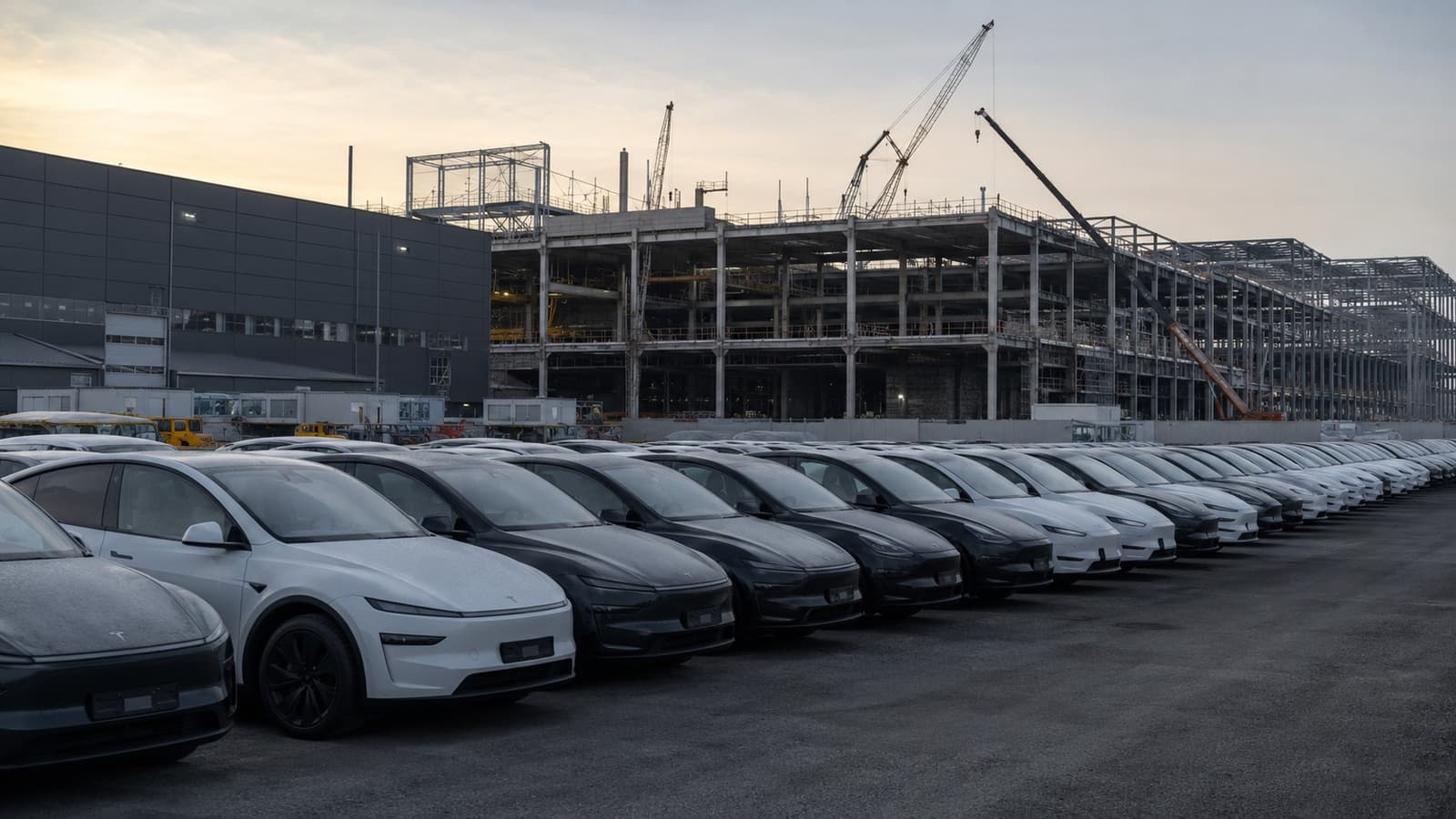
Tesla answered the demand question this quarter and replaced it with a returns question. Record second-quarter deliveries showed the vehicle franchise can still grow. A 1.4% operating margin and negative free cash flow showed how little that growth currently earns. With spending headed past $25 billion this year, the debate now centers on what all that capital will return.
Deliveries recovered, economics lagged
The volume evidence was solid. Tesla delivered 480,126 vehicles, up 25%, against production of 451,758. Deliveries beat output by more than 28,000 units, and days of supply fell to 15 from 27 in the first quarter. Buyers are absorbing cars faster than factories can build them. Gene Munster of Deepwater said the quarter marked the end of an EV winter that began in March 2024. Edison Yu of Deutsche Bank pointed to international and European strength. Trailing revenue crossed $100 billion for the first time.
The economics tell a harder story. Revenue per vehicle, using total automotive revenue over deliveries, ran near $42,700, down about 1.5% from a year ago. Regulatory credits collapsed to $146 million from $439 million. Automotive gross margin excluding credits was 16.3%. That is up from 15.0% a year ago but down sharply from 19.2% in the first quarter. Operating expenses rose 47%, led by a 49% jump in R&D and stock compensation tied partly to the 2025 CEO award. The result: 26% revenue growth and a 57% drop in operating income, to $398 million.
The earnings print needs unpacking
Consensus sources split on the size of the revenue beat. Bloomberg's survey sat at $26.3 billion; LSEG-based estimates clustered near $25.7 billion. Reported revenue of $28.2 billion beat both. Profit missed on any measure. Adjusted EPS of $0.33 fell short of the roughly $0.50 consensus, and adjusted EBITDA of $3.3 billion missed the $4.0 billion estimate.
GAAP earnings need a further asterisk. Net income of $1.1 billion leaned on items outside the business. Tesla bought a $2.0 billion stake in SpaceX in the first quarter. That stake produced a $1.0 billion unrealized mark-up this quarter, worth $0.22 per share after tax. Discrete tax items added $0.08 more. Strip both from the $0.32 GAAP figure and quarterly earnings nearly vanish. The non-GAAP number excludes those gains but adds back nearly $1 billion of stock compensation. Operating income is the cleanest lens, and it points down.
Software adoption is real, and still undisclosed
The strongest structural evidence sits in the software lines. Paid FSD subscriptions reached 1.48 million, up 56% in a year and 16% in the quarter. More than 55% of North American deliveries now include an FSD subscription, a record. Approvals arrived in Lithuania, Estonia, Denmark and Belgium, building on the Netherlands, and customers in those markets have driven 31 million miles on FSD. Services and Other revenue grew 50% to $4.6 billion with a record $648 million gross profit at a 14% margin. Tesla still discloses no subscription revenue, churn or contribution margin, so the profit pool remains a black box.
Robotaxi progress was harder to grade. The service is live in seven metros, and Cybercab entered production in Texas. Ashok Elluswamy, Tesla's AI software chief, cited 380,000 unsupervised miles with zero notable incidents. Cumulative paid robotaxi miles reached about 2.4 million. Electrek read the same chart less kindly: the quarter added roughly 900,000 paid miles, about the same as the first quarter, from an unsupervised fleet it estimates at around 21 vehicles. Waymo, for comparison, was already running about 500,000 fully autonomous rides per week heading into the print. Tesla disclosed no fleet size, utilization or revenue per mile. The program has moved past demonstration. Forecastable economics remain out of reach.
Optimus enters the same category. Tesla decommissioned the Model S and X lines in Fremont and is installing first-generation Optimus lines, with production expected later this year. Initial units will supply an internal training academy while customer shipments wait. No pricing, cost or volume disclosure accompanied the milestone.
The bill is rising faster than the proof
Capital spending was the quarter's defining number. Capex reached $5.8 billion, up from $2.5 billion in the first quarter and $2.4 billion a year ago. CFO Vaibhav Taneja guided full-year spending above $25 billion, roughly in line with the $25.2 billion analysts had modeled, spread across AI compute, a semiconductor fab in Austin, batteries, solar and the robot ramp. Free cash flow swung to negative $1.1 billion, the first negative quarter since early 2024. Operating cash flow of $4.7 billion was solid, and demand held up. The outflow traces to the pace of investment.
The funding posture is shifting with it. Taneja said Tesla is positioning to borrow up to $30 billion. Cash and investments ended at $43.5 billion, down $1.2 billion in the quarter. The balance sheet can carry the cycle for now. The comparison that should worry investors is structural. Hyperscalers fund AI buildouts from high-margin recurring profit pools. Tesla is attempting a similar buildout on a 1.4% operating margin, while energy margins also compressed on vendor cell warranty charges and the segment's revenue missed the pace of its 41% deployment growth.
The market's verdict matched that math. Shares fell more than 3% after hours, on top of a 17% decline this year before the print. Musk faced questions about a possible SpaceX combination and said such decisions require an appropriate process. Related-party exposure now runs in both directions: Tesla holds a SpaceX stake that moves its reported earnings, and it is negotiating framework agreements with a company its CEO controls.
What would settle the debate
The bull case needs conversion evidence. FSD attach rates keep climbing and eventually get disclosed economics. Paid robotaxi miles resume compounding with a growing fleet. Cybercab and Optimus move from milestones to revenue. Free cash flow recovers as the spending peak passes. The delivery rebound and record services profit show parts of the machine already work.
The bear case needs only continuation. Credits keep shrinking. Pricing stays soft while spending compounds. Software stays undisclosed, which usually means small. The robotaxi fleet stays tiny while a competitor scales. Debt fills the gap between ambition and operating cash.
A year ago Tesla had to prove people still wanted its cars. It did. The new burden is proving that a company earning $398 million a quarter from operations can productively deploy $25 billion a year. Volume can be demonstrated every quarter. Returns on fabs, fleets and robots will take years to show. This quarter started that clock.