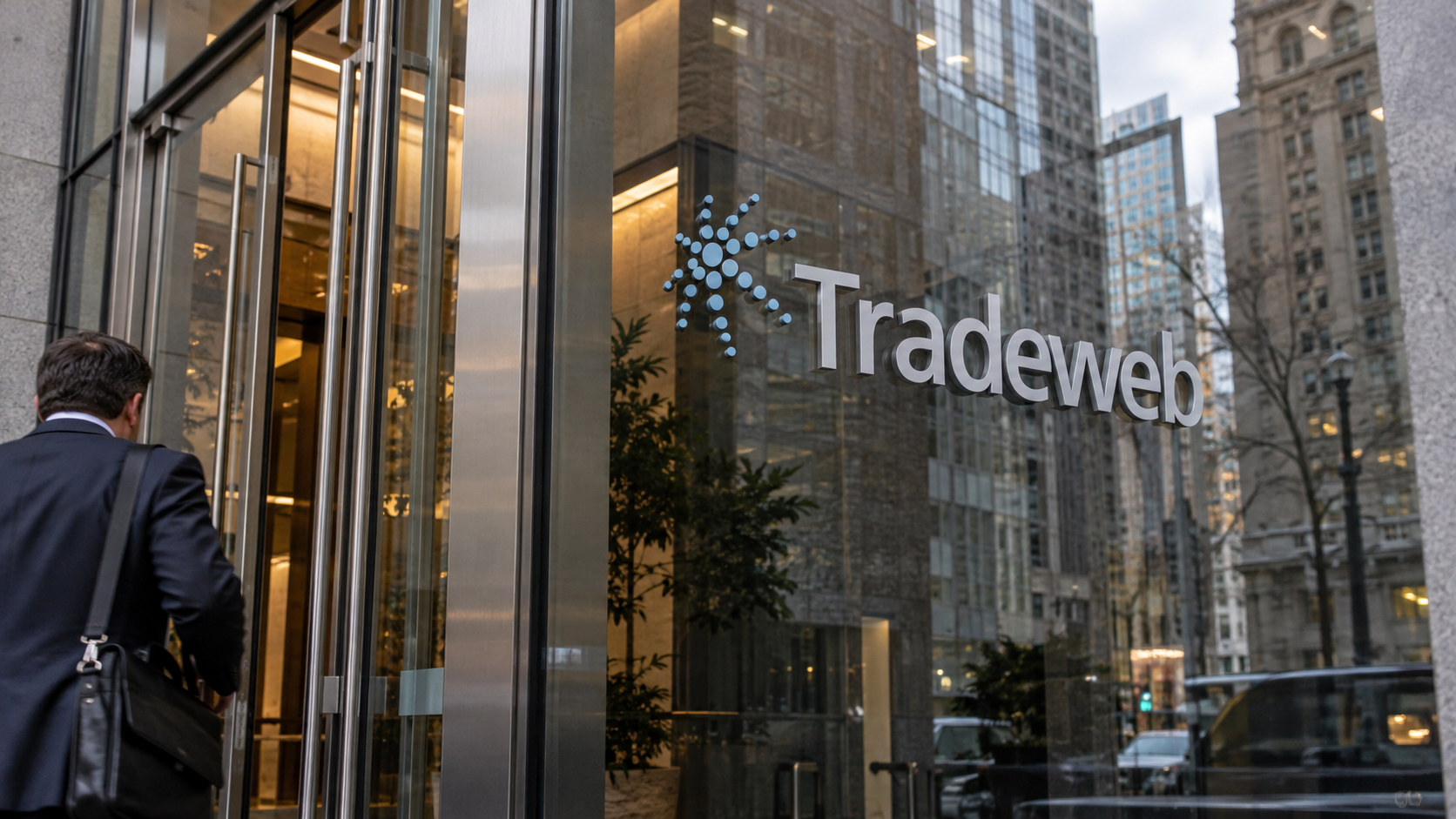
The electronic trading operator agreed to buy the venture-backed corporate bond platform for about $1.89 billion in cash and $82 million of stock, funded mainly from cash on hand. About $220 million of the price is for tax assets. The deal is expected to close in the first half of 2027.
Trumid's private backers are getting paid without waiting for a stock market listing.
Tradeweb Markets said on Monday after the U.S. close that it had signed a definitive agreement to acquire Trumid Holdings, an electronic marketplace for trading corporate bonds. The price is about $1.97 billion, subject to customary adjustments. Of that, $1.75 billion is for the business and about $220 million for tax assets that come with it. Tradeweb will pay about $1.89 billion in cash, funded primarily from cash on hand, and $82 million in its own shares.
Both boards approved the deal unanimously. It requires regulatory approvals and is expected to close in the first half of 2027. Tradeweb said it expects the acquisition to add to its adjusted earnings per share in the first full year after closing, and scheduled an investor call for 8:30 a.m. Eastern on Tuesday. Morgan Stanley advised Tradeweb and Goldman Sachs advised Trumid.
Who gets paid
Trumid was built with venture and strategic capital. Its investors have included George Soros, Peter Thiel and Delphi Financial Group, according to The Wall Street Journal and Dow Jones. Neither company disclosed Trumid's last private valuation, how ownership is split among its backers or what they will receive.
What the structure does reveal is the form of the payout. About 96% of the consideration is cash, by this publication's arithmetic, and it comes mainly from cash on hand. For Trumid's investors, that means liquidity at a fixed value on closing, without the market risk of holding a listed acquirer's stock or waiting for a public offering.
The cleaner number
The $1.97 billion headline overstates what Tradeweb is paying for the trading business itself. About 11% of the price is attributed to tax assets, by this publication's arithmetic. The $1.75 billion paid for the business is the figure that functions as a market reference point for other private trading and data platforms.
It is not the only such deal in play. The London Stock Exchange Group confirmed on Oct. 13 that it is in talks to acquire Octus, a credit data and research business owned by Permira. Two listed market operators are now pursuing private fixed-income businesses in the same month.
What Tradeweb gets
Trumid operates platforms for trading investment-grade, high-yield, distressed and emerging-market corporate bonds, with a client base that includes hedge funds and systematic traders. For Tradeweb, the deal adds scale in corporate credit trading.
Tradeweb said Trumid's revenue grew at about 30% a year from 2022 through 2025 and is running at about $150 million a year, with an adjusted EBITDA margin of about 20%. It put the $1.75 billion business price at 19.4 times Trumid's 2026 adjusted EBITDA including $60 million of expected cost savings. That is also about 11.7 times annualized revenue, by this publication's arithmetic. Trading volumes were not disclosed.
The multiple depends heavily on the savings. Without them, a 20% margin on $150 million of revenue is about $30 million of EBITDA, so most of the 19.4 times figure rests on Tradeweb delivering the $60 million. On Trumid's own earnings, the price is roughly 58 times EBITDA, by this publication's arithmetic. Tradeweb's shares swung between a drop of about 11% and a gain of about 3.7% in after-hours trading after the announcement.
Market implications
One reading is that strategic buyers are now the reliable exit for private financial infrastructure. Listed acquirers with cash can pay a fixed price at signing, giving venture and private equity owners liquidity that does not depend on public market conditions.
A second reading is that a strategic sale caps the upside for private backers. Investors who sell for cash give up any gain a listing might have produced, and the buyer is paying a multiple that depends on cost savings it, not they, will capture. Without disclosure of Trumid's last valuation, there is no way to know whether this price represents a step up.
What to watch
Detail on Trumid's volumes and the timing of the $60 million of savings from Tuesday's investor call; the regulatory approvals required; Tradeweb's third-quarter results on Oct. 29; and the outcome of LSEG's talks over Octus. A timetable showing most of the savings arriving in the first full year would make the multiple easier to defend.