
TQ Morning Briefing
The US-China trade truce is extended to January 10. The 30-year Treasury yield hit its highest level since 2004. SoftBank borrowed $11 billion in bonds to fund its final OpenAI payment. Futures are down sharply.
Yields Keep Rising. Futures Are Down. Iran Is Not Cooperating.
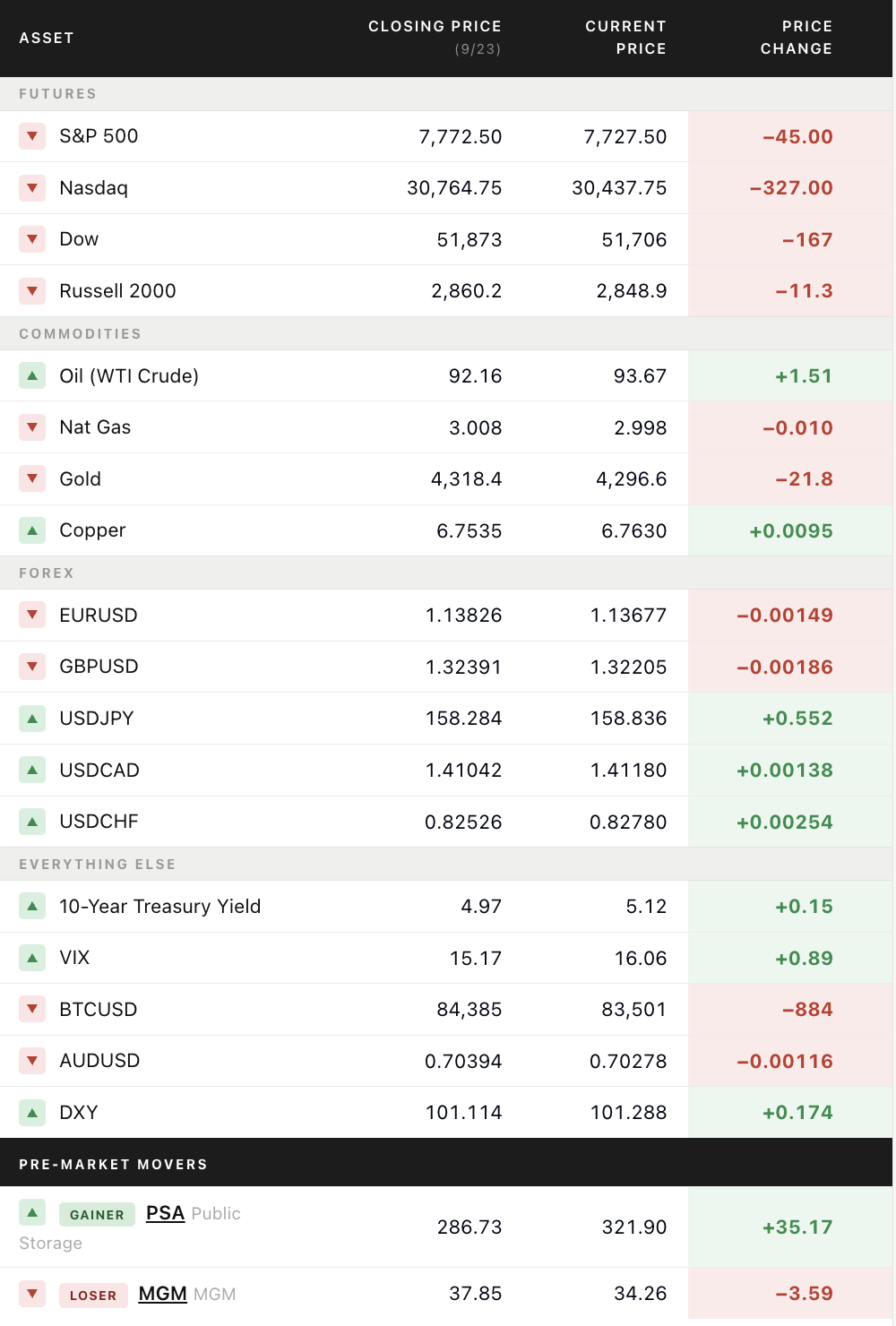
Nasdaq futures are down 1%. S&P futures are off 0.6%. Dow futures fell 0.4%. The 30-year Treasury yield hit 5.44%, its highest level since June 2004. The 10-year is at 5.14%. WTI is back above $93.
Iran's president Pezeshkian spoke at the UN yesterday and made things worse. He said Tehran will never surrender to "bullying," and that Hormuz stays closed as long as US sanctions remain.
Hours before his speech, a cargo ship was attacked in the Strait, killing an Indian sailor. Oil futures contracts expiring next August closed at $80.96, their highest since May. Markets are starting to price the conflict as structural, not temporary.
Market Implication
The trade truce extension is the one positive this morning. Everything else is pointing the same direction as yesterday. Yields rising, futures down, oil back up, Iran hardening. The Xi summit is happening today but the macro backdrop heading in is worse than it was 24 hours ago.
In January, Gold Touched Nearly $5,600 an Ounce. Today It's Around $4,100.
So the story's over, right?
Then explain this.
The metal is still leaving the vaults. Physical deliveries still running at levels the exchange rarely processed before. Central banks still buying. Dealers charging 30-40% premiums over paper price for real coins.
When price falls but physical demand doesn't — only one of those two is telling the truth.
The paper market sets the price. The physical market sets the deadline.
Anyone who wished they'd bought miners before January's run just got handed the entry back.
One company I've been tracking controls an 88 million ounce deposit — trading near $4 billion. About 1% of the value of its metal in the ground.
That gap is the whole opportunity.
The US-China Trade Truce Was Extended to January 10. Bessent Announced It Last Night.
Treasury Secretary Bessent confirmed the US and China extended their bilateral trade truce until January 10, avoiding the higher tariffs and rare earth restrictions that were set to kick in around November 10. Xi landed in Washington yesterday for the state visit running through Friday.
The extension removes one specific tail risk that had been embedded in chip and tech stocks all week. The November 10 date is no longer the pressure point. January 10 is. The extension gives both sides roughly two more months to negotiate the underlying issues: AI guardrails, tariffs, rare earth export controls, and affiliated-entity rules for blacklisted Chinese firms.
Bessent added that Beijing still needs to fulfill "more deliverables." That language is the live variable. The truce extended. The underlying disputes did not resolve.
Structural Setup
Watch what language emerges from today's Xi-Trump bilateral on the specific deliverables Bessent referenced. An extension with named deliverables and a verification mechanism is a different outcome than an extension that just moves the date. The chip trade was pricing maximum optimism. Named deliverables with teeth would justify that. A vague extension would not.
The Bond Selloff Has Mechanics Now. Forced Selling Is Making It Worse.
The 30-year Treasury yield hit 5.44%, its highest since 2004. The 10-year is at 5.14%. Japan's 10-year government bond yield hit 3.08%, its highest since 1996. French 10-year yields hit a post-financial-crisis high. UK gilts pushed higher too. This is a global bond selloff, not just a US one.
The mechanics behind the move are getting clearer. Traders had been positioned in a popular bet that short-term yields would rise faster than long-term ones. That bet unwound badly over the past two weeks as long-end yields surged instead. MUFG called it a "pain trade and forced selling." Jefferies said "there appears to be a lot of pain on the street in fixed income."
Forced selling creates feedback loops. As traders unwind positions, yields rise, which forces more unwinding. The Institute of International Finance also noted that global debt topped $365 trillion in the first half of the year, up $10 trillion, while calling the four largest economies out specifically for "persistently large deficits and rising interest expenses."
Sector Read
A bond selloff driven by position unwinds tends to overshoot fair value before it stabilizes. Watch the 30-year yield. If it breaks above 5.5% today, the forced selling narrative is still in motion. If it stalls, the worst of the unwind may be clearing.
Jim Rickards Predicts: Trump's Next Big Buy
This tiny $2 stock holds the exclusive rights to the largest gold reserve in the country.
And it has the potential to be the biggest fortune maker in Trump’s second term.
According to Jim Rickards...
Trump is about to take a direct stake in this $2 stock.
And if you’d like to learn how to stake your claim in this asset before President Trump and his administration make a move…
You need to act before November 3rd.
Click here to see Jim’s big prediction: “Trump’s Next Big Buy.”
SoftBank Borrowed $11 Billion to Pay the Third Tranche of Its $30 Billion OpenAI Bet.
SoftBank (SFTBY) shares jumped more than 7% in Tokyo after the company announced it issued $10 billion in dollar-denominated senior notes and $1.1 billion in euro-denominated notes. The proceeds fund the third and final tranche of its $30 billion follow-on investment in OpenAI, expected to close October 1.
SoftBank is borrowing $11 billion in the bond market to pay for a private company stake in an AI lab. The math only works if OpenAI's valuation keeps rising. OpenAI was discussed at a private round valuing it near $1.2 trillion earlier this year. At that price, SoftBank's $30 billion total investment represents a small fraction of the implied equity value.
The issuance also tells you something about bond market appetite. SoftBank got $11 billion away in two currencies on the same day the 30-year Treasury hit a 20-year high. Demand for corporate paper at these rates is real, even as sovereign yields climb.
Watch Signal
Watch OpenAI's next valuation disclosure after the October 1 close. SoftBank just paid a large final installment. Any recalibration of OpenAI's private market valuation downward would reprice SoftBank's balance sheet instantly and visibly.
Asia Is Importing the Most Crude Since the Iran War Began. WTI Is Rising Anyway.
Asia's crude oil imports rose in September to the highest level since the war began in February, according to commodity analytics firm Kpler. The region is on track to import 23.96 million barrels per day, up from 23.38 million in August.
The reason is important. Saudi Arabia's pipeline testing and ship-to-ship transfers near Oman have kept crude physically moving even through the Hormuz disruption. The oil is reaching buyers. The problem is not supply volume. It is the cost and risk of getting it there.
This explains why WTI can reverse upward even as Iran diplomacy headlines move in both directions. Physical supply is flowing. But the freight premium, insurance cost, and delivery uncertainty stay elevated as long as Hormuz is effectively restricted. Asian buyers are paying to import more oil and paying more per barrel to get it delivered.
The Read
Asia importing more crude should in theory weigh on oil prices. It is not. The freight and risk premium is the buffer that keeps WTI elevated even when volume improves. Watch tanker hiring rates. If they ease from the recent highs near $1 million per day, the premium compresses. If they stay high, WTI stays supported above $90 regardless of import volumes.
The Man Who Called Nvidia Before It Soared 1,000% Issues New Elon Musk BUY Alert

Luke Lango was ranked America's #1 stock picker in 2020. He was mentored by two hedge fund billionaires from the Soros network and trained at Caltech. His readers have had the chance to see gains as high as AMD +8,500%... Nvidia +5,000%... Tesla +3,500%... Palantir +1,000%... and Apple +890%. Now he's releasing his next big pick.
This ad is sent on behalf of InvestorPlace Media at 1125 N. Charles Street, Baltimore, Maryland 21201. If you're not interested in this opportunity, please click here.
Economic Data: New home sales today | Weekly jobless claims today | Kansas City Fed survey today
Fed Speakers: New York, Richmond, Cleveland, and Philadelphia Fed presidents all speaking today
Earnings: Costco (COST) after close today | Darden Restaurants (DRI) today | BlackBerry (BB) today
Xi Summit: Xi-Trump bilateral meeting in Washington today through Friday
Overnight: Nikkei +0.8%, CSI 300 -1.5%, Hang Seng -0.3%, DAX -0.9%, FTSE flat
Yields Are at Multi-Decade Highs. The Truce Bought Time. Iran Hardened.
The trade truce extension is the cleanest positive this morning. January 10 replaced November 10. That removes one pressure point heading into midterms.
Everything else is harder. The 30-year is at a 20-year high. Iran's president told the UN that Hormuz stays closed while sanctions stand. A cargo ship was hit in the strait overnight. Forced selling in bonds may not be done.
Four Fed presidents speak today. Costco reports after the bell. That print is the most direct read on whether the consumer under a 5.1% 10-year and $6.50 diesel is still holding up or starting to crack. The market needs that answer today.
3 STOCKS OUR SIGNAL ENGINE SAYS TO WATCH CAREFULLY
Three stocks. Three signals. Two weeks later, the story changed.
On September 2, we published three market questions around KLAC, HPE and PG&E.
Two weeks later, every one of them produced new evidence.
One company delivered record revenue and raised its outlook.
Another saw weakness spread across its entire peer group.
And in the third, a market risk that had only been showing up beneath the surface suddenly became explicit.
Yet none of these stories is finished.
That’s why we built Market Tell.
To track the signals that keep moving after the headline is gone — and show you what investors should be watching next.
We’ve put the latest analysis into a new FREE Special Report:
3 Stocks at a Major Turning Point
See what changed… what still hasn’t been resolved… and the signals we’re watching now.