

Something odd is happening inside this market. The Federal Reserve just raised interest rates for the first time since July 2023, pushing the fed funds target to 3.75% to 4.00% at its September meeting. Today at 2:00 PM ET, the minutes from that decision land. The 10-year Treasury yield is sitting at 5.28%. China's holdings of US Treasuries have dropped to their lowest level since 2008.
And the Nasdaq Composite hit a fresh all-time high yesterday.
That is the contradiction sitting in every portfolio manager's inbox this morning. Rates are going up. The dollar is near its strongest level since early 2025. Bond yields are climbing for reasons that have nothing to do with oil anymore. And yet the market keeps buying, narrowly and aggressively, into a handful of names running the AI trade.
Here is the number that makes the tension real: only 27% of S&P 500 stocks are trading above their 50-day moving average. The index is near a record. The breadth underneath it is crumbling. That is a market running on stilts, and today's FOMC minutes will tell us how many Fed officials want to make the stilts taller.
The minutes that explain the hike nobody expected
At 2:00 PM ET today, the Federal Reserve releases the minutes from its September 15 to 16 meeting, the session where it raised rates for the first time in over three years.
The decision was not unanimous. The vote was reportedly tight, and the September dot plot showed multiple officials penciling in at least one more hike before year-end. Futures markets are currently pricing roughly 80% odds of a hold at the October 28 meeting, with about 20% odds of another 25 basis point increase. By December, the probability of at least one more hike rises to roughly 81%.
The question is not whether the Fed hiked. We know that. The question is how close the committee came to hiking by 50 basis points instead of 25, and how many participants pushed for it. The July minutes flagged that "many participants" believed further tightening would likely be necessary if inflation failed to decline. If the September minutes confirm that view hardened, the October meeting becomes live, not theoretical.
Markets have gone from pricing rate cuts at the start of 2026 to pricing roughly four more hikes over the next twelve months, according to BlackRock's weekly commentary. That is a full-year repricing of the most important variable in finance.
The market signal?
If the minutes show three or fewer dissents, the hold-in-October thesis stays intact and equities exhale. If the language reveals a broader consensus for further tightening, the 10-year pushes through 5.30% and rate-sensitive sectors take another leg down.
The Big AI Story Nobody Knows

There's a website called RentAHuman.ai. Its tagline: "Robots need your body."
721,000 people across 100 countries have signed up.
And according to Alexander Green - the man who bought Apple under $1, Netflix at $1.62, Amazon under $2* - this is the clearest signal yet that Phase 2 of the AI supercycle has arrived. (Split adjusted prices)
He's identified three companies set to dominate this next phase.
Record highs on a crumbling foundation
The Nasdaq Composite (NDAQ) closed at 27,477.31 on Tuesday, up 1.05% and registering a fresh all-time high. The S&P 500 rose 0.66% to 7,773.95. The Dow added 0.18% to 51,267.90. Ten of eleven S&P sectors finished higher, with materials leading on copper and silver strength tied to AI infrastructure demand.
But here is what the headline numbers do not tell you. Market breadth is deteriorating. Only 27% of S&P 500 components are trading above their 50-day moving average. That means nearly three out of four stocks in the index are in short-term downtrends, even as the index itself approaches records.
The leadership is razor-thin. Over the past three months, the Nasdaq 100 is up 4.6%. The Dow has fallen 3.4%. The Russell 2000 has dropped 5.4%. This is a market where a handful of mega-cap AI names are carrying the entire weight of the index, and everything else is quietly bleeding.
Nvidia (NVDA) set new all-time highs on Monday, approaching a market capitalization of $6 trillion. The PHLX Semiconductor Index has rallied nearly 20% off its late-July lows. That chip momentum, fuelled last week by Micron Technology's (MU) earnings beat and this week by Foxconn's record-smashing quarter, is the engine keeping the index aloft.
The market signal?
A 27% breadth reading at all-time highs is historically unstable. It does not guarantee a correction, but it guarantees that when one comes, it will feel worse than the index suggests. If you own the Nasdaq, you are fine. If you own the median stock, you are not.
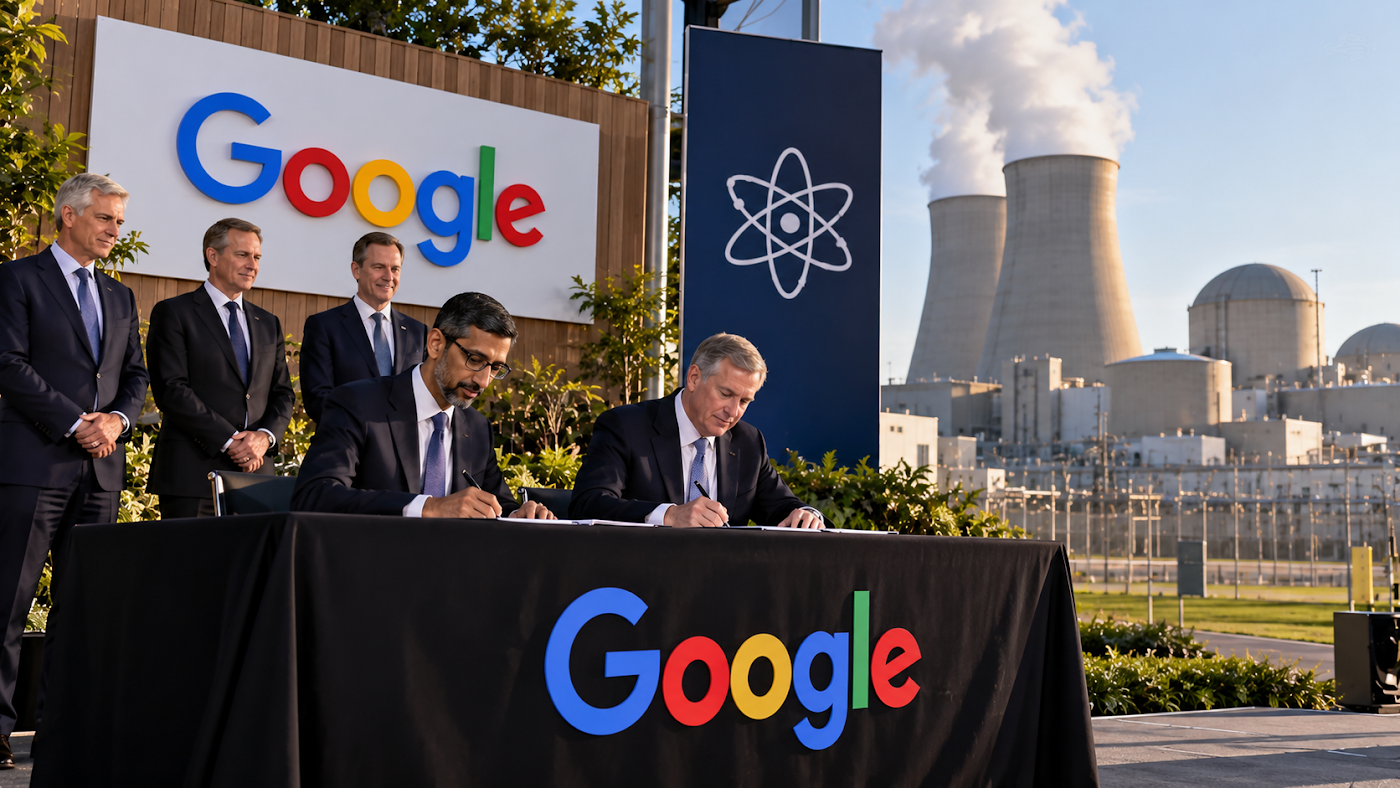
Google just signed the biggest nuclear power deal of the AI era
Constellation Energy (CEG) jumped more than 8% on Monday after announcing a 20-year deal with Alphabet's Google (GOOGL) to provide 3,590 megawatts of power, including a nuclear energy component.
Read that number again. 3,590 megawatts. For context, Microsoft's Three Mile Island restart deal was roughly 835 megawatts. Amazon's Calvert Cliffs deal was 690. Meta's Clinton deal was 1,100. Google just signed a contract larger than the previous three hyperscaler nuclear deals combined.
This is the AI power story reaching its logical conclusion. The hyperscalers are not shopping for power on the margin anymore. They are locking up entire power plants for two decades because the alternative is losing the AI race. Constellation now has 20-year contracts with Microsoft, Amazon, Meta, and Google. Four of the five largest companies on earth are paying it for the one thing AI cannot run without.
The market signal?
Nuclear power stocks have become duration bets on the AI infrastructure cycle. A 20-year contract is not a trade. It is an annuity. As long as AI demand keeps growing, these contracts keep appreciating in value. The real question is whether Constellation has enough uncontracted capacity left to sign more.
Could This Stock Be “Trump’s Next Big Buy”?
Jim Rickards believes the Trump administration is about to take a direct stake in a tiny $2 stock.
The Trump administration has taken a direct stake in MP Materials, Lithium America, Trilogy Metals, and USA Rare Earth.
Each time, shares sprinted higher. Click here to see why Jim believes this one is next.
Foxconn's quarter just confirmed the AI hardware cycle is accelerating
Foxconn, formally Hon Hai Precision Industry, posted third-quarter revenue of T$3.03 trillion ($95.4 billion), up 47% year-over-year and well above the LSEG SmartEstimate of T$2.83 trillion. September alone crossed T$1.16 trillion, a single-month record and the first time the company has ever surpassed T$1 trillion in a single month.
Foxconn is not a chipmaker. It is the company that assembles the physical servers, loads the GPUs, and ships the finished AI infrastructure. Its cloud and networking products division drove the beat, and the company said AI-related operations are expected to keep growing in Q4.
When the world's largest contract electronics manufacturer posts a 47% revenue jump on AI demand, it confirms the buildout is not slowing. Order books are real. Delivery schedules are full. The pipeline feeding Nvidia, Advanced Micro Devices (AMD), and Marvell Technology (MRVL) is running hotter than anyone's model predicted at the start of the year.
Separately, Citi on Monday raised its price target on AMD to $800 from $575, keeping its buy rating. The firm hiked its 2030 CPU total addressable market estimate to $300 billion following the launch of several AI agents, including Meta Platforms' (META) Muse. AMD rose nearly 2% on the news.
The market signal?
When the assembler, the chipmaker, and the analyst all tell the same story simultaneously, pay attention. The AI hardware cycle has at least four to six quarters of strong demand baked into current order backlogs. The risk is not demand. The risk is what happens to margins when yields at 5.28% start making all that capex more expensive to finance.
The $15 billion buyout that nobody saw coming
Sometimes the best market stories are the ones that arrive without a press tour.
Option Care Health (OPCH) surged more than 33% on Monday after the Financial Times reported the company is in advanced talks on a possible joint buyout by McKesson (MCK) and private equity firm Clayton, Dubilier & Rice.
Option Care is the largest independent provider of home and alternate-site infusion services in the United States: IV medications, biologics, and specialty drugs administered outside of a hospital setting. No AI angle. No nuclear deal. No semiconductor in sight.
But it sits at the intersection of two structural forces reshaping American healthcare. Hospital costs are rising so sharply that insurers are pushing treatments to cheaper settings. Home infusion is one of the cheapest. And the specialty pharmacy market is growing at double digits as biologic drugs proliferate, most requiring infusion to administer.
McKesson, the country's largest pharmaceutical distributor, already dominates drug logistics. Adding Option Care would give it control over both distribution and delivery of high-value therapeutics, vertically integrating a historically fragmented supply chain.
The market signal?
When a $15 billion healthcare deal moves a stock 33% in a day, the market had completely mispriced the strategic value of the asset. Watch for competing bids. A company that controls home infusion for biologic drugs in an aging, cost-conscious healthcare system is exactly the kind of target that draws more than one buyer.
Wall Street veteran goes ALL in on Bank of Elon

A 20-year Wall Street veteran – who worked at a $10 billion hedge fund – is putting ALL his money in Elon Musk's new bank. He says he can see the writing on the wall for traditional banks. And he's not the only one. See if you should join him here (not just for the 6% yield).
This ad is sent on behalf of InvestorPlace Media at 1125 N. Charles Street, Baltimore, Maryland 21201. If you're not interested in this opportunity, pleaseclick here.
- The FOMC minutes land at 2:00 PM ET today, and three Fed speakers are also scheduled, which means by the close, markets will have a clearer view on whether October 28 is a live meeting or a placeholder. The 10-year note auction on Wednesday is the other yield event to track, after last month's disappointing tallies.
- Earnings season arrives in earnest starting next week. JPMorgan Chase (JPM), Goldman Sachs (GS), Wells Fargo (WFC), Citigroup (C), and UnitedHealth Group (UNH) all report on October 13. Credit spreads have widened for eight straight days, so the big banks will face pointed questions about loan quality and credit stress. Today's warm-ups: Levi Strauss (LEVI) and Applied Digital (APLD) after close. PepsiCo (PEP) reports tomorrow morning.
- The yield-oil decoupling is becoming its own story. Oil fell 2.3% on Tuesday to $87.37 on rising Gulf exports, yet Treasury yields barely budged. China's holdings of US Treasuries dropped to their lowest since 2008, Japan and South Korea are also reducing, and heavy corporate issuance is adding to supply. The bond market is repricing for structural reasons that have nothing to do with energy.
- The market signal across all three? Today is a setup day. The minutes set the tone for October's rate decision. The bank earnings next week will test whether credit stress is real or theoretical. And the bond market is quietly telling a story the equity market has not yet absorbed. If you are long the Nasdaq, today is about the minutes. If you are long everything else, today is about yields.

That's it for today's Slate. FOMC minutes at 2 PM, three Fed speakers, and a 10-year auction tomorrow. Stay close to the feed.
Today's reply prompt: What is the single most important number in markets right now: 5.28% (the 10-year yield), 27% (breadth), or 3.75% (the fed funds rate)?
3 STOCKS OUR SIGNAL ENGINE SAYS TO WATCH CAREFULLY
Three stocks. Three signals. Two weeks later, the story changed.
On September 2, we published three market questions around KLAC, HPE and PG&E.
Two weeks later, every one of them produced new evidence.
One company delivered record revenue and raised its outlook.
Another saw weakness spread across its entire peer group.
And in the third, a market risk that had only been showing up beneath the surface suddenly became explicit.
Yet none of these stories is finished.
That’s why we built Market Tell.
To track the signals that keep moving after the headline is gone — and show you what investors should be watching next.
We’ve put the latest analysis into a new FREE Special Report:
3 Stocks at a Major Turning Point
See what changed… what still hasn’t been resolved… and the signals we’re watching now.