

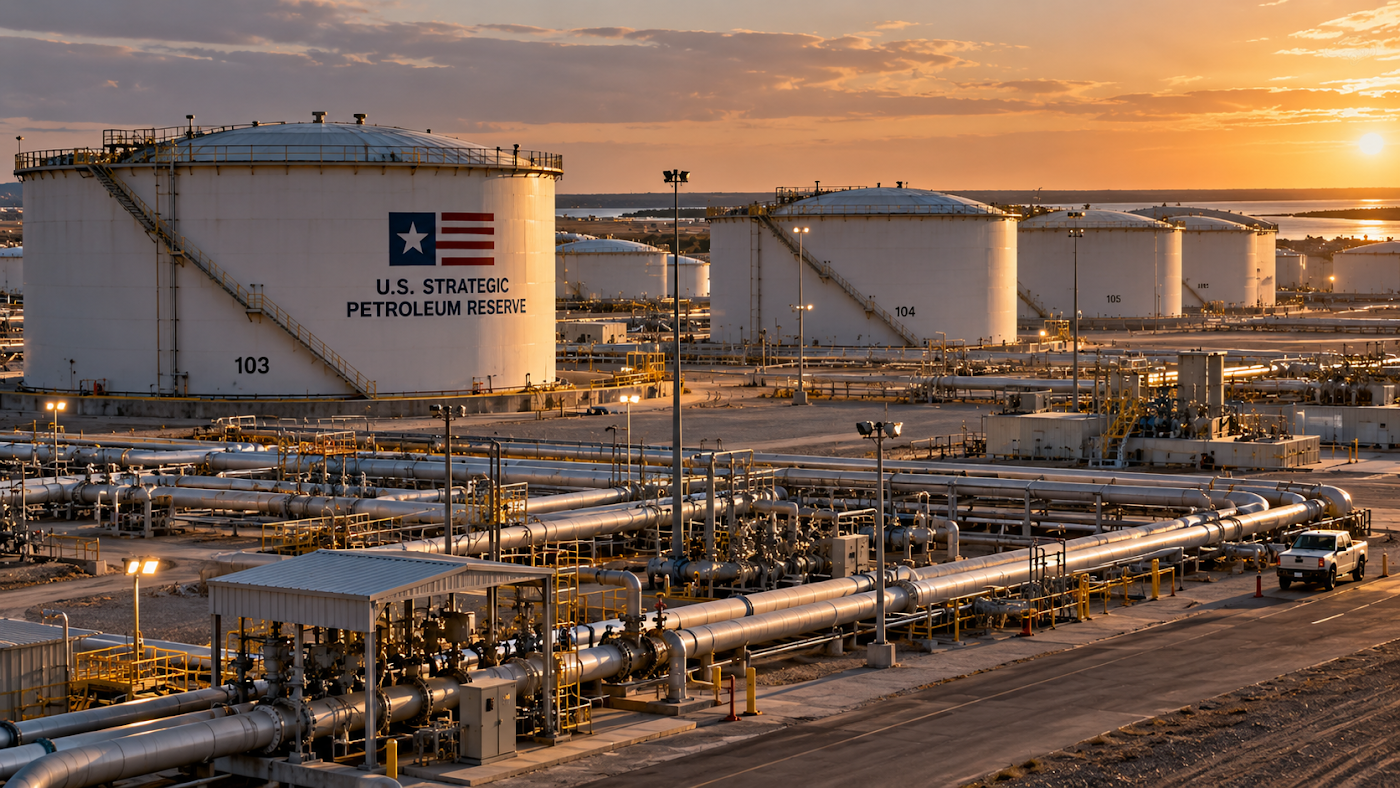
The G7 just signed off on releasing another 100 million barrels from strategic oil reserves. That brings the seven-month total to half a billion barrels, most of it pulled from underground salt caverns in Texas and Louisiana that engineers say are approaching structural limits. The reserves were built for genuine emergencies. They are increasingly being spent to manage pump prices ahead of elections. At some point, the backup plan stops being a backup plan.
But before we get to that, let's take a quick look at the markets and what matters today...
3 Movers in 3 Minutes
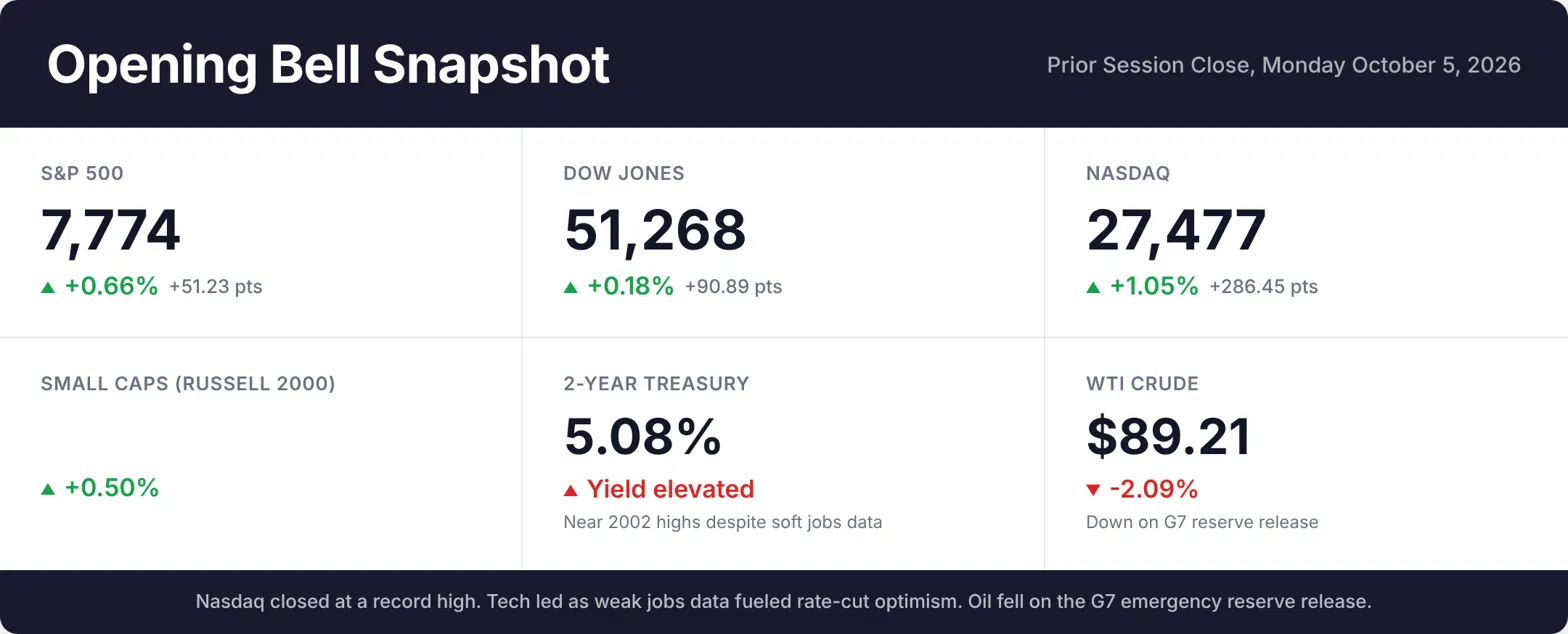
- Schneider Electric bids $22.6 billion for PTC. The French industrial giant offered $205 per share for PTC (PTC), a 42% premium to PTC's Friday close. The deal, expected to close in Q3 2027, would combine Schneider's energy management platform with PTC's product design and engineering software. PTC shares surged 34% on Monday.
- September payrolls come in ice cold. The U.S. economy added just 29,000 jobs in September, badly missing the 84,000 consensus estimate. Unemployment ticked up to 4.2%. The weak print immediately boosted rate-cut expectations, with fed funds futures pricing in a full 25-basis-point cut before year-end.
- G7 announces 100-million-barrel reserve release. The IEA-coordinated release targets diesel and crude over four months, with a substantial diesel drawdown within the first 20 days. WTI fell 2.1% on Monday to $89.21. The announcement came after the White House reportedly threatened to ban U.S. diesel exports if Europe did not act.
3 Signals for Today
U.S. trade balance (8:30 AM ET) lands today for August, with the goods deficit expected to widen past $100 billion as energy imports climbed through the summer.
Constellation Brands (STZ) reports before the bell, with investors watching for the latest read on consumer spending habits as beer and spirits volumes face pressure from both inflation and the GLP-1 effect on alcohol consumption.
Fed Governor Lisa Cook speaks (3:30 PM ET) on "Global Central Banking" in a discussion that could offer the first post-payrolls reaction from inside the Fed. FOMC minutes from the September meeting drop tomorrow at 2:00 PM.
Investing In The Titans of AI

Carnegie didn't invent steel. He used new technology to produce it cheaper and faster than anyone on Earth.
Rockefeller didn't discover oil. He used industrial machinery to refine it more efficiently.
Vanderbilt didn't build the railroad. He understood that whoever controlled the infrastructure controlled the economy.
Their combined fortunes were between $700 billion and $1 trillion.
Best-selling financial author Alexander Green has identified three companies positioned to be the Titans of the AI age.
And with that out of the way, let's get to today's big story: the world's emergency oil reserves are being drained faster than anyone planned, and the consequences are more physical than financial.
The Sip
Five Hundred Million Barrels and Counting
There is a number that should unsettle anyone who drives, ships freight, or heats a home: 283.8 million.
That is how many barrels of crude remain in the U.S. Strategic Petroleum Reserve as of September 28, according to the Department of Energy. The lowest level since October 1982. In February, the SPR held 415 million barrels. Seven months later, more than 130 million are gone.
And last Thursday, the G7 agreed to release another 100 million barrels of crude and diesel from strategic reserves across the alliance.
The stated reason is diesel. Average U.S. diesel prices crossed $6 a gallon for the first time in September, with 28 states setting all-time records. Trucking companies are adding fuel surcharges that flow straight into grocery prices. The political math writes itself: midterm elections are four weeks away, and voters filling up their trucks do not want to hear about geopolitical strategy.
But the SPR was never designed to be a price-management tool. It was designed to keep the country running if supply got cut off. And the gap between those two purposes is widening fast.
Built for Wartime, Spent on Politics
Congress created the SPR in 1975, one year after the Arab oil embargo brought gas lines to every major American city. The government carved 60 caverns into salt domes along the Gulf Coast with a combined capacity of 714 million barrels. For decades, presidents tapped it sparingly: 21 million barrels during the first Gulf War, 30 million after Katrina, 60 million during the Libyan civil war. Each release was tied to a real supply disruption. Each time, the reserve was refilled.
Then came March 2026. Iran's missile strikes in the Strait of Hormuz disrupted tanker routes carrying roughly 20% of the world's seaborne oil. The IEA coordinated the largest emergency release in history: 400 million barrels. The United States contributed 172 million.
That release had a clear strategic rationale. Seven months later, the G7 is back with another 100 million barrels, and this time the trigger is not a tanker blockade. It is a diesel price that polls badly.
The Salt Caverns Have a Limit
Here is the part most coverage misses. Strategic reserves are not numbers on a spreadsheet. They are physical infrastructure with constraints that politicians rarely discuss.
The SPR's salt caverns sit more than 1,000 feet underground. To push oil out, operators pump freshwater in. That water dissolves the salt walls, widening the chambers and thinning the barriers between them. Each drawdown cycle accelerates the erosion.
"We should be highly concerned about the integrity of the caverns anytime crude inventories drop below 300 million barrels," according to Siddharth Misra, a petroleum engineering professor at Texas A&M. The caverns were designed for five full drawdown cycles over a 25-year lifespan. They have endured dozens.
A "bloodbath" Is Coming

Silicon Valley billionaires are hoarding guns, gold, and even military grade gas masks... or fleeing the country altogether. What do they know that you don't? This AI insider is stepping forward with this time-critical message: Move your money before October 31st, ahead of the dangerous next phase of the AI market. Here's the one urgent move you need to make with your money immediately.
This ad is sent on behalf of TradeSmith at 1125 N. Charles Street, Baltimore, Maryland 21201. If you're not interested in this opportunity, please click here.
There is also a thermal problem. The salt formations are naturally warm. Cool water pumped in creates thermal shock that fractures salt and damages piping. The lower the oil level, the more water needed per barrel extracted.
The DOE maintains that 70 million barrels is the operational floor. Engineers say the risk starts much higher. At 283.8 million and falling, each additional drawdown does not just reduce the reserve. It may permanently reduce the reserve's capacity.
A Firebreak That Gets Smaller Each Time
In February, before the Iran release, the SPR held 415 million barrels, roughly 22 days of total U.S. oil consumption. Today it sits at 283 million, about 15 days. If the new G7 release pulls another 40 to 50 million barrels from the American share, the SPR could fall to around 240 million. Barely 12 days of cover.
The IEA recommends member nations hold emergency reserves equal to at least 90 days of net oil imports. The United States still meets that threshold by counting commercial inventories and domestic production. But the SPR itself is approaching levels where it loses practical usefulness in a genuine crisis.
The supply picture is not helping. China suspended fuel exports for October to shore up domestic stocks, removing a major source of refined product from global markets. Iranian exports remain disrupted. OPEC+ has shown no interest in raising output, with Saudi Arabia comfortable above $90 Brent.
One detail in the G7 communique received almost no attention: member nations agreed not to impose energy export restrictions on each other. The fact that this needed to be written down tells you how fragile the cooperative framework has become.
The Refill Problem
Every president who has drawn down the reserve has promised to refill it. The math rarely cooperates. Buying crude to refill the SPR means competing with refiners for supply, pushing prices up. Doing so when oil is above $85 means taxpayers are buying high after selling low.
There is also a capacity problem. The DOE has acknowledged that older caverns at the Bryan Mound site in Texas need repairs before they can accept new crude. The pace of recent drawdowns has deferred maintenance, meaning the SPR's usable capacity is now lower than its theoretical maximum.
The Atlantic Council warned that the SPR's current trajectory creates a "structural vulnerability" in U.S. energy security. The reserve built to survive a six-month embargo is being spent in increments to smooth out price spikes that last weeks.
Porter Stansberry's Critical New Warning:
Trump Is Replacing The U.S. Dollar
"The last time America reset its money, it created 1,300 millionaires every day. This could be bigger."
The MarketSips Takeaway
Strategic reserves work only if they are strategic. Once they become a routine tool for managing prices or political cycles, they lose the one thing that makes them valuable: the credible threat that a government can flood the market if it needs to. At 283.8 million barrels and falling, the United States is not out of oil. But it is running out of options. The thing to watch is not whether oil prices fall this week on the G7 release. It is what happens the next time there is an actual emergency and the caverns are already half empty.
Today’s Poll: What is the bigger risk to oil markets right now?
- SPR running too low to respond to a real crisis
- Diesel prices staying above $6 through the winter
- China hoarding fuel while the G7 drains reserves
- OPEC+ refusing to raise output
Until then, sip slowly!
The Market Sip Desk
Reply prompt: What is the bigger risk to oil markets right now?
3 STOCKS OUR SIGNAL ENGINE SAYS TO WATCH CAREFULLY
Three stocks. Three signals. Two weeks later, the story changed.
On September 2, we published three market questions around KLAC, HPE and PG&E.
Two weeks later, every one of them produced new evidence.
One company delivered record revenue and raised its outlook.
Another saw weakness spread across its entire peer group.
And in the third, a market risk that had only been showing up beneath the surface suddenly became explicit.
Yet none of these stories is finished.
That’s why we built Market Tell.
To track the signals that keep moving after the headline is gone — and show you what investors should be watching next.
We’ve put the latest analysis into a new FREE Special Report:
3 Stocks at a Major Turning Point
See what changed… what still hasn’t been resolved… and the signals we’re watching now.